CREDO: An Anthology of Manifestos and Sourcebook for Creative Writing (C&R Press, May 2018) Now Available for Pre-Order!

Rita Banerjee’s edited volume CREDO: An Anthology of Manifestos and Sourcebook for Creative Writing (C&R Press, May 2018) is now available for pre-order!  The cover illustration has been designed by Eugenia Loli, and the anthology is edited by writers Rita Banerjee and Diana Norma Szokolyai and assistant editors Alexander Carrigan and Megan Jeanine Tilley.  You can now  pre-order CREDO on the C&R Press Website here and on Amazon.com!

Here is some information about the CREDO:

CREDO. I believe. No other statement is so full of intent and subversion and power. A Credo is a call to arms. It is a declaration. A Credo is the act of an individual pushing back against society, against established stigmas, taboos, values, and norms. A Credo provokes. It desires change. A Credo is an artist or community challenging dogma, and putting oneself on the front line. A Credo is art at risk. A Credo can be a marker of revolution. A Credo, is thus, the most calculating and simple form of a manifesto.

CREDO creates a bridge from the philosophical to the practical, presenting a triad of creative writing manifestos, essays on the craft of writing, and creative writing exercises. CREDO: An Anthology of Manifestos and Sourcebook for Creative Writing is a raw look at what motivates authors today.

Contributing Authors:

Kazim Ali \ Forrest Anderson \ Rita Banerjee \ Lisa Marie Basile \ Jaswinder Bolina \ Stephanie Burt \ Alexander Carrigan \ Sam Cha \ Melinda J. Combs \ Thade Correa \ Jeff Fearnside \ Ariel Francisco \ John Guzlowski \ Rachael Hanel \ Janine Harrison \ Lindsay Illich \ Douglas Charles Jackson \ Caitlin Johnson \ Christine Johnson-Duell \ Jason Kapcala \ Richard Kenney \ Eva Langston \ John Laue \ Stuart Lishan \ Ellaraine Lockie \ Amy MacLennan \ Kevin McLellan \ E. Ce. Miller \ Brenda Moguez \ Peter Mountford \ Nell Irvin Painter \ Robert Pinsky \ Kara Provost \ Camille Rankine \ Jessica Reidy \ Amy Rutten \ Elisabeth Sharp McKetta \ David Shields \ Lillian Ann Slugocki \ Maya Sonenberg \ Kathleen Spivack \ Laura Steadham Smith \ Molly Sutton Kiefer \ Jade Sylvan \ Anca L. Szilágyi \ Diana Norma Szokolyai \ Marilyn L. Taylor \ Megan Jeanine Tilley \ Suzanne Van Dam \ Nicole Walker \ Allyson Whipple \ Shawn Wong \ Caroll Yang \ Matthew Zapruder

Editors:

ritabanerjeeRita Banerjee the Executive Creative Director of the Cambridge Writers’ Workshop and editor of CREDO: An Anthology of Manifestos and Sourcebook for Creative Writing (C&R Press, May 2018).  She is the author of the poetry collection Echo in Four Beats (Finishing Line Press, March 2018), which was a finalist for the Red Hen Press Benjamin Saltman Award, Three Mile Harbor Poetry Prize, and Aquarius Press / Willow Books Literature Award, the novella “A Night with Kali” in Approaching Footsteps (Spider Road Press, 2016), and the poetry chapbook Cracklers at Night (Finishing Line Press, 2010). She received her doctorate in Comparative Literature from Harvard and her MFA in Creative Writing from the University of Washington, and her writing appears in the Academy of American PoetsPoets & Writers, Nat. Brut.The ScofieldThe Rumpus, Painted Bride Quarterly, Mass Poetry, Hyphen Magazine, Los Angeles Review of BooksElectric Literature, VIDA: Women in Literary Arts, AWP WC&C Quarterly, Queen Mob’s Tea House, Riot Grrrl Magazine, The Fiction Project, Objet d’Art, KBOO Radio’s APA Compass, and elsewhere.  She received her doctorate in Comparative Literature from Harvard and her MFA in Creative Writing from the University of Washington.  She is an Associate Scholar of Comparative Literature at Harvard and teaches at Ludwig Maximilian University of Munich in Germany.  She is the judge for the 2017 Minerva Rising “Dare to Speak” Poetry Chapbook Contest, and she is currently working on a novel, a documentary film about race and intimacy, a book on South Asian literary modernisms, and a collection of lyric essays on race, sex, politics, and everything cool.
Headshot.McCarrenPark,WillamsburgDiana Norma Szokolyai is a writer and Executive Artistic Director of Cambridge Writers’ Workshop. Her edited volume,CREDO: An Anthology of Manifestos and Sourcebook for Creative Writing , will be released by C&R Press in May 2018.  She is author of the poetry collections Parallel Sparrows (honorable mention for Best Poetry Book in the 2014 Paris Book Festival) and Roses in the Snow (first runner-­up Best Poetry Book at the 2009 DIY Book Festival). She also records her poetry with musicians and has collaborated with several composers including David Krebs (US), Robert Lemay (Canada), Claudio Gabriele (Italy), Peter James (UK), Jason Haye (UK), and Sebastian Wesman (Estonia). Diana Norma is a founding member of the performing arts groups Sounds in Bloom, ChagallPAC, and The Brooklyn Soundpainting Ensemble.  Her poetry-music collaboration with Flux Without Pause, “Space Mothlight,” hit #16 on the Creative Commons Hot 100 list in 2015, and can be found in the curated WFMU Free Music Archive. Her work has been recently reviewed by The London Grip and published in VIDA: Reports from the Field, The Fiction Project, Quail Bell Magazine, Lyre Lyre, The Boston Globe, Dr. Hurley’s Snake Oil Cure, The Dudley Review and Up the Staircase QuarterlyThe Million Line Poem, The Cambridge Community Poem, and elsewhere, as well as anthologized in Our Last Walk, The Highwaymen NYC #2, Other Countries: Contemporary Poets Rewiring History, Always Wondering, and Teachers as Writers.  She is currently at work on her next book and an album of poetry & music.  Diana Norma holds a M.A. in French (UCONN, La Sorbonne) and an Ed.M in Arts in Education (Harvard).  Diana Norma Szokolyai is represented by Nat Kimber (The Rights Factory).

Pre-Order CREDO on the C&R Press website here or on Amazon.com!

The Scofield (Issue 3.1) Launches feat. Rita Banerjee on James Baldwin

The Scofield, Issue 3.1 on “Kōbō Abe & Home” launched this week and features the work of Rita Banerjee on James Baldwin.  On Baldwin, Banerjee writes:

In The Devil Finds Work, James Baldwin takes an incisive and illuminating look at the movies, both American and European, and examines the black gaze on the white body, the black gaze on the black body, and what it means to be black and still maintain a dynamic sense of subjecthood in America and in Europe. In the collection of essays, Baldwin traces the origins of his own critic’s eye to the inimical tension between his parents, his father’s violent relationship towards him as a young boy, and his unexpected allies and mentors in teachers like Bill Miller, a young white woman, who took him, as a child to see Uncle Tom’s Cabin and A Tale of Two Cities and who shed light on the relationship between racism and classism in America.

Read the full issue here.

Rita Banerjee’s poem “Sleep” feat. on the Academy of American Poets as a Poem-a-Day

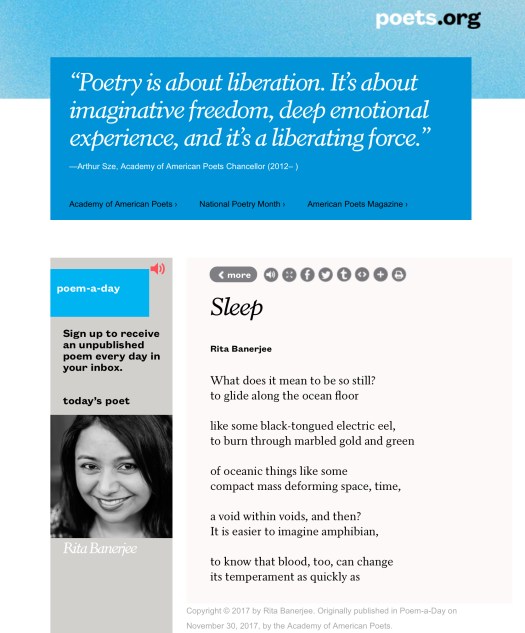
Rita Banerjee’s poem “Sleep” is featured on the Academy of American Poets as their Poem-a-Day for Thursday, November 30, 2017.  “Sleep” is part of Rita Banerjee’s new collection of poems Echo in Four Beats (FLP, 2018).  Combining elements, rhythms, and personas from American jazz, blues, and ragtime, poet Rita Banerjee presents a modern-day spin on the love story of Echo and Narcissus in her debut full-length poetry collection, Echo in Four Beats.  But in this story, told in four parts, Echo is more than just a fragment, she is a Sapphic voice that speaks, foretells, forestalls, and repeats Echo in Four Beats, which was a finalist for the Red Hen Press Benjamin Saltman Award, the Three Mile Harbor Book Prize, the Aquarius Press/Willow Books Literature Award, will be released by Finishing Line Press on February 2, 2018.  “Sleep” was inspired by a recent trip to Taiwan.  Of the experience and poem, Banerjee writes:

‘Sleep’ explores the space where human agency or communication seems impossible until an unexpected moment of connection or surprise occurs, often between two people, often through art.  A few years ago, I had the honor of traveling through Jinshan, Taiwan. At a monastery, I attended a conference on Buddhism. Outside the temple grounds, English held no cachet. Jinshan was famous for its hot springs and pools of captive koi. I watched them move through the water without a sound, and began writing this poem. One day, I got lost in a local marketplace. To ask for directions home, I tried speaking in Japanese. A woman selling herbs and flowers answered. She had been forced to learn Japanese as a schoolgirl during the occupation of Taiwan. After independence, she never thought the language would come in handy again, especially not in the twenty-first century, especially not while talking to a Bengali American traveler like me. We talked, our conversation halting, full of sorrow and surprise, for nearly an hour.”

To read the full poem, please visit the Academy of American Poets here.

Rita Banerjee is the author of Echo in Four Beats, forthcoming from Finishing Line Press in February 2018. She is the Executive Creative Director of the Cambridge Writers’ Workshop and teaches on modernism, art house film, and South Asian aesthetics and literary theory at the Ludwig-Maximilian University of Munich in Germany, where she currently lives.

Rita Banerjee’s lyric essay “Mano a Mano” on race and intimacy featured in Nat. Brut.

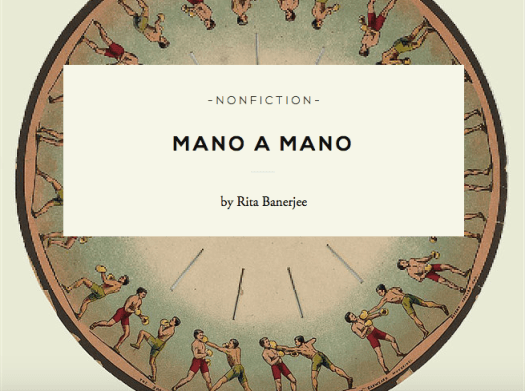
Rita Banerjee’s lyric essay, “Mano a Mano” is featured in the new issue of Nat. Brut.  “Mano a Mano” ” examines the relationship between race, power, and sexuality.  The essay follows two writers, one male, one female, one of a religious minority, and the other of an ethnic minority, as they deconstruct the origins of racism and racial violence in the United States and Europe today.  In this real-life account, the two writers and sparring partners find themselves dismissing and torpedoing one another’s experiences with racism and othering as they attempt to create a documentary film, which challenges the white gaze on the black body, their own voyeurism, and the brewing tension between them.  The essay takes a playful and pointed look at racism, othering, and attraction, and the fault line between intimacy and cool.  An excerpt from the essay follows below:

“Rita, I’m just going to turn up the heat.” And so, in the rain, covered by a too-thin umbrella, Michael launched his assault.

“You’re just a privileged kid from the suburbs.” He would accuse me later of being born with a silver spoon. He was chagrined that I had mentioned Harvard during the orientation of the workshop we were both teaching at. He said that I always took the higher, moralistic position on things. That I was some sort of truth-seeker. That basically, I didn’t want to get my hands dirty. That I essentially pooh-poohed any discussion on race and instead went for the safe, predictable PC route. That I was not digging deeper inside myself. That I was not confused enough yet. That I did seem a little damn righteous.

The tirade continued, publicly, as we waited in the line to enter the Fondation Cartier, for what seemed to me like an eternity lasting only 15 minutes. What’s the saying? Time slows when you’re not having fun.

And just as the mic was turned over to me, we arrived at the ticket booth. Michael paid for all of our tickets. We went inside without talking to one another.

After some time, once we had played a game of hide and seek between paintings and looked at the Congolese art, the conversation began to flow almost naturally. We studied paintings, magazine covers, and collages, and read the bodies in them for intent and subversion. In many of the pieces, the gaze of the voyeur was flipped back on the voyeur, himself. Michael and I struck up a conversation about a painting of four discombobulated Black musicians playing in a band, whose erased faces and organs were attached to what looked like computerized instruments. I mentioned that the players wore the forced smiles of performers on stage, and that their expressions seemed to climax and fall. “Almost like coitus and post-coitus,” Michael said. The conversation continued until two women from security flagged us down. I tried to convince them that the filming was for a private project, but they were reluctant to let us continue. Later. I translated what I said to them to Michael, and he smiled back at me, “So you can be bad.”

To read the full essay, please visit Nat. Brut. here.

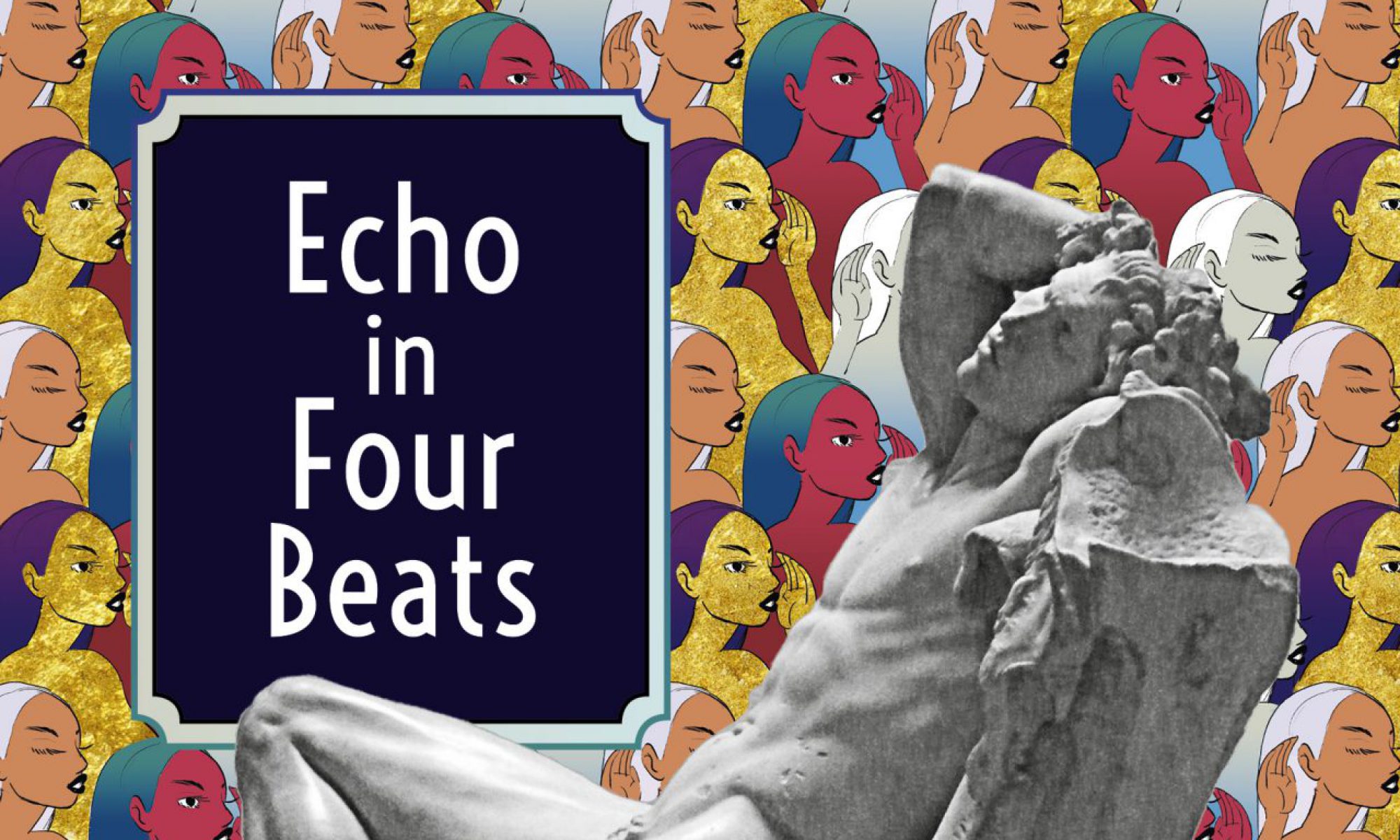
Echo in Four Beats (poetry debut) by Rita Banerjee Available for Pre-Order October 10 – December 8, 2017!


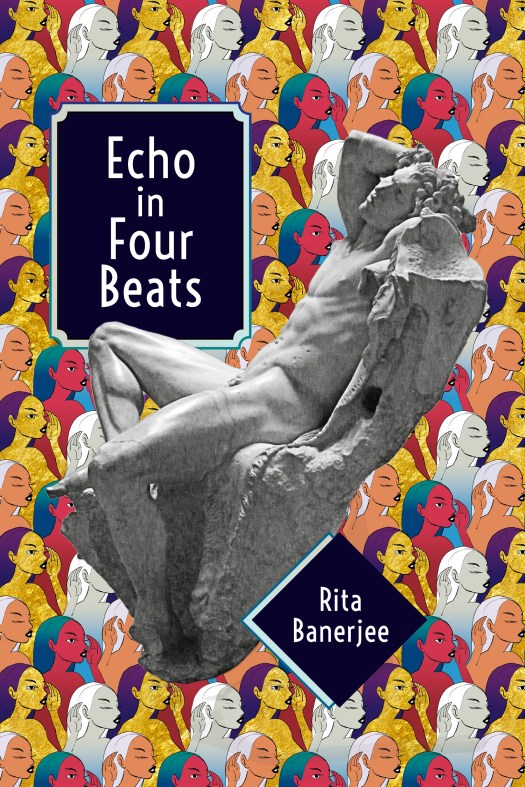
Rita Banerjee’s poetry debut, Echo in Four Beats, is now available for pre-order on the Finishing Line Press website from October 10 – December 8, 2017!

Combining elements, rhythms, and personas from American jazz, blues, and ragtime, poet Rita Banerjee presents a modern-day spin on the love story of Echo and Narcissus in her debut full-length poetry collection, Echo in Four Beats.  But in this story, told in four parts, Echo is more than just a fragment, she is a Sapphic voice that speaks, foretells, forestalls, and repeats.  Echo in Four Beats, which was a finalist for the Red Hen Press Benjamin Saltman Award, the Three Mile Harbor Book Prize, the Aquarius Press/Willow Books Literature Award, will be released by Finishing Line Press on February 2, 2018.

Early Praise for Echo in Four Beats:

Echo in Four Beats sounds the singular pulse of Harlem, Kyoto, Nainital and San Francisco to uncover a deeper mystery; what makes a word into a sensation, a sensation into a moment and what, in the swirling constellation of geographies, turns a moment into the sublime. Amidst the kinetic search for buried treasure in everyday encounters with photocopiers and the breathless search for lost objects, there are also unexpected collisions with silence so shocking, they stop us dead in our tracks. We realise the whiteness between words was here all along; its stillness curving the inside of this syncopated journey across time and space.”

— Dipika Guha, playwright and author of Mechanics of Love and The Rules, and screenwriter for American Gods

“Rita Banerjee’s Echo in Four Beats is a lyric wonder. Wildly intertextual and multilingual, Banerjee mines literatures, histories, and geographies, both eastern and western, to produce an expansive collection of poems. The breadth of her work is staggering and yet utterly approachable, at once intimate and worldly. This may well be the first truly post-national book of poems I’ve ever read. I look forward to reading it again and again.”

— Jaswinder Bolina, author of The 44th of July, Phantom Camera, andCarrier Wave

“Rita Banerjee’s Echo in Four Beats is a multilingual, intercontinental arpeggio of a journey on which ‘one layer/ of enchantment// dispels another.’ From Ovid to Baudelaire, from Manhattan to Atlantis to the Ganges, these poems conjure shape-shifting and gyroscopic worlds where erasure is sustenance, myth is religion, and home is but a constant state of momentary arrivals. Banerjee’s attentive, precise, incantatory poems reverberate ‘not sound not/ voice” and resound with the “enchantments of art/ and life.’”

— Tara Skurtu, author of The Amoeba Game and Skurtu, Romania

“In our narcissism-addled times, Rita Banerjee awakens Echo out of mythical slumber and accords her center stage, with stirring results. These poems dance nimbly from the playful to the sacred, the pentatonic-ancient to the jazzy-contemporary, the observational to the contemplative, and cross languages and borders with abandon, from trains in India to a Munich museum to the local copy shop. Yet while they may ‘change [their] temperament as quickly as salamanders change skin,’ Echo in Four Beats  is constantly returning us to a tonic center and rebuilding its chords and arpeggios anew, offering a music both savory and profound.”

— Tim Horvath, author of Understories and Circulation

“Banerjee’s polyglot collection–pushing at the edges of language; abounding with erasure, mistranslation and wit; impossible to contain in a single tongue. From the smallest pieces of our world–the falling snow, cobblestone, a reflection in the water–Banerjee has crafted something astonishing that reaches towards higher truths.”

— Stephen Aubrey, author of Daguerreotype and What I Took in My Handand Co-Artistic Director of The Assembly Theater, NYC

Pre-Order Echo in Four Beats on the Finishing Line Press website now!

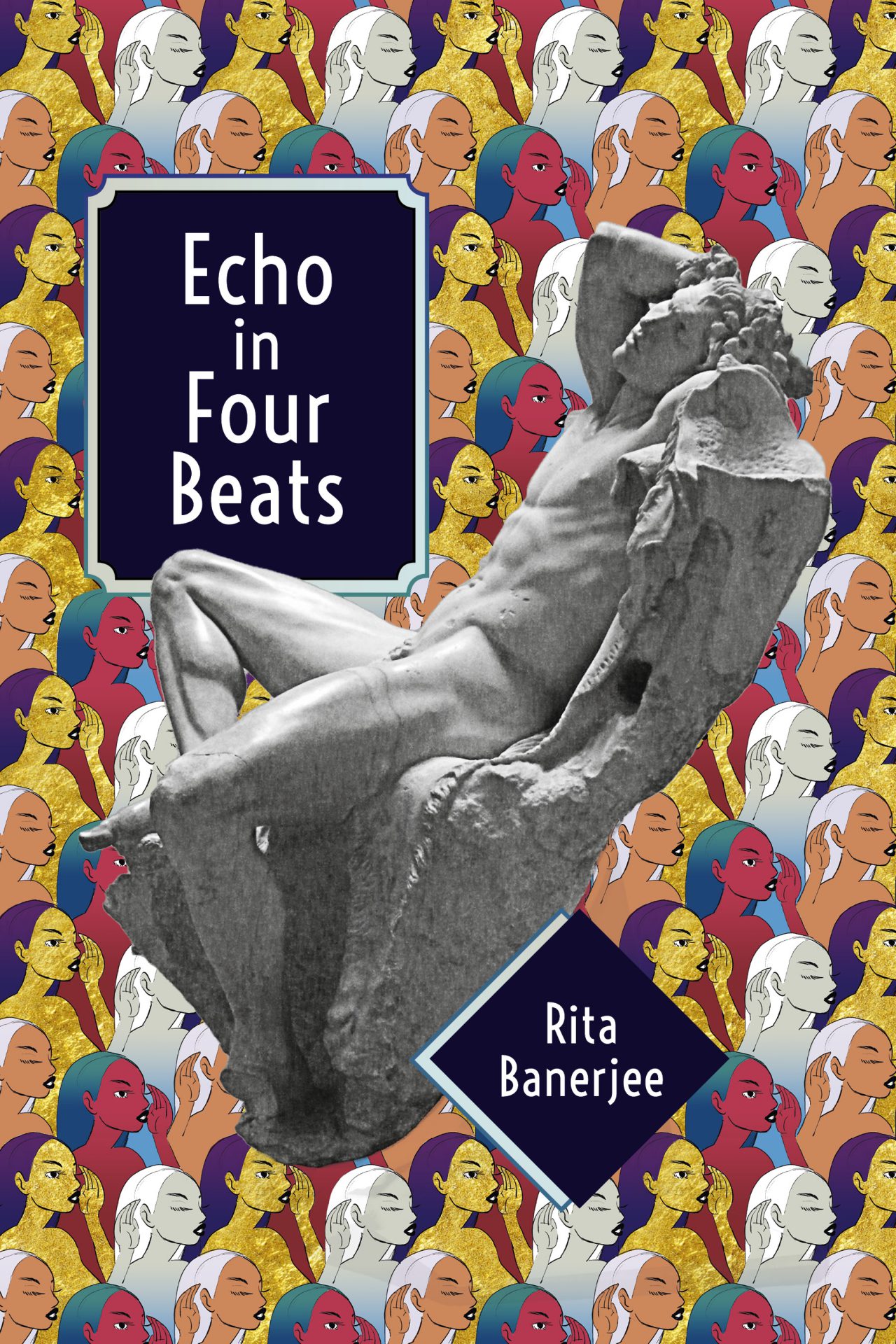
Echo in Four Beats by Rita Banerjee Forthcoming in February 2018

Combining elements, rhythms, and personas from American jazz, blues, and ragtime, poet Rita Banerjee presents a multi-lingual, modern-day spin on the love story of Echo and Narcissus in her debut full-length poetry collection, Echo in Four Beats.  But in this story, told in four parts, Echo is more than just a fragment, she is a Sapphic voice that speaks, foretells, forestalls, and repeats.  Echo in Four Beats, which was a finalist for the Red Hen Press Benjamin Saltman Award, the Three Mile Harbor Poetry Book Prize, and the Aquarius Press/Willow Books Literature Award, will be released by Finishing Line Press on February 2, 2018.  The poetry manuscript will be available for pre-order on Finishing Line Press’s website from October 10 – December 8, 2017.  On Rita Banerjee’s poetry, the following writers have written:

“Rita Banerjee’s poems are an acrobatic music, a swinging erudition, a hip lyric to make shape of Whitman’s ‘ostent evanescent,’ a phrase he uses to conjure the metaphysical projections of the physical world. Banerjee, with thrilling compression and off-beat breaks, fashions a multi-dimensional America…With wit, play, consonance, anagram, assonance, the unexpected rhyme, Banerjee offers, in this short collection, a material, feminist, postcolonial critique of where we are as a nation, what we are made of, what we fail to make, and what we can make of language regardless…’ – Patrick Rosal, author of Brooklyn Antediluvian, My American Kundiman, and Uprock, Headspin, Scramble, and Dive

“’I had no roam / no hope to / call a // road’” writes Rita Banerjee, but I don’t believe her for a second. This is a mobile and hopeful speaker, capable of making her home in a rail car heading out of Manipal just as easily as she inhabits Renoir’s Bougival. Throughout, the worldliness is laced with heartache, in search of “’some solace that would heal the lines / between blue and continent.’” ~ Srikanth Reddy, author of Voyager and Facts for Visitors

“Rita Banerjee’s poems spin the reader into a world of tightly packed imagery that leaves us gasping at the edge of violent endings or floating in wondrous, ancient silences. With lyric intensity, delicacy, and humor, she has the capacity to make places and sounds palpable, taking the reader on a journey from Harlem to the Himalayas. This is a new voice of hypnotizing and rare beauty.” ~ Diana Norma Szokolyai, author of Parallel Sparrows and Roses in the Snow

Mad Heart Be Brave now available from the University of Michigan Press!

Born and raised in Kashmir, Agha Shahid Ali (1949–2001) came to the United States in the mid-1970s to pursue graduate study in literature; by the mid-1980s, he had begun to establish himself as one of the most important American poets of the late 20th century.  Mad Heart Be Brave: On the Poetry of Agha Shahid Ali is the first comprehensive examination of all stages of his career, from his earliest work published in India but never reissued in the U.S., through his seven poetry volumes from American publishers, ultimately collected as The Veiled Suite.  Contributors to this volume include Sejal Shah, Rita Banerjee, Amanda Golden, Ravi Shankar, Abin Chakraborty, Amy Newman, Christopher Merrill, Jason Schneiderman, Stephen Burt, Raza Ali Hassan, Syed Humayoun, Feroz Rather, Dur e Aziz Amna, Mihaela Moscaliuc, Reginald Dwayne Betts, Mahwash Shoaib, Shadab Zeest Hashmi, Grace Schulman, and Ada Limón. Mad Heart Be Brave closes with a long biographical sketch and elegy by Agha Shahid Ali’s friend Amitav Ghosh and a comprehensive bibliography assembled by scholar Patricia O’Neill with Reid Larson.

In her essay, “Between Postindependence and the Cold War: Agha Shahid Ali’s Publications with the Calcutta Writers Workshop,” Rita Banerjee writes:  “In 1958, editor, critic, translator, and poet P. Lal established the English-language creative writing group the Writers Workshop in Kolkata. The Writers Workshop helped launch the careers of many well-known English-language South Asian authors, such as Anita Desai, Bharati Mukherjee, Vikram Seth, A. K. Ramanujan, Arvind Krishna Mehrotra, and Agha Shahid Ali. As an editor, P. Lal was a key figure in establishing the relevance and necessity of Anglophone South Asian writing in the postindependence period. His seminal work, Modern Indian Poetry in English: The Writers Workshop Selection, an Anthology & a Credo (1969) served as a manifesto for the function and viability of Indian English literature in the postindependence period and featured one of Agha Shahid Ali’s most dystopian and memorable poems, “Lunarscape.” In the poem Ali not only critiqued the rivalry between the United States and the USSR during the Cold War but also presented the recent American moon landing as a neocolonial and self-destructive move. After the publication of “Lunarscape,” Agha Shahid Ali went on to publish his first and second collections of poems, Bone-Sculpture (1972) and In Memory of Begum Akhtar (1979) with P. Lal’s Writers Workshop. Ali’s first collection, Bone-Sculpture, featured several poems that reflected his response to the postindependence and postpartition realities of South Asia, his own conflicted feelings over his divided home state of Kashmir, and poems that responded to the Cold War, cultural revolutions, and other global political events of the time and captured Ali’s own experiences of immigration…”  To read the full essay, please order Mad Heart Be Brave: On the Poetry of Agha Shahid Ali from the University of Michigan Press here.

CREDO: An Anthology of Manifestos & Sourcebook for Creative Writing (ed. Rita Banerjee & Diana Norma Szokolyai) forthcoming from C&R Press in March 2018!

The Cambridge Writers’ Workshop is proud to announce that CREDO: An Anthology of Manifestos and Sourcebook for Creative Writingedited by Rita Banerjee and Diana Norma Szokolyai, and produced by the Cambridge Writers’ Workshop (with assistant editors Alexander Carrigan and Megan Tilley), will be published on March 7, 2018 by C&R Press.  C&R Press began in 2006 as a literary press committed to publishing books from new and emerging writers.  C&R Press is interested in supporting authors whose thoughtful and imaginative contribution to contemporary literature deserves recognition and support. C&R Press’s catalogue includes exciting new poetry, fiction, nonfiction, as well as reportage/journalism.

CREDO. I believe. No other statement is so full of intent, subversion and power. A Credo is a call to arms. It is a declaration. A Credo is the act of an individual pushing back against society, against established stigmas, taboos, values, and norms. A Credo provokes. It desires change. A Credo is an artist or community challenging dogma, and putting themselves on the frontline. A Credo is art at risk. A Credo can be a marker of revolution. A Credo, is thus, the most calculating and simple form of a manifesto.

The Cambridge Writers’ Workshop’s CREDO: An Anthology of Manifestos and Sourcebook for Creative Writing is a raw look at what motivates 21st century authors. CREDO is a triad of creative writing manifestos, essays on the craft of writing, and creative writing exercises. These manifestos interrogate and harken back to the modernist manifestos of the early 20th century. The second section of CREDO focuses on craft of writing essays that examine the writing process with candid vulnerability. The third section includes writing exercises, which are meant to challenge and incite creativity.

CREDO is our declaration against violence and limitations of free speech. Our CREDO focuses on transgender poetics, world literature and aesthetics, collage and appropriation, and the politics of place. The anthology bridges the theoretical and the practical with accessible writing advice, and its ultimate mission is to inspire innovative writing and to provoke it. CREDO features writing from contemporary authors such as Kazim Ali, Forrest Anderson, Rita Banerjee, Lisa-Marie Basile, Jaswinder Bolina, Stephen Burt, Alexander Carrigan, Sam Cha, Melinda Combs, Thade Correa, Jeff Fearnside, John Guzlowski, Rachael Hanel, Janine Harrison, Lindsay Illich, Douglas C. Jackson, Caitlin Johnson, Christine Johnson-Duell, Jason Kapcala, Richard Kenney, Eva Langston, John Laue, Stuart Lishan, Ellaraine Lockie, Amy MacLennan, Kevin McLellan, E. Ce. Miller, Brenda Moguez, Peter Mountford, Robert Pinsky, Kara Provost, Jessica Reidy, Amy Rutten, Elisabeth Sharp McKetta, David Shields, Lillian Ann Slugocki, Maya Sonenberg, Kathleen Spivack, Laura Steadham Smith, Molly Sutton Kiefer, Jade Sylvan, Anca Szilágyi, Diana Norma Szokolyai, Marilyn Taylor, Megan Tilley, Suzanne Van Dam, Nicole Walker, Allyson Whipple, Shawn Wong, Caroll Yang, and Matthew Zapruder.

Stay tuned for our upcoming launch & book tours for CREDO!  For inquiries and reading engagements regarding CREDO and publications by the Cambridge Writers’ Workshop, Inc., please contact our agent, Natalie Kimber at The Rights Factory.

Rita Banerjee’s poem “Ilha Formosa” feat. in Hyphen Magazine

For the month of March, Hyphen Magazine has featured a new poem by Rita Banerjee entitled, “Ilha Formosa.”  On Banerjee’s poetry, editor Eugenia Leigh writes:

This March—a season of spring, of sloughing off the dead weight of winter and examining our year’s progress—we offer Rita Banerjee’s meditative and magical profile of the “Ilha Formosa” that “knows / more than sulfur and air and water shift / between earth and its beautiful blue fringe—”. This poem quiets the clamor of our blue-lit lives so we can catch the “rhythm of the blood-beat” in the South Pacific. Banerjee teaches us to see what the eye “almost misses”: not only the mountain, but also “your own face grown thick” reflected in that mountain and in the entire natural world around us.  —Eugenia Leigh, Poetry Editor, Hyphen Magazine

You can read Rita Banerjee’s poem, “Ilha Formosafeatured on Hyphen Magazine here.

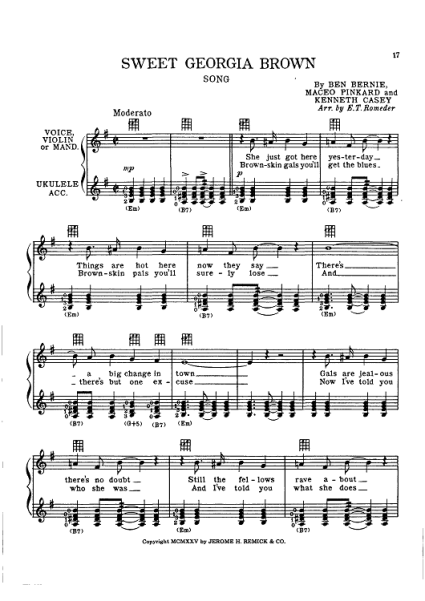
Rita Banerjee’s poems “Georgia Brown” and “The Suicide Rag” feat. on Painted Bride Quarterly’s Print Annual & Podcast, “Episode 27: Suicides & Skeleton Jazz”

georgiabrownPainted Bride Quarterly’s podcast, “Episode 27: Suicides and Skeleton Jazz,” features two new poems from Rita Banerjee.  Here’s is a message from the PBQ Editors:

In the midst of excitedly preparing for AWP 2017, we record this episode in which we discuss two poems by Rita Banerjee, “The Suicide Rag” and “Georgia Brown”

Rita Banerjee is the Creative Director of the Cambridge Writers’ Workshop and is currently working on a futuristic dystopian novel about Mel Cassin, a half-Tamil, half-Jewish girl stuck in the middle of a familial crisis and an epic political meltdown, and a collection of essays on race, sex, politics, and everything cool.  A jet-setter at heart, she spends her time between Munich, Germany and the United States.

This week’s discussion both took us back and made sure that none of us would see the world the same way again. With images of breakdancing, gospel choir, and the not-so-innocent Georgia Brown, we were in it. Whether we’re distinguishing jazz from jazz or figuring out what a clapper is, this episode is filled with risky moves.

Here is a sample of Rita Banerjee’s poetry:

Georgia Brown

Harlem had yet to be born,
the globe had not been spun,
but we knew how to whistle,
how to call clappers and skirts on cue:
That summer, we first met Georgia,
she was an echo in four beats,
we learned to hum her story.
Mike played her with a licked reed
but she was all brass, sharp
like an abandoned railroad cutting through
wild wood, and when she took stage,
she made those trombone boys whisper,
“Sweet Georgia, Sweet.”

The Suicide Rag

Billy played ragtime
on the church
organ but we

lunch hour kids,
kept time by another
name.  Behind St. Augustine’s

we learned to hit
the pavement, sound
like an anvil

crack
hammers hitting
steel, Billy playing

skeletons
on the fifth,
we arpeggioed

haloed, froze
on the black
top.  Learning

to cakewalk
This was our
battle—

tar-mat babies
doing handsprung
suicides

for the girls
standing ’round
with knife-like eyes

That’s all
we needed—
a rolling

beat, a firing squad
and schoolyard
skirts

scouring the lot
as we fell
face forward

hands locked
& stiff, the only
thing

that could’ve
come between
us was a kiss.

To here the full discussion of Rita Banerjee’s poetry, listen to the PBQ “Episode 27: Suicides and Skeleton Jazz,podcast here.