Electric Literature – “War is Beautiful: An Interview with David Shields”

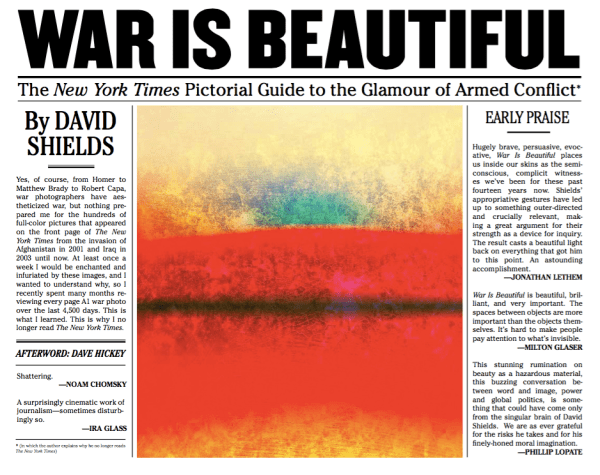
WarisBeautifulEarlier this month, I sat down with David Shields to interview him about his new book, War Is Beautiful: The New York Times Pictorial Guide to the Glamour of Armed Conflict (powerHouse Books 2015). During our conversation, Shields spoke about the New York Times’s use of sanitized, sensually inviting front-page photography to glamorize the wars in Afghanistan and Iraq; these photos—in Shields’s view—desensitize readers to the cruelty and violence of these wars.

David Shields is the author of international bestsellers and critically acclaimed books, including The Thing About Life Is That One Day You’ll Be Dead (Knopf 2008), Black Planet (Three Rivers Press 2009), and Reality Hunger: A Manifesto (Knopf 2010), which argued for the obliteration of the distinction between fiction and nonfiction, the overturning of laws regarding appropriation, and the creation of new forms for a new century. Over the past several years, Shields’s work has become increasingly political.

Rita Banerjee:  The images of war in the book are very provocative. For example, in the Nature section, in the photo where you’re looking at a beautiful field of flowers and then you see the helmet of a soldier, it’s shocking. It grabs you. And even in the “Paintings” section, many of the images are so aesthetically inviting.

David Shields:  They look like Abstract Expressionist paintings. They might as well have been painted by Rothko or Pollock.

RB:  Reading War is Beautiful, you realize how cleaned up American media is. It’s weirdly Puritan, weirdly sanitized.

DS:  It’s quite striking how this process happened over the last couple of decades. First of all, the rise of digital culture so that a picture could be sent instantaneously from the battlefield to the Times. Second of all, the advent of color photography on page A1 (starting in October 1997).

In the book’s afterword, Dave Hickey points out how serious and great war photography was from Mathew Brady in the Civil War all the way through Robert Capa during World War II and, say, Tim Page in Vietnam. And basically what happened during World War II was the rise of something he calls the “swipe photograph”—the quick photograph that conveys a quick, blurry image; for example, Capa, with his famous picture of a fallen Spanish soldier during the Spanish Civil War. And then what Hickey argues is that with the rise of Abstract Expressionism, people like Diebenkorn, Rothko, Pollock, Gerhard Richter, the swipe image became a huge part of Abstract Expressionism. And now war photographs are not based on what the war photographer is actually seeing in war. Rather, he or she is trying to reproduce Abstract Expressionist tropes—swipe-image gorgeousness.

All of these pictures from the New York Times are remarkably hollow and bloodless, composed, and abstract. All of these photographs have come, to a staggering degree, from art history.  These pictures are beautiful but dead.

RB:  I was really struck by your commentary in the beginning of War Is Beautiful. You raise the point, Is the Times complicit in selling a certain kind of narrative to the United States? That is, the Times promotes its institutional power as a protector or curator of a death-dealing democracy. Who is responsible for it? We all are. We are all inscribed in that death-dealing democracy.

Maybe that’s why we’re so accepting of capitalism as well. We don’t see the devastation. If people are dying of chemical poisoning in an Apple factory in China, how much do we care? The same with Iraq or Afghanistan. As Americans, we’re so used to the idea of distance. When the political world is distant from us, not only are we desensitized and numb to it but it’s almost as if we’re watching cinema or playing in a video game; there’s even a certain aspect of pleasure in a weird way. We have power and yet we’re at such a great distance from what’s going on and what’s going down.

DS:  I try to make this emphatically clear via the book’s opening epigraph from Edmund Burke: “When danger or pain press too nearly, they are incapable of giving any delight, and are simply terrible; but at certain distances and with certain modifications, they may be, and they are delightful, as we every day experience. The cause of this I shall endeavour to investigate further.” Capitalism, distance, aesthetic pleasure, drone voyeurism are all part of one complicated cocktail. You’ve summarized it very well; it’s clearly capital that’s driving all this. We take pleasure in the privileged distance that capitalism buys.

Read the rest of the interview on Electric Literature.
Premchand’s Shatranj ke Khilari and Satyajit Ray’s The Chess Players – November 24

the-chess-playersRita Banerjee will introduce and lead the discussion for Satyajit Ray’s 1977 film, The Chess Players, on Tuesday November 24 from 6-8:30 pm for the Institute for Indology and Tibetology at Ludwig-Maximilians-Universität München, (Ludwigstr. 31, Seminarraum 427).  The screening is part of the course Translation and Modern South Asian Literatures at LMU.  Anyone interested in translation studies, Modern South Asian literature, or art house film is welcomed to join the screening.

“Satyajit Ray’s gently satiric parable The Chess Players reminds us that, in the days before America’s machinations in Iraq, we had the British East India Company running roughshod in much same way in India. Ray opens his movie with a documentary-style recap of the Company’s mid-19th century wheeling-dealing in Oudh, a wealthy province in northeastern India. The Company had Oudh’s king, Wajid Ali Shah, by the balls: If the king agreed to finance the Company’s regional ambitions, and even supply it with necessary troops, it wouldn’t meddle in or usurp the king’s power. By 1856, though, the British, eager to fatten their imperial coffers, broke their détente with King Wajid, and instructed their local operative, General Outram, to do whatever it takes to roll into Oudh and take charge…[In the film], Mirza (Sanjeev Kumar) and Meer (Saeed Jaffrey), two Lucknow noblemen, are so enamored of chess playing that they’re oblivious to the political and domestic upheavals around them. While Mirza’s wife wiles away in her bedroom, cross and neglected, Meer uses her husband’s all-day devotion to chess playing as an opportunity for some cuckolding. These guys are too tuned-out, however, too buffoonish to pick up on these clues. Likewise, they blissfully shrug off rumors of the East India Company’s troops imminently laying siege to their pleasure haven and deposing their king. “ – Jay Antani, Slant

Tagore’s The Broken Nest & Satyajit Ray’s Charulata – November 17

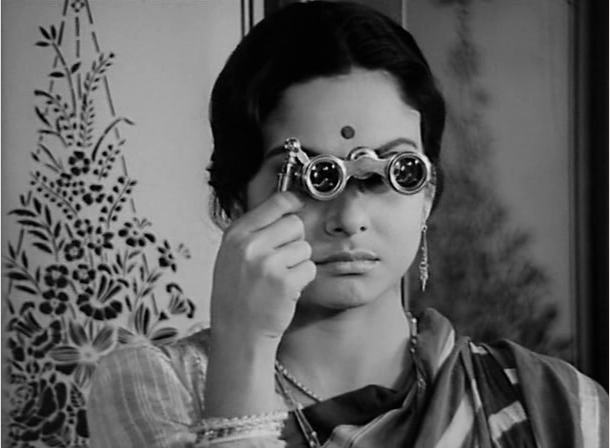
CharulataRita Banerjee will introduce and lead the discussion for Satyajit Ray’s 1964 film, Charulata, on Tuesday November 17 from 6-8:30 pm for the Institute for Indology and Tibetology at Ludwig-Maximilians-Universität München, (Ludwigstr. 31, Seminarraum 427).  The screening is part of the course Translation and Modern South Asian Literatures at LMU.  Anyone interested in translation studies, Modern South Asian literature, or art house film is welcomed to join the screening.

“Satyajit Ray’s film Charulata, based on Rabindranath Tagore’s story The Broken Nest, is 50 years old, but it’s just so extraordinarily vivid and fresh. While watching this – in fact any of his films – the same question recurs: why aren’t we talking about Ray more? Or, in fact, all the time? There is such miraculous clarity here, such great acting, staged with theatrical aplomb and shot with unshowy genius. It has the effortless fluency and gaiety of a Shakespearean comedy. The setting is Calcutta in British India: Charulata, played by the hypnotically beautiful Madhabi Mukherjee, is the bored, cultured wife of a newspaper editor and proprietor who prides himself on being a bold free-thinker. His charming young wastrel cousin, a would-be writer called Amal (Soumitra Chatterjee), comes to stay and Amal and Charulata take an interest in each other’s literary aspirations – as well as in each other generally. The delicate pathos and subtle comedy of their romance is a joy, and there is wonderful audacity in the way Ray shows Charulata’s life at the beginning – simply looking out of the window, studying the passersby with the engaged curiosity of a true artist. Ray’s own artistry and poise emerges very strongly. This film is a tonic – a vitamin boost for the mind and heart.” – Peter Bradshaw, The Guardian

National Write-a-Novel Month 2015 Writing Workshops & Write-Ins at the Munich Readery – November 7, 14, 21, 28

RoyalTypeWriterDuring November, The Munich Readery will host workshops and write-ins for writers developing or working to complete a book-length manuscript. We’ll kick off the month by hosting a workshop with Rita Banerjee on “Life and Lived Stories” and the craft of nonfiction and fiction writing on Saturday, November 7. Writers will bring in their project proposals and ideas for a book-length project to be reviewed in class. We’ll review a text that blurs the line between fact and fiction and can serve as a launching pad for building longer narratives. Beginning writers also welcome.  On the next three Saturdays, November 14, 21, and 28, The Munich Readery will host special “write-in” sessions, during which writers will work on their book-length projects.  Rita Banerjee will meet individually with writers during these sessions to discuss their projects and progress.  Rita will help writers set goals for each write-in, and the sessions will conclude with self-assessments and a question and answer period.  Workshop Fee: €30/workshop.  Email Lisa at the Munich Readery to enroll at store@themunichreadery.com

Location: The Munich Readery, Augustenstraße 104, 80798 München
Saturday November 7 – Life & Lived Stories Workshop (9 am – 12 noon sharp) [SOLD OUT]
Saturday November 14, 21, 28 – Write-ins (9 am – 12 noon sharp)

Rita Banerjee received her doctorate in Comparative Literature from Harvard University and teaches at Ludwig Maximilian University of Munich.  Her writing has been featured in VIDA: Women in Literary Arts, Riot Grrrl Magazine, Poets for Living Waters, The Fiction Project, Objet d’Art, and on KBOO Radio’s APA Compass in Portland, Oregon. Her first collection of poems, Cracklers at Night, received First Honorable Mention for Best Poetry Book at the 2011-2012 Los Angeles Book Festival.  Creative Director of the Cambridge Writers’ Workshop, she is currently working on a novel and a book of lyrical essays.

Flaubert’s Madame Bovary & Ketan Mehta’s Maya Memsaab – November 10

MayaRita Banerjee will introduce and lead the discussion for Ketan Mehta’s 1993 film, Maya Memsaab, on Tuesday November 10 from 6-8:30 pm for the Institute for Indology and Tibetology at Ludwig-Maximilians-Universität München, (Ludwigstr. 31, Seminarraum 427).  The screening is part of the course Translation and Modern South Asian Literatures at LMU.  Anyone interested in translation studies, Modern South Asian literature, or art house film is welcomed to join the screening.

“Maya (Deepa Sahj) says she has everything she could possibly want, with a decent but awkward professional man as a husband, and two lovely daughters. However, she is just as attracted to men as they are to her, and she falls into and out of any number of disastrous sexual liaisons. Indeed, she eventually cuts such a swath through society that the police are looking for some way to remove her from circulation, and concoct something called “the Maya scandal” to permit them to put her away. This tragic melodrama is based on Madame Bovary by Gustave Flaubert.” – Clarke Fountain, Rovi.

Shakespeare’s Hamlet & Vishal Bhardwaj’s Haider – November 3

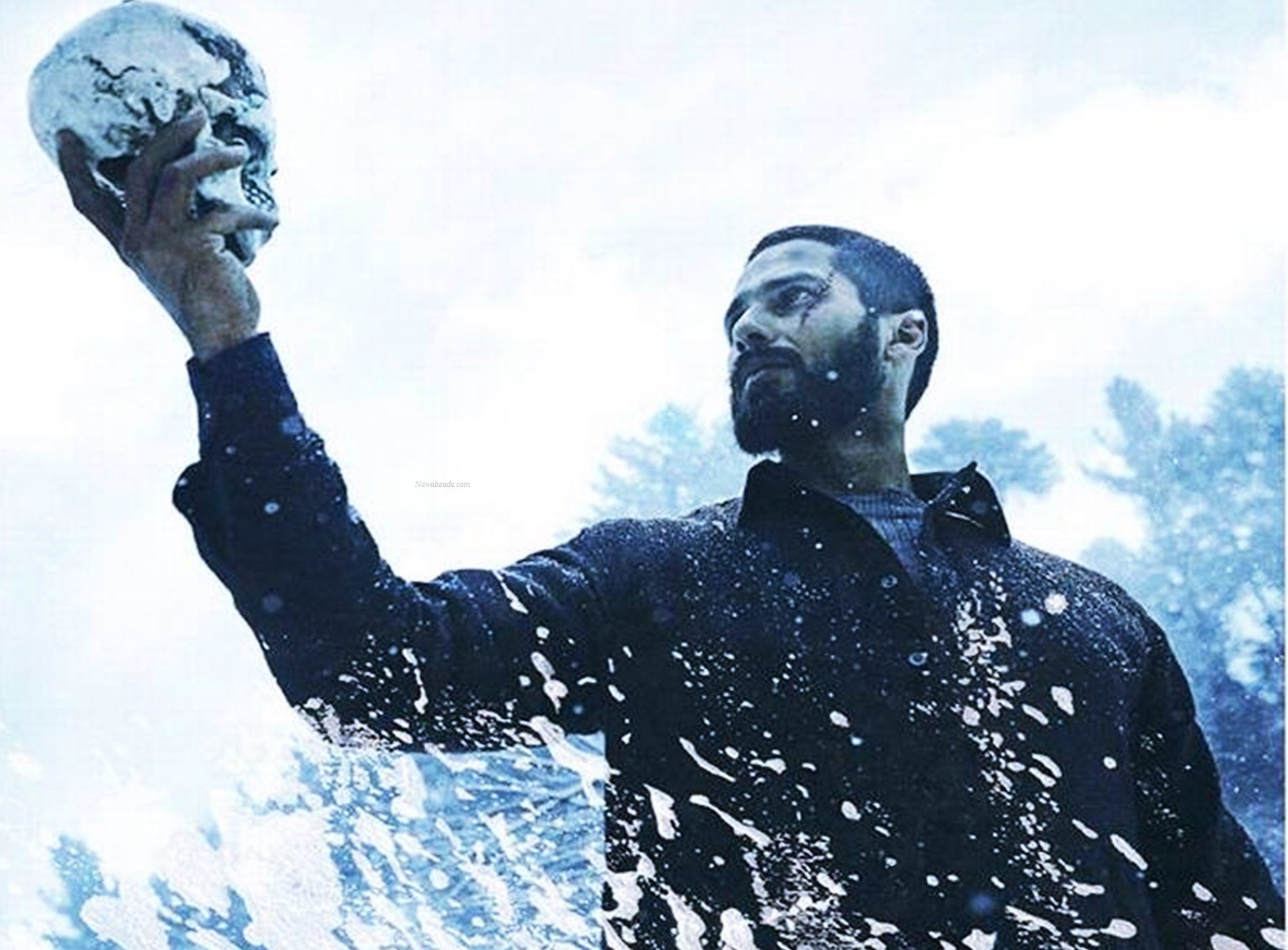
HaiderRita Banerjee will introduce and lead the discussion for Vishal Bhardwaj’s 2014 film, Haider, on Tuesday November 3 from 6-8:30 pm for the Institute for Indology and Tibetology at Ludwig-Maximilians-Universität München, (Ludwigstr. 31, Seminarraum 427).  The screening is part of the course Translation and Modern South Asian Literatures at LMU.  Anyone interested in translation studies, Modern South Asian literature, or art house film is welcomed to join the screening.

“The Bollywood director Vishal Bhardwaj has made his name by adapting Shakespeare into film, using the plays to reflect the violence and vicissitudes of modern India. Maqbool, an adaptation of Macbeth, was set in the Mumbai underworld; Omkara transported Othello to the feudal badlands of northern India. His latest effort, a loose adaptation of Hamlet called Haider that takes place in Kashmir during the turbulent 1990s, has become one of the most acclaimed and contentious Bollywood movies of the year…[In the film] Haider is sent away by his parents to Aligarh, a university town in north India, to shelter him from the violence overtaking Kashmir. The movie’s plot is set in motion when he returns to his homeland to search for his father, who has been abducted by the military. Through Haider’s search, the movie plunges into a looking-glass world, where lies and deception are common, and the government has abandoned human rights and the rule of law to crush the armed insurgency.” – Vaibhav Vats, The New York Times

The Recognition of Śakuntalā: Sex, Comedy, and Rasa – October 1

A Lecture by: Dr. Rita Banerjee
Rutgers University *
Thursday October 1, 2015 * 3:20-4:40 pm
Rutgers Cinema Room 2 * Livingston Campus

This lecture will focus on how Rasa Theory, as outlined by the dramatist Bharata in his Nāṭyaśāstra and the 10th century aesthetician Abhivanagupta, can be read in Kālidāsa’s play, The Recognition of Śakuntalā.  This talk will focus on how Kālidāsa employs various bhāvas (emotions), alaṃkāras (literary devices), and forms of abhinaya (acting) through suggestion (dhvani) to manipulate the emotional state of his audience.  Sex, comedy, and the emotional upheaval of Kālidāsa’s play will be compared to later adaptations of Śakuntalā and to the structure and eros of Goethe’s Faust.

South Asia and Theories of the Avant-Garde: The International Scope of South Asian Literary Modernisms – September 24

KavitaA Lecture by: Dr. Rita Banerjee
Institut für Indologie und Tibetologie
Ludwig-Maximilians-Universität München

Rutgers University
Thursday September 24, 2015
Reception 4:30 p.m. – Lecture 5:00 p.m.
Alexander Library, Pane Room

169 College Avenue, New Brunswick, NJ 08901

RBThis presentation will highlight the role that translation and multilingualism played in opening up discussions and theories of modernism within the South Asian literary canons of Bengali, Hindi, and English in the early to mid-20th century. The lecture will explore the representations and international scope of literary modernisms in journals such as Kallol, Kavitā, and Krittibās in Bengali, the Nayī Kavitā journal and the Tār Saptak group in Hindi, and the Writers Workshop group in English. Theories of modernism as proposed by critics such as Dipti Tripathi and Acharya Nand Dulare Bajpai will be contrasted with manifestos of modernism, with Agyeya’s defense of experimentalism (prayogvād), with theories of translation as proposed by Bhola Nath Tiwari, and with translations of foreign writers and aesthetic forms. In doing so, the presentation will note how the study of modernist practices, translation, and theory in Bengali, Hindi, and English provides insight into the pluralistic, multi-dimensional, and ever-evolving cultural sphere of modern South Asia beyond the suppositions of postcolonial binaries and monolingual paradigms.

Sponsored by: Program in Comparative Literature • South Asian Studies Program •
Department of African, Middle Eastern, and South Asian Languages and Literatures •
Office of the Dean of Humanities and Office of Undergraduate Academic Affairs, School of Arts and Sciences

The Brooklyn Book Festival presents New York’s Exciting New Voices – September 20

BBF-NewYorksExcitingNewVoices2015The Brooklyn Book Festival in collaboration with the Cambridge Writers’ Workshop is proud to announce New York’s Exciting New Voices, a Brooklyn Book Festival Bookend Reading at Muchmore’s (located at 2 Havemeyer Street, Brooklyn, NY) on Sun September 20 from 7 – 9 pm.

The event will be moderated by Diana Norma Szokolyai and features writers Rita Banerjee, Jonah Kruvant, Brandon Lewis, Elizabeth Devlin, Lisa Marie Basile, Gabriella Rieger Lapkoff, Jessica Reidy, Gregory Crosby, Matty Marks, and Emily Smith.  Enjoy a drink and a bite to eat in the heart of Williamsburg as you hear from some of New York’s most exciting, new voices, many of whom are faculty members for the Cambridge Writers’ Workshop.  The Brooklyn Book Festival is the largest free book event in New York City and presents established as well as emerging writers each year.  The Bookend Events kick off the week’s festivities each year with literary themed events at clubs, bookstores, parks, etc.  More information is available at cww.nyc

The Monarch Review features Rita Banerjee’s poems “Please Listen and Do Not Return” and “Storyteller”

MonarchReviewThe current issue of The Monarch Review, Seattle’s literary and arts magazine, features two new poems by Rita Banerjee, “Please Listen and Do Not Return” and “Storyteller.”  The poems are inspired by Nick Carraway, Tom Joad, and Gloria Rich, respectively.

Rita Banerjee is a writer, and received her PhD in Comparative Literature from Harvard University.  She holds an MFA in Creative Writing and her has been featured in VIDA: Women in Literary Arts, Riot Grrrl Magazine, Poets for Living Waters, The Fiction Project, Jaggery, The Crab Creek Review, The Dudley Review, Objet d’Art, Vox Populi, Dr. Hurley’s Snake-Oil Cure, Chrysanthemum, and on KBOO Radio’s APA Compass in Portland, Oregon. Her first collection of poems, Cracklers at Night, received First Honorable Mention for Best Poetry Book at the 2011-2012 Los Angeles Book Festival. She is Executive Creative Director of the Cambridge Writers’ Workshop.