UW Press Celebrates “Aiiieeeee!” and a 50-year Legacy of Asian American Literature feat. Rita Banerjee

In honor of AANHPI month and the 50th anniversary of its publication, poet and writer Shin Yu Pai writes about the game-changing and inspiring legacy of Aiiieeeee! An Anthology of Asian-American Writers (eds. Frank Chin, Jeffery Paul Chan, Lawson Fusao Inada, and Shawn Wong, 1974) for University of Washington Magazine. In the article, “Finding the Words: UW Press Celebrates Aiiieeeee! and a 50-year Legacy of Asian American Literature,” Pai writes:

In 1970, when Shawn Wong was 19 and a student at the University of California at Berkeley, he had to go hunting for Asian American literature on the street.

An English professor told him no such literature existed. But Wong and his friends and fellow writers, Jeffery Paul Chan, Frank Chin and Lawson Fusao Inada, knew that wasn’t true. They had connected over a shared quest to discover Asian American literature. Their dogged search through Bay Area thrift stores and a handful of literary anthologies led them to 14 writers whose work had been largely ignored by mainstream publishers.

As the young editors continued to refine their list of work by overlooked authors, they decided to create an anthology. Chan brought their fledgling manuscript into the Asian American literature class he was teaching at San Francisco State University, while Wong—who would later join the faculty at the UW—used the material in a class he was teaching at Mills College in nearby Oakland. Eventually, the first-time editors published that group of 14 authors, which included UW alumnus John Okada, ’47, ’51, as well as now well-known wordsmiths Toshio Mori, Oscar Peñaranda and Diana Chang. Their radical undertaking culminated in “Aiiieeeee! An Anthology of Asian-American Writers.” 
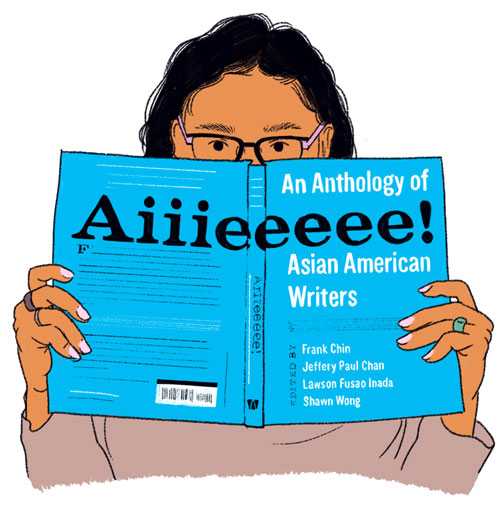
This year, “Aiiieeeee!” turns 50. First published by the Howard University Press in 1974, the book was republished in 2019 by the University of Washington Press. The new edition holds a foreword by Tara Fickle, associate professor of Asian American studies at Northwestern University, who offers the current generation of readers context about the era and people involved in bringing the book to life. Fickle studied Wong’s correspondence with the writers and his fellow editors. She also looked at the production notes for the book to understand how the collection evolved through the editorial process and what the stakes were for the editors. Fickle’s research into Wong’s archives unearthed the editors’ own reflections on their project. In a letter to Wong, for example, Inada envisioned the anthology’s success. “Our place in history will have the secure feel of real beginnings. After a while, people will refer to us as the fathers … the cornerstones of our culture.”

Inada’s words held true. “Aiiieeeee!”  became a foundational text in Asian American Literature, and its editors were credited for both rescuing stories out of time and opening readers to a diversity of voices and experiences from the Asian American community. The anthology’s 14 pieces range from the 1940s to the 1970s, ending in a time when activists and scholars were challenging stereotypical representations and expectations of the Asian American voice and experience to highlight neglected perspectives and more freshly define the culture. 

Author and activist Ishmael Reed helped the four writers and would-be editors find their way to the Howard University Press. The Howard editors “were the first to realize the legitimacy of Asian American literature,” Wong says. “It was one of the first 10 books on their list. And it was the only one that wasn’t an African American title.”

Reed dubbed Wong and his friends the “Four Horsemen of Asian-American Literature” and encouraged their efforts to provoke, develop and define an Asian American literary canon. Right away, the book garnered positive reviews in Rolling Stone and The New York Times and advanced Wong and his collaborators along their paths as writers and literary activists.

Today, the UW is steeped in the legacy of their groundbreaking work. A wealth of modern Asian American literary voices includes UW alumni and scholars who studied Asian American literature, English literature and ethnic cultural studies.

Wong joined the UW faculty in 1984, after teaching at Mills College, UC Santa Cruz and San Francisco State. He is currently a professor in the English department and has served as chair of English, director of the Creative Writing Program, director of the University Honors Program and faculty in Cinema & Media Studies.

“The UW has always been a place where you can reinvent yourself,” says Wong. “It’s large enough that I could try different things and bring my perspective to lots of different fields.”

Alongside Wong’s legacy, the University of Washington Press has its own long history of engaging contemporary scholars in republishing and recontextualizing Asian American classics for new generations of readers. It also has a long-standing commitment to supporting Asian American scholarship dating to the early 1970s when editor-in-chief Naomi Pascale saw an opportunity to position the press at the forefront of the discipline. In 1973, the press republished Filipino novelist Carlos Bulosan’s “America Is in the Heart.” Over her decades-long career at the UW Press, Pascale acquired many other titles in this area, including Jade Snow Wong’s “Fifth Chinese Daughter” and Janice Mirikitani’s “Awake in the River and Shedding Silence.”

When Nicole Mitchell became publisher of the press in 2012, she led the redesign and refresh of its Asian American classics series and invited contemporary writers and scholars to develop introductions for these new editions. The UW Press also has published titles from UW faculty across disciplines. “Becoming Nisei,” by professors Lisa Hoffman in the School of Urban Studies and Mary Hanneman, ’91, of the School of Interdisciplinary Arts and Sciences, looks at Japanese Americans in Tacoma before World War II. Professor Stephen Sumida’s “And the View from the Shore” explores the literary traditions of Hawai’i. The press also has supported prominent Northwest-based Asian American writers including Frank Abe, Peter Bacho, ’74, and Cindy Domingo.

In 2020, Shawn Wong established the Shawn Wong Book Fund at the UW Press to recover forgotten titles, like Louis Chu’s “Eat a Bowl of Tea,” and bring them back into print for the wider public. The newest title in Wong’s series is Willyce Kim’s “Dancer Dawkins and the California Kid”—the first Asian American lesbian novel.

Rising scholars and talented writers are drawn to the UW’s English Ph.D. program. Poet and writer E.J. Koh, ’23, won the Washington State Book Award for her memoir, “The Magical Language of Others.” Her novel, “The Liberators,” was released last fall. At the UW, Koh studied Korean American literature, history and film. Rita Banerjee’s, ’06, recent contemplation on female cool, “The Female Gaze,” was featured in “The Best American Essays” last year. And in her new memoir, “Meet Me Tonight in Atlantic City,” Jane Wong, ’16, writes of finding in the literature of other Asian American artists ways to tell her own story… Today is a new day for underrepresented voices, and Asian American literature is flourishing with fresh new voices… Today is a new day for underrepresented voices, and Asian American literature is flourishing with fresh new voices.

You can read Shin Yu Pai’s full article here.

University of Washington’s Presidential Blog Celebrating AANHPI Communities feat. Rita Banerjee

In honor of AANHPI month, University of Washington President Ana Mari Cauce’s recently honored the legacy and impact Asian American, Native Hawaiian, and Pacific Islander communities at the University of Washington in her Presidential Blog. President Cauce writes:

Each May, the nation and our UW community are proud to honor National Asian American, Native Hawaiian and Pacific Islander (AANHPI) Heritage Month and to recognize the enormous impact and influence of our AANHPI community members here on campus and across the globe.

Connections to our Asian American (AA) and Native Hawaiian and Pacific Islander (NHPI) communities run deep at the University of Washington and across the Pacific Northwest. This year’s theme, “Advancing Leaders through Innovation,” offers a terrific lens through which to celebrate the significant role these diverse communities have had in the shaping of America, each through their own language, heritage and culture…

We also celebrate artists like UW Bothell artist-in-residence Anida Yoeu Ali, whose current debut solo show “Hybrid Skin, Mythical Presence” marks Seattle Asian Art Museum’s first exhibition by a Cambodian American artist. And the work of Native Hawaiian astrophysicist Brittany Kamai, cofounder of the Society of Indigenous Physicists (SIP), whose UW course, Pacific Indigenous Astrophysics, focuses uniquely on Indigenous navigation and is available to all UW students.

UW alumni include many talented creators from the AANHPI diaspora, as well, including Washington State Book Award winner E.J. Koh (’23) and Rita Banerjee (’06), whose essay “The Female Gaze,” explores the concept of keeping one’s cool as a woman of color.

This year also marks the 50th anniversary of  the publication of “Aiieeeee!” by the UW Press. This foundational compilation of nearly forgotten works by 14 Asian American writers was anthologized by Shawn Wong, now a UW professor of English. For over five decades, the UW Press has been at the forefront of Asian American scholarship, from republishing work by Filipino novelist Carlos Bulosan in 1973 to the establishment of the Classics of Asian American Literature series, which recently published Willyce Kim’s groundbreaking queer novel, “Dancer Dawkins and the California Kid.”

This month of awareness is also a time to re-affirm our commitment to fighting anti-Asian racism and take collective responsibility in battling all forms of hatred, bigotry and discrimination here on campus and beyond. Let’s celebrate AA and NHPI communities and contributions — in May and throughout the year — for how they contribute to the University’s uniquely diverse and beautifully rich tapestry of cultures and identities.

You can read President Cauce’s full blog post here.

Greg Bem reviews CREDO: An Anthology of Manifestos and Sourcebook for Creative Writing in Rain Taxi

In the Spring 2019 issue of Rain Taxi, Seattle writer Greg Bem reviews Rita Banerjee and Diana Norma Szokolyai’s CREDO: An Anthology of Manifestos and Sourcebook for Creative Writing (C&R Press, May 2018).  In the review, Bem writes:

The relationship between the writer and their practice is ongoing, and this collection feels like a generous gift to those who already write, those who may be dabbling, and those who may be completely stuck in either newness or crisis. In CREDO, this relationship the individual has with their act is explored via three different forms of writing-on-writing: manifestos, statements on craft, and writing exercises. Each section in the anthology contains contributions from different writers, fifty in all, who are connected to one another via the Cambridge Writers’ Workshop, an ongoing project which serves to “create a global network of creative writers, artists, and intellectuals who actively bridge their private aesthetic philosophies with their public forms of art.” The spread is, to some degree, diverse; the writers come from different styles and backgrounds and identities, and we see intricate and personal relationships between the writers and their works through the book’s three sections.

To read the full review, visit Rain Taxi here.

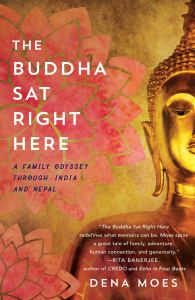
Dena Moes’s new memoir “The Buddha Sat Right Here” now available for pre-order!

Dena Moes’s exciting new memoir is now available for pre-order

Dena Moes is a Hollywood-born, Yale-educated midwife with a BA in literature and an MS in Nursing. Dena and her family live in Chico California but leave town each summer to attend Rainbow Gatherings and Burning Man, and tour the West Coast festival circuit as the Moes Family Band. They always come home in time for school to start – except in 2014, when they set off for India and Nepal. The Buddha Sat Right Here is Dena’s first book.  On the memoir, Rita Banerjee writes:

“The Buddha Sat Right Here redefines what memoirs can be.  Moes spins a great tale of family, adventure, human connection, and generosity.”

Book Riot: Christina M. Rau Recommends CREDO: An Anthology of Manifestos and Sourcebook for Creative Writing

In Book Riot‘s “2 Contemporary Books to Get You Writing,” poet Christina M. Rau reviews and recommends Rita Banerjee and Diana Norma Szokolyai’s craft of writing book CREDO: An Anthology of Manifestos and Sourcebook for Creative Writing (C&R Press, May 2018).  In the review, Rau writes:

CREDO offers a more in-depth swell of writing craft.

For writers who want motivation by way of the profound, this anthology offers philosophical essays about writing. These essays address why we write and how we write creatively. The philosophy behind building the craft appears as a way to urge writers to hone their own skills.

For writers who are looking to be inspired by the creative writing of others, there are literary snippets. Read a poem by Camille Rankine. Read some prose by Caitlin Johnson. Then write your own poetry and prose.

For writers who want a more pragmatic approach, creative writing exercises also appear. These are prompts in various genres available to any writer looking to write in any way.  Both You/Poet and CREDO urge writers to continue to create through writing.”

You can read the full review of CREDO  on Book Riot here.

The Quarterly Conversation: Pauline Jansen van Rensburg reviews Echo in Four Beats

South African novelist and essayist Pauline Jansen van Rensburg reviews Rita Banerjee’s debut poetry collection Echo in Four Beats for current issue of The Quarterly Conversation.  In her review, she writes:

“Rita Banerjee´s debut poetry collection, Echo in Four Beats, published by Finishing Line Press, is a modern feminist re-interpretation of the myth of Echo and Narcissus from Ovid´s Metamorphoses. Echo in Four Beats performs at the intersection between classical Greek and Indic myth, gender politics, political oppression, Vedic and Buddhist philosophy, and deeply personal narratives through verse redolent with tonal originality. The collection is not exclusively centered on the rampant narcissism of our times, nor is it just an appeal to reclaim an authentic female narrative free of patriarchal heteronormative echoes—its contemporary topical significance also lies in its rally against the discourse of capitalistic ideologies and the damaging heritage of colonisation. The collection encourages the reader to ponder the transformative and transcendental power of art and spiritual consciousness.

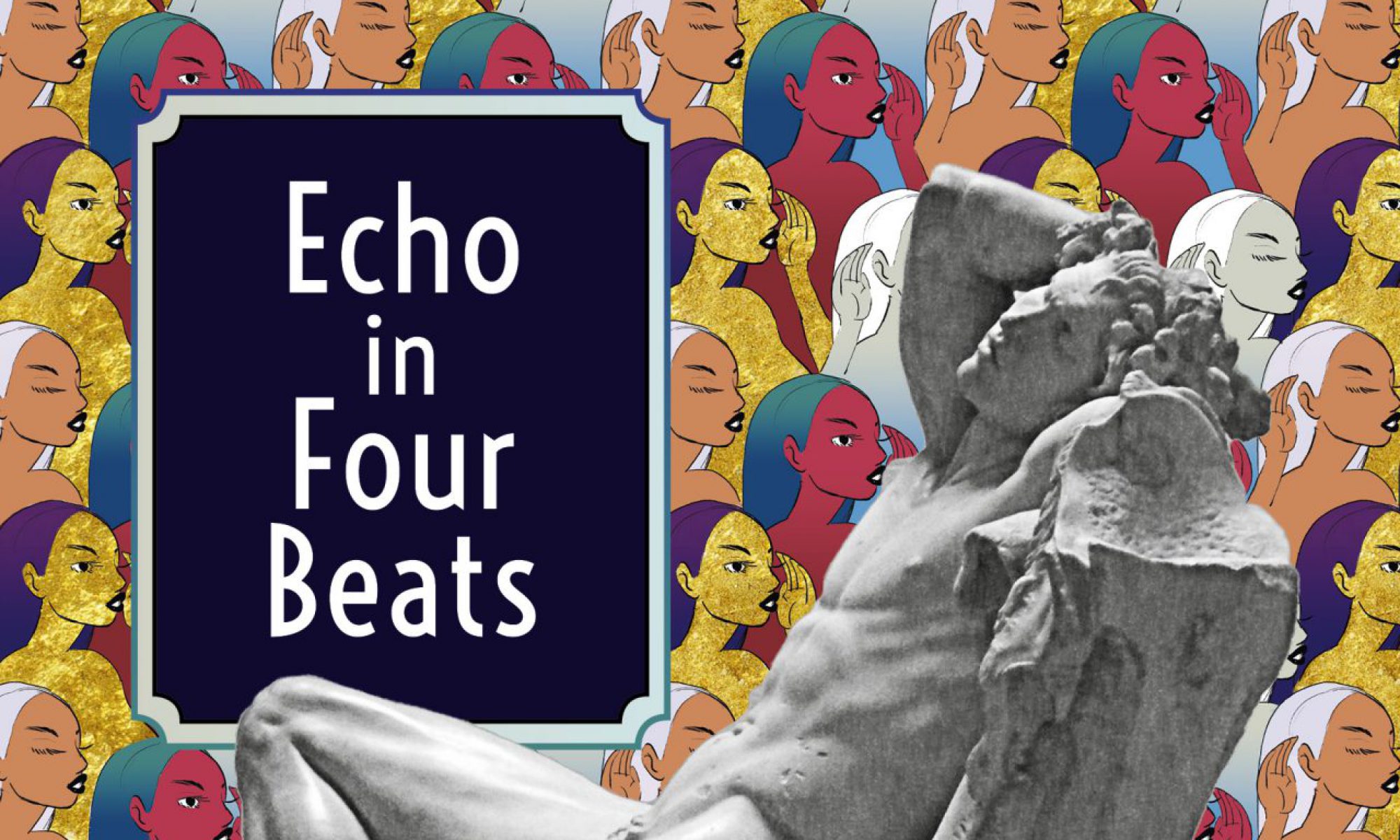
The title Echo in Four Beats alludes to the Greek myth and references the four distinct waves of feminism that have culminated into a global crescendo today. Hence, the fourth beat may be perceived as analogous with the fourth wave of feminism, which promises to become more intersectional, more open to debate, and more transformative than precedent waves. The cover is suggestive of The Women´s March in Washington, DC. It depicts a crowd of women cupping their hands to their mouths to enunciate and receive wisdom back. The women move and surround a reclining Satyr, the infamous Barberini Faun, from the entourage of the God of Ecstasy, Dionysus, who is narcissistically confident in his lascivious abandon and powerful aesthetic beauty. He is seemingly oblivious to the throngs of what could be revolutionary women around him, uniting to take back the mic and reclaim their own voices.

The fundamental Vedic and Buddhist religious concept of Saṃsāra, a Sanskrit word meaning ‘wandering,’ and denoting a spiritual journey towards enlightenment through the cycle of life-death-rebirth, acts as a blueprint for the structure of the collection. It transposes onto the first three beats, which correspond with: Brahma and creation, Vishnu as the preserver or sustenance in the second beat, and Shiva, the destroyer and destructive transformation in the third beat. The fourth beat explores what liberation from this cycle of creation, sustenance and destruction might look like and the poem ‘Beyond Saṃsāra’ ironically suggests the possibility of women regaining their freedom from past destructive cycles.”

Read the full review of Echo in Four Beats on The Quarterly Conversation here.

Kendrick Loo reviews Rita Banerjee’s “Echo in Four Beats” for Singapore Unbound

In Singapore Unbound, author and critic Kendrick Loo of the University of St. Andrews reviews Rita Banerjee’s debut poetry collection Echo in Four Beats (Finishing Line Press, March 2018).  He writes:

When Sandra Gilbert and Susan Gubar published The Madwoman in the Attic in 1979, their focus on how women writers were limited by patriarchal stereotypes of female embodiment represented a landmark recognition that writing is hardly apolitical or objective. Decades on, we understand that canonical writing was formed by predominantly male ecosystem of publishers, translators, and critics. However, tension remains in how to deal with the problematic legacy that our literary forebears have left us—how do we acknowledge ‘canonical texts’ as meriting analysis, while simultaneously remembering and honoring those rendered invisible and pushed to the margins by the historical prejudice. Out of this quagmire emerges Rita Banerjee’s debut collection, Echo in Four Beats. A reflective book that questions the status of canonical writing, its multilingual intertextuality belies a poetic voice that dances between criticism and innovation of poetry to restore female voices to literary canon. Concerned with language as political signifier—which is to say how language connotes, inscribes, and affects how one is perceived—it retains a feminist approach to historical texts.

Subdivided into four sections, Echo in Four Beats is, as suggested by its title, concerned about the Ovidian myth of Echo and Narcissus. In the classic tale, Echo’s misfortune begins when she tricks the goddess Juno so that her sisters—who had slept with Juno’s husband, Jupiter—can escape. Cursed by Juno to repeat only the words of others as punishment, Echo later fails to approach Narcissus, a beautiful man Echo has admired from a distance but never spoken with. Terrified, Narcissus runs away from Echo while Echo herself wastes away from heartbreak, leaving only her voice behind. In Banerjee’s collection, this myth is visited in a poetic sequence titled “Creation Hymn,” “Sustenance Hymn,” and “Destruction Hymn,” where a process of erasure is enacted upon a translation of Ovid’s The Metamorphoses to create a personal version of events. This technical restriction enables Banerjee to honor and resist simultaneously the restraints that Juno imposed, while creating a lyrical and haunting voice that speaks for both poet and muse. The reader is rewarded with thematically resonant poetry that can be easily attributed to the original myth such as the following fragment from “Sustenance Hymn I”:

Her voice, her bones,
shapes of stone heard
by everyone: sound lives in her

Based on the titles alone, one might say that the process of creation and destruction is a kernel around which the collection is formed. However, the hymnal sequence is compelling for other reasons, namely that of transformation. Consider how the detachment of the sequence vanishes when one reaches the segment titled “Destruction Hymn I,” where the introduction of a first-person perspective creates a personal voice, breathing life into the poem. Its immediacy and intimacy signals that a female voice has been discovered, delivering retrospective justice to Echo who was consigned by Ovid to a mute end, embedded within and serving Narcissus’ larger narrative. Banerjee’s I retrospectively fulfills the promise raised by the very first section of the sequence, “Creation Hymn I”:

she, who cannot be
silent, might learn how
to speak first herself

The desire to amend history, therefore, is an impulse that the poetic voice of Echo in Four Beats keeps central to its work, emerging from the feminist recognition of the marginalization of women in literary works. However, Banerjee never loses control of her grasp for reinvention: in the opening poem of the book, “The moon had jackknifed,” Ovid’s myth is given a new ending. Banerjee describes via the use of past tense a man who dissolves into “a lovely blank” at the touch of the moon. Such evocative imagery strengthens the poetry, as it does in the lines “the orbs splitting yellow/ spoke of oblivion,/ his eyes glimmered,/ the moon understood.” By suggesting the contours of the original myth, Banerjee positions her collection as an alternative chain of events, picking up where Ovid leaves off when the male figure fades away.

Nonetheless, Banerjee does not limit herself to interacting with creative works solely inspired by the myth of Narcissus and Echo. Echo in Four Beats is redolent with rich allusions to a wide range of writers and artists. The poem “Please Listen and Do Not Return,” for instance, critiques F. Scott Fitzgerald and John Steinbeck for their female characters, who are conceived as extensions of desire and utility to the narrative’s male protagonists. The title therefore is a blunt warning not to repeat the mistakes of these protagonists, situating the poem as a post-script to the original works. Yet, one might wonder why Banerjee engages in intertextuality and ekphrastic writing. This question is answered in Banerjee’s collection by a poem called “The Figure,” which asserts that despair results from the desire to quantify things that exist beyond our capacity for description. Instead of starting with a question that would premise, and therefore demarcate understanding, the persona of the poem singles out the act of enlightenment:

I only understood by casting you
first in flesh, then in clay,
and finally in frail, sea-water words.
You tendered there—
adrift on the tide

This process of creation in reverse, from flesh to water, generates solace while never revealing what the narrator knows. Only the foreword, with a line by the Japanese literary figure Jun-ichirō Tanizaki (“We find beauty not in the thing itself/ but in the patterns of shadows”), and a line on the repairing of old wounds (“…heal the lines/ between blue and continent”), suggests that the original question is about beauty and meaning that cannot be quantified by categorization and description. This explains why the poem quoted above focuses on the growing transience of the figure’s form, instead of explaining the figure’s gradual dissolution. Only by creating, not explicating, can the speaker grasp an elusive meaning.

The focus on blurring and subverting boundaries is why praise for Echo in Four Beats focuses on the “post-national” nature of the collection. In the second and third sections of the collection, for example, a large number of poems deal with foreign travel, going beyond America to engage with nations such as India or Japan. Some of these poems take a step further into the conceptual realm, when Banerjee translates into English a poem first written in another language by her own hand. These poems—namely “A Water’s Sound” and “One Night”—position Banerjee in the dual role of poet and translator, inviting us to consider how translation and writing are closely intertwined. While the work of the original poet is crucial, the inclusion of both translated and non-translated versions of the same poem makes the argument that lacking translation, we lose not only the basic contents of the poem but also the nuanced explanations of cultural signifiers and references that exist only in the original language. Some slippage is of course inevitable, but Banerjee reminds us that there is still value in attempting to translate.

Read the full review of Echo in Four Beats  on Singapore Unbound here.

Rita Banerjee’s Echo in Four Beats Reviewed on Yellow Rabbits

Greg Bem, curator of Yellow Rabbits, reviews Rita Banerjee’s debut poetry collection Echo in Four Beats (Finishing Line Press, March 2018).  In the review, Bem writes:

For every moving shade,
there was a jewel,
a bunt cake,
tea with honey,
rubies, too,
found them dead in a village
near the Ganges,
in some bastard king’s chest

(from “Pygmalion & the Slippers”)

At its core, the Echo in Four Beats is about Ovid’s myth of Echo and Narcissus, which serves as a fitting allegory for poetry in general, but also the landscape previously-described. A dualism within the speakers of these poems is a dualism of acceptance and rejection, of sequences of flight and iterations of home…


We were like that—lanterns in the midday sun,
laughter against a white-noise wind, tongues
circling salt-water stories, cliffs cocooned by the afternoon, cameras
catching harbor fish, reptiles, serpents, impossible possibilities–

(from “Atlantis”)

Much of the experience where these transformations are derived, carried by the mythic allegories the poet’s subtle adaptations of ancient lessons, is tangibly encountered in place and culture. While the back cover of Echo in Four Beats contains a quote by Jaswinder Bolina describing the book as “post-national,” I believe the antithesis is far more obvious. This is a book collecting poems that encounters and elevates individual nations, individual cultural histories, and appreciates them through their intertwining. In the ways the otherness in Echo and Narcissus is an otherness of affection and difference, so too is the distinct origins of the spaces and roots presented in this book.

Read the full review of Echo in Four Beats on Yellow Rabbits here.

Book Riot’s Must-Read Poetic Voices from Split This Rock 2018 feat. Rita Banerjee’s Echo in Four Beats

Poet Christina M. Rau reviews the “Must-Read Poetic Voices from Split This Rock 2018” on Book Riot and features Rita Banerjee’s new poetry collection Echo in Four Beats (Finishing Line Press, March 2018).  She writes:

Split This Rock is an organization that “celebrates poetry that bears witness to injustice and provokes social change.” Every two years, they host a festival. This year, I was fortunate enough to attend its readings, workshops, and panels. In the tumultuous socio-political landscape of the United States today, poetry filled the air in DC. Voices rang out, speaking to a vast array of issues. Here are some of the voices we should be paying close attention to.

On my own panel, “Fantasy as Reality: Activism and Catharsis through Speculative Literature,” I was fortunate enough to sit beside Marlena Chertock and Rita Banerjee. Chertock uses her experience with skeletal dysplasia as a bridge to science writing. She spoke of a project she’s currently working on about imaging the future during climate change. Her current collection that includes a proposed application to NASA is Crumb-Sized: Poems. Banerjee’s work comes from a slant of decolonization and celebrating diverse writers. Echo In Four Beats is her latest project that re-imagines mythologies through language and power shifts.

This small round-up of voices is only a fraction of what Split This Rock had to offer. Line after line, moment after moment, action unfolded through poetry and then a literal walk to the White House in support of students protesting against gun violence. Reading these collections is one way to start to see a bigger picture of who we are as citizens of the world. That’s a great way to keep alive the conversations that began and continued at this festival.

Read the whole article on Book Riot here.

“Tongue Circling Stories” – Emily Shearer reviews Echo in Four Beats for Minerva Rising

Emily Shearer, Poetry Editor for Minerva Rising Press, reviews Rita Banerjee’s debut poetry collection Echo in Four Beats  on Minerva Rising.  In her review, entitled “Tongue Circling Stories: A Book Review of Echo in Four Beats by Rita Banerjee,” Shearer writes:

If you have been waiting for sounds to fall from Echo’s lips and stir you to wakefulness, do not wait until after tomorrow. Banerjee is here with a rallying cry to carpe the f*ck out of this diem. “There were no tomorrows left anymore,” she warns in “Après-demain,” and “. . . there isn’t a story i haven’t believed in,” from “Paper Men.”

Jaswinder Bolina, author of The 44th of July, Phantom Camera, and CarrierWave, has called this book “the first truly post-national book of poems [he’s] ever read.”

Banerjee’s scope is wide, and her reach does not exceed her grasp. While she looks for home, characterized as nothing more than a “constant state of momentary arrivals*,” she dwells in ocean, in moonlight, in making love to Thanatos as a lover worships the body next to her in bed. She explores the realms of water, whether shipwrecked Atlantis or sound inside a leaf-grown well. She revels in the oop! and wop of a didgeridoo and regales in the language of Hindu gods, Japanese frogs, and those the world over whose tongues circle the stories of these poems, “ready for what / it will allow: / to wait for sounds.”

Read the full review of Echo in Four Beats  here.