
South Asia and Theories of the Avant-Garde: The International Scope of South Asian Literary Modernisms – September 24

KavitaA Lecture by: Dr. Rita Banerjee
Institut für Indologie und Tibetologie
Ludwig-Maximilians-Universität München

Rutgers University
Thursday September 24, 2015
Reception 4:30 p.m. – Lecture 5:00 p.m.
Alexander Library, Pane Room

169 College Avenue, New Brunswick, NJ 08901

RBThis presentation will highlight the role that translation and multilingualism played in opening up discussions and theories of modernism within the South Asian literary canons of Bengali, Hindi, and English in the early to mid-20th century. The lecture will explore the representations and international scope of literary modernisms in journals such as Kallol, Kavitā, and Krittibās in Bengali, the Nayī Kavitā journal and the Tār Saptak group in Hindi, and the Writers Workshop group in English. Theories of modernism as proposed by critics such as Dipti Tripathi and Acharya Nand Dulare Bajpai will be contrasted with manifestos of modernism, with Agyeya’s defense of experimentalism (prayogvād), with theories of translation as proposed by Bhola Nath Tiwari, and with translations of foreign writers and aesthetic forms. In doing so, the presentation will note how the study of modernist practices, translation, and theory in Bengali, Hindi, and English provides insight into the pluralistic, multi-dimensional, and ever-evolving cultural sphere of modern South Asia beyond the suppositions of postcolonial binaries and monolingual paradigms.

Sponsored by: Program in Comparative Literature • South Asian Studies Program •
Department of African, Middle Eastern, and South Asian Languages and Literatures •
Office of the Dean of Humanities and Office of Undergraduate Academic Affairs, School of Arts and Sciences

The Brooklyn Book Festival presents New York’s Exciting New Voices – September 20

BBF-NewYorksExcitingNewVoices2015The Brooklyn Book Festival in collaboration with the Cambridge Writers’ Workshop is proud to announce New York’s Exciting New Voices, a Brooklyn Book Festival Bookend Reading at Muchmore’s (located at 2 Havemeyer Street, Brooklyn, NY) on Sun September 20 from 7 – 9 pm.

The event will be moderated by Diana Norma Szokolyai and features writers Rita Banerjee, Jonah Kruvant, Brandon Lewis, Elizabeth Devlin, Lisa Marie Basile, Gabriella Rieger Lapkoff, Jessica Reidy, Gregory Crosby, Matty Marks, and Emily Smith.  Enjoy a drink and a bite to eat in the heart of Williamsburg as you hear from some of New York’s most exciting, new voices, many of whom are faculty members for the Cambridge Writers’ Workshop.  The Brooklyn Book Festival is the largest free book event in New York City and presents established as well as emerging writers each year.  The Bookend Events kick off the week’s festivities each year with literary themed events at clubs, bookstores, parks, etc.  More information is available at cww.nyc

The Monarch Review features Rita Banerjee’s poems “Please Listen and Do Not Return” and “Storyteller”

MonarchReviewThe current issue of The Monarch Review, Seattle’s literary and arts magazine, features two new poems by Rita Banerjee, “Please Listen and Do Not Return” and “Storyteller.”  The poems are inspired by Nick Carraway, Tom Joad, and Gloria Rich, respectively.

Rita Banerjee is a writer, and received her PhD in Comparative Literature from Harvard University.  She holds an MFA in Creative Writing and her has been featured in VIDA: Women in Literary Arts, Riot Grrrl Magazine, Poets for Living Waters, The Fiction Project, Jaggery, The Crab Creek Review, The Dudley Review, Objet d’Art, Vox Populi, Dr. Hurley’s Snake-Oil Cure, Chrysanthemum, and on KBOO Radio’s APA Compass in Portland, Oregon. Her first collection of poems, Cracklers at Night, received First Honorable Mention for Best Poetry Book at the 2011-2012 Los Angeles Book Festival. She is Executive Creative Director of the Cambridge Writers’ Workshop.

Riot Grrrl Magazine features Rita Banerjee’s “Pygmalion & the Slippers” and “Currency”

RiotGrrrlMagazineThe current issue of Riot Grrrl Magazine features two new poems by Rita Banerjee, “Pygmalion & the Slippers” and “Currency.” 

Riot Grrrl Magazine is named after the feminist punk rock movement that began in the early 1990s.  The magazine is meant to show an appreciation for the community of women who raised their voices about gender equality, abuse and other complex issues, especially within the music scene.  The mission of the magazine is to provide entertaining and engaging content, and reflect diverse narratives.  Riot Grrrl Magazine is here to empower diverse audiences. The magazine strives to create a space for women of color, trans women, queer women, and disabled women.

Shakespeare and Company Reading, Paris – July 23, 2015

The Cambridge Writers’ Workshop is proud to announce that we will be hosting Guggenheim Fellowship and two time NEA fellowship recipient David Shields for a reading at Shakespeare and Company Bookstore in Paris. The reading will take place as part of our Summer in Paris Writing Retreat on Thursday July 23, 2015 from 7 p.m. – 8 p.m.  Rita Banerjee will introduce and moderate the event, which will feature David Shields and his French translator, Charles Recoursé, performing the dialogue of Shields and Caleb Powell from I Think You’re Totally Wrong: A Quarrel.  The performance will be followed by a discussion of collage and the literary essay by Shields and Recoursé, followed by a Q&A portion, which will be lead by Diana Norma Szokoloyai.

David Shields is the author of Reality Hunger (named one of the best books of 2010 by more than thirty publications), The Thing About Life Is That One Day You’ll Be Dead (New York Times bestseller), Black Planet (finalist for the National Book Critics Circle Award) and I Think You’re Totally Wrong (released this year alongside a film directed by James Franco). Shields’ work has been published in the New York Times Magazine, Harper’s, Esquire, Yale Review, Village Voice, Salon, Slate, McSweeney’s, and Believer.

Shakespeare and Company became the “literary culture in bohemian Paris” after it was opened by George Whitman in 1951. The English-language bookstore was frequented by many Beat Generation poets like Allen Ginsberg and William S. Burroughs, as well as other writers like Anaïs Nin and Henry Miller. The bookstore regularly hosts poetry readings and houses young writers.

To apply for the Summer in Paris Writing Retreat (July 22-30, 2015), visit cww.submittable.com and send an application by May 25, 2015.

Screening of Ramesh Sippy’s Sholay – July 16

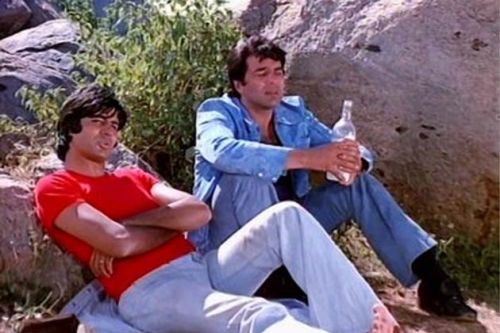
SholayRita Banerjee will introduce and lead the discussion for Ramesh Sippy’s 1975 film, Sholay, on Thursday July 16 from 6-8:30 pm for the Institute for Indology and Tibetology at Ludwig-Maximilians-Universität München.  The screening is part of the course Modernity and the South Asian Imaginaire at LMU.  Anyone interested in Modern South Asian literature, history, or art house film is welcomed to join the screening.

This 1975 film provides a superb look at popular Hindi cinema. Although it can be called an adventure, it has a spaghetti-western storyline, martial-arts sequences, comedy, soap-opera melodrama, and even musical numbers, including an early scene that has the two main characters riding a motorcycle and singing like Elvis Presley in the carnival flick, Roustabout. The film itself is indeed a carnival, and many of the features produced by India’s popular movie industry exhibit a similar mixture of ingredients in an attempt to meet the audience’s every possible expectation. Veeru (Dharmendra) and Jaidev (Amitabh Bachchan) are two small-time troublemakers who, in the past, have run afoul of Thakur Baldev Singh (Sanjeev Kumar); the Thakur, a former law officer, has seen the pair’s heroic nature despite their criminal ways. When a gang of bandits led by Gabbar Singh (Amjad Khan) murders the Thakur’s family and cuts off his arms, rendering him helpless rather than killing him, he enlists Veeru and Jaidev to help him seek revenge. In the Thakur’s rural village, the two bandits find romance and a hope for redemption and seek to free the village from Gabbar and his minions. The massive appeal in India of films like Sholay becomes evident; surprisingly, it succeeds in almost every genre it attempts to play. ~ Jonathan E. Laxamana, Rovi

Screening of Stephen Frears and Hanif Kureishi’s My Beautiful Laundrette – July 9

my-beautiful-laundrette-06-gRita Banerjee will introduce and lead the discussion for Stephen Frears’s 1985 film, My Beautiful Laundrette, on Thursday July 9 from 6-8:30 pm for the Institute for Indology and Tibetology at Ludwig-Maximilians-Universität München.  The screening is part of the course Modernity and the South Asian Imaginaire at LMU.  Anyone interested in Modern South Asian literature, history, or art house film is welcomed to join the screening.

My Beautiful Laundrette, written by Hanif Kureishi and directed by Stephen Frears, is the first real sleeper of 1985. The film is a rude, wise, vivid social comedy about Pakistani immigrants in London, , particularly about the initially naive, university-age Omar (Gordon Warnecke) and Omar’s extended family of wheeler-dealers and unassimilated layabouts.   ”Take my advice,” says Omar’s Uncle Nasser (Saeed Jaffrey) early in the film, ”there’s money in muck.” Omar heeds his uncle and enlists the aid of Johnny (Daniel Day Lewis), a Cockney mate from his school days. Together, Omar and Johnny set out to revitalize ”Churchill’s,” a failing laundromat, owned by Nasser, in a seedy section of London where enthusiastic, hustling immigrants are at odds with alienated, disenfranchised natives. Like the film itself, the relationship between Omar and Johnny is not quite as simple as it initially seems. Both men are outsiders. In the years since he and Omar were first friends, Johnny has drifted from one jobless limbo to the next. When Omar meets him again, Johnny is affecting a punk haircut and, with his pals, bashing Pakistanis, mostly because there’s nothing better to do.   It gradually becomes clear why Johnny has agreed to give up his street life to join Omar, who, being a Pakistani, isn’t easily explained to his Cockney pals. Johnny is bored with his own aimlessness. He never quite admits it, but he’d like to get ahead in the world. Further, and most important, he’s in love with Omar, something that Omar responds to and, like the hustler he’s becoming, uses to his own advantage. ~ Vincent Canby, The New York Times.

An Evening with Peter Orner – June 30

peter-ornerAn Evening with Peter Orner
Moderated by Rita Banerjee
The Munich Readery * 8:00 – 9:00 pm
Augustenstr. 104, Munich, Germany

The Munich Readery is proud to host Guggenheim fellow and American fiction writer, Peter Orner on Tuesday June 30 for “An Evening with Peter Orner.”  Orner be reading from the novel Love and Shame and Love as well as from the story collection, Last Car Over the Sagamore Bridge.  “I am very happy about coming back to Munich, a city I’ve always admired for its sense of calm, its architecture, food, and kind people. It’s a city I also love to wander around in and have been happily lost on its streets a number of times….” – Peter Orner

Peter Orner is an American writer and the author of four books of fiction. His first book, Esther Stories was a Finalist for the Pen Hemingway Award and Winner of the Rome Prize from the American Academy of Arts and Letters, and has been recently re-issued with a new introduction by Marilynne Robinson. His novel, The Second Coming of Mavala Shikongo, set in Namibia, has been translated widely, including in German by Hanser. Love and Shame and Love, Orner’s second novel, has also recently been published in German by Hanser. Orner’s most recent book, a collection of stories, Last Car Over the Sagamore Bridge was named a New York Times Editor’s Choice Book last year. Orner has also published two books of non-fiction, a book on immigration in the U.S. and another about political violence in Zimbabwe. Orner is a Guggenheim Fellowship recipient, and has taught at The University of Iowa Writers’ Workshop, Bard College, The University of Montana, and teaches in the MFA Program at San Francisco State University. He lives in Bolinas, California where he is a proud member of the Bolinas Volunteer Fire Department.

Guest Lecture: The Rāmāyaṇa as Speculative Fiction by Anil Menon – June 17

BreakingtheBowSouth Asian Science-Fiction writer Anil Menon will give a special guest lecture on “Rendevous with Rama: The Rāmāyaṇa as Speculative Fiction” in Rita Banerjee’s course Modernity and the South Asian Imaginaire.  The lecture will take place on Wednesday June 17 from 12-2 pm at the Institute for Indology and Tibetology at Ludwig-Maximilians-Universität München in Seminar Room 427 (Ludwigstr. 31, Munich).  The lecture is part of the course Modernity and the South Asian Imaginaire at LMU.  Anyone interested in Modern South Asian literature, history, or art house film is welcomed to join Menon’s special guest lecture.

Rendezvous With Rama: The Rāmāyaṇa as Speculative Fiction

In speculative fiction, a story’s context is also a part of the story, and when writing speculative fiction, an author can play with many other contexts as well: political, psychological, social, anthropological, historical, ethical, and so on.  Speculative fiction is thus a literature of ambiguity, interpretation, and surprise.  In this talk, we’ll examine the Rāmāyaṇa (mainly, Valmiki’s version) and see if it can be characterized as speculative fiction. As Naiyar Masud’s story “Sheesha Ghat” illustrates, it can be tricky to make these decisions. At the other end of the spectrum, we have “The Jaguar’s Wife,” a narrative with rather improbable events, but which insists on being read as a realist tale. Between the stuttered speech of Masud’s child protagonist and the multitude of voices in “The Jaguar’s Wife,” may be positioned the silent lonely figure of Lord Rama, the man devoted to moral action. I’ll argue that it is in playing with the contextual assumption that Text (words, laws, rules,…) can represent the actual world, that the Rāmāyaṇa becomes a work of speculative fiction.

AnilM15Anil Menon’s short fiction has appeared in a variety of magazines and anthologies including Albedo One, Interzone, Interfictions, Jaggery Lit Review, LCRW, Sybil’s Garage, and Strange Horizons. His stories have been translated into Chinese, French, German, Hebrew and Romanian. His debut novel The Beast With Nine Billion Feet (Zubaan Books, 2010) was short-listed for the 2010 Vodafone-Crossword award and the Carl Brandon Society’s 2011 Parallax Award. Along with Vandana Singh, he co-edited Breaking the Bow (Zubaan Books 2012), an anthology of speculative fiction stories inspired by the Ramayana. He has a forthcoming novel Half Of What I Say (Bloomsbury, 2015). He can be contacted at iam@anilmenon.com.

Screening of Satyajit Ray’s The Zoo – June 16

Ciriyakhana2Rita Banerjee will introduce and lead the discussion for Satyajit Ray’s 1967 film, The Zoo (Ciṛiẏākhānā, চিড়িয়াখানা), on Tuesday June 16 from 6-8:30 pm for the Institute for Indology and Tibetology at Ludwig-Maximilians-Universität München.  The screening will take place in Seminar Room 427 (Ludwigstr. 31, Munich).  The screening is part of the course Modernity and the South Asian Imaginaire at LMU.  Anyone interested in Modern South Asian literature, history, or art house film is welcomed to join the screening.  Satyajit Ray’s Ciṛiẏākhānā (The Zoo) is a detective film based on the famous crime novel of the same name by Saradindu Bandopadhyay. It features the detective Byomkesh Bakshi, and the zoo in question isn’t literally a zoo; just a flower-cum-dairy-cum-poultry farm called Golap Colony, which is inhabited by a very odd assortment of outsiders and outcasts. The founder of Golap Colony is Nishanath Sen (Sushil Majumdar), a judge who retired 10 years earlier at the age of 47, after being told by his doctor that his high blood pressure could drive him into an early grave. On a rainy day, with trams going by in the street below, Mr Sen comes to visit Byomkesh Bakshi (Uttam Kumar) at his flat. The room where he’s received is crowded with symbols of Byomkesh’s eclectic interests: a skeleton, a baby python, books, a cluttered desk with a soft board above it on which are pinned various phrases written in Bengali and English. Also, staying with Byomkesh at present is his friend and chronicler (“Your Dr Watson?” says Mr Sen), Ajit (Shailen Mukherjee). Mr Sen, having introduced himself and told Byomkesh about Golap Colony, gives a hint of why he’s come. Mysterious incidences have been happening at the Golap colony which Mr. Sen wants the famed detective Byomkesh Bakshi and his assistant Ajit to solve. But Mr. Sen is troubled by another, stranger problem: there’s an old Bengali movie song, Bhalobashar tumi ki jaano (“What do you know of love?”) that haunts him, as does the disappearance of the actress who originally sang it. – Madhulika Liddle