Disobedient Futures Anthology – Open for Submissions

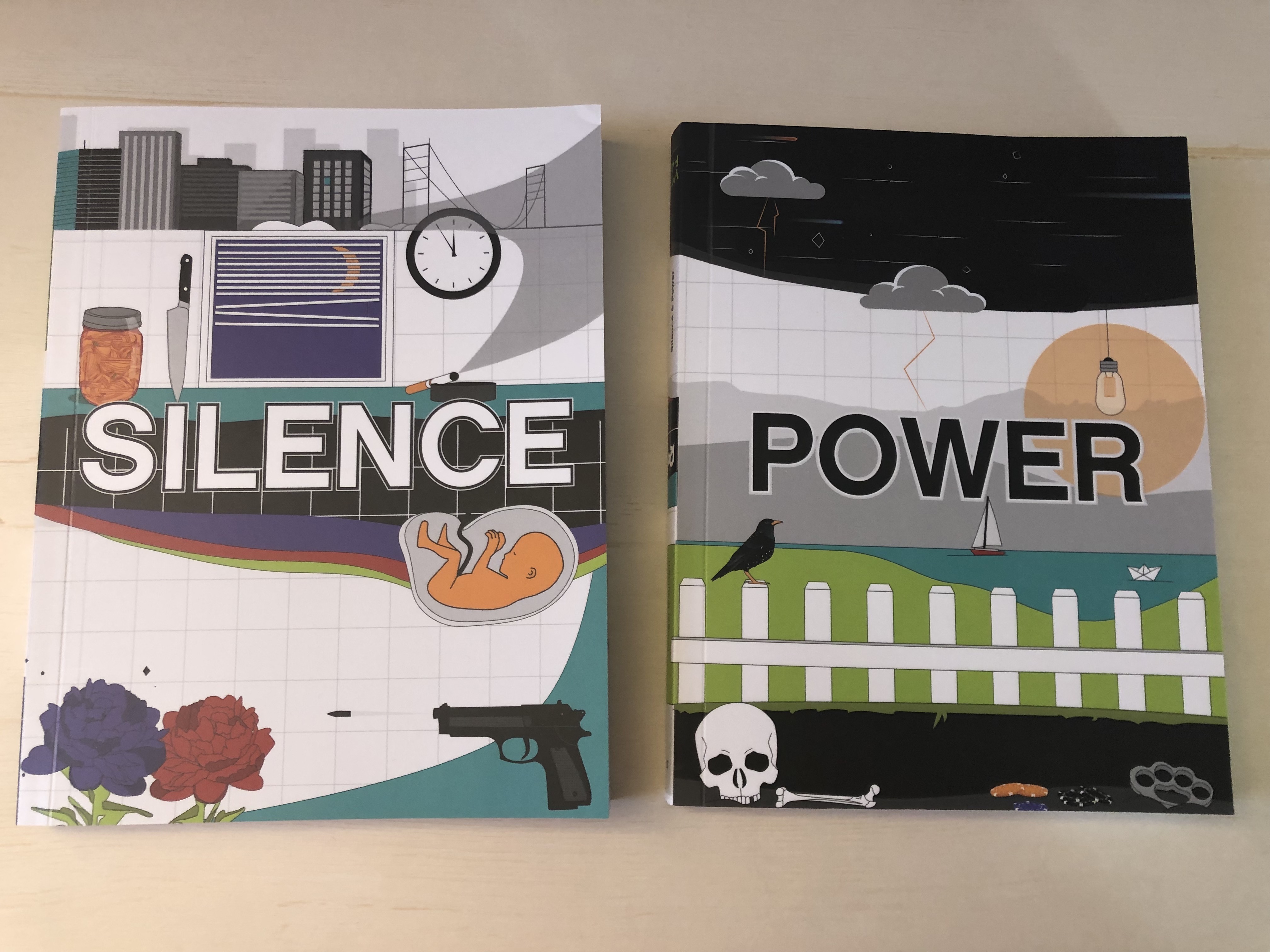
Rita Banerjee and Diana Norma Szokolyai will be editing Disobedient Futures, a new speculative literature and art anthology by the Cambridge Writers’ Workshop, which is now open for submissions until February 14, 2019!

Cambridge Writers’ Workshop welcomes submissions of poetry, fiction, nonfiction, mixed-genre work, plays, and screenplays on the topic of “Disobedient Futures” for our new speculative literature anthology. Writers are encouraged to imagine what the future cultures of America and the world might look like, and submit their work on the following topics:

Disobedient Women: How might women, feminists, female-identifying, and/or non-binary individuals disobey and reconfigure our understandings of power and femininity and masculinity in the future?

Disobedient Tribes: What if Americans found a way to subvert racial categories and challenge tribalism and cultures of fear? How might tribes disobey the rules of the game and create new types of community identities and cultural bridges?

Disobedient Class: Could Americans in the future overcome systems of class oppression and capitalist gluttony? How might individuals in the future subvert class hierarchies?

Disobedient Futures: Tell us what the future cultures of America and the world have in store. How might the emerging generations of today and tomorrow reconfigure today’s value systems, challenge today’s modes of violence, oppression, and power, and create new visions of society? Give us your best speculative writing which explores the possibilities and disruptions of disobedient futures.

Writers are welcome to submit utopian, dystopian, parallel history, futuristic, alternative reality, speculative essay, and even purely speculative fiction, nonfiction, poetry, and theatre. Optimistic and pessimistic tales of the future are welcome in equal measure, but gratuitous violence and discrimination are not. Poetry submissions should be 3-5 pages in length. Prose submissions can be 10-20 pages in length.  Excerpts from longer works with synopses are welcome. Visual art related to these categories of Disobedient Futures is also welcome.  Submit your retelling of the future today!

Submit your work at cww.submittable.com
Deadline: February 14, 2019
Rita Banerjee’s Hindi / English poem “One Night” (एक रात में) feat. on Soundcloud

Rita Banerjee’s Hindi poem, “एक रात में” (“Ek Rāt Meṃ,” “One Night”) is now available for streaming through Tahoma Literary Review‘s Soundcloud.  You can listen to the original Hindi and English translation of the poem here.  A copy of the Hindi poem follows below:

एक रात में

मैंने एक रात बािरश के हाज़ार नाच सुने
चूड़ी की तरह आकाश टुकड़े टुकड़े हो गया
गली के आइने में पृथ्वी उलटी लगी
पानी के िहलने से सब दुिनया बदलने लगी
और मेरी तस्वीर भी दूसरी हो गई
चारों तरफ़ आकाश के नाच में
असली दुिनया नक़ली लगने लगी
और पानी के एक एक टुकड़े में
चाँद हँस रहा था।

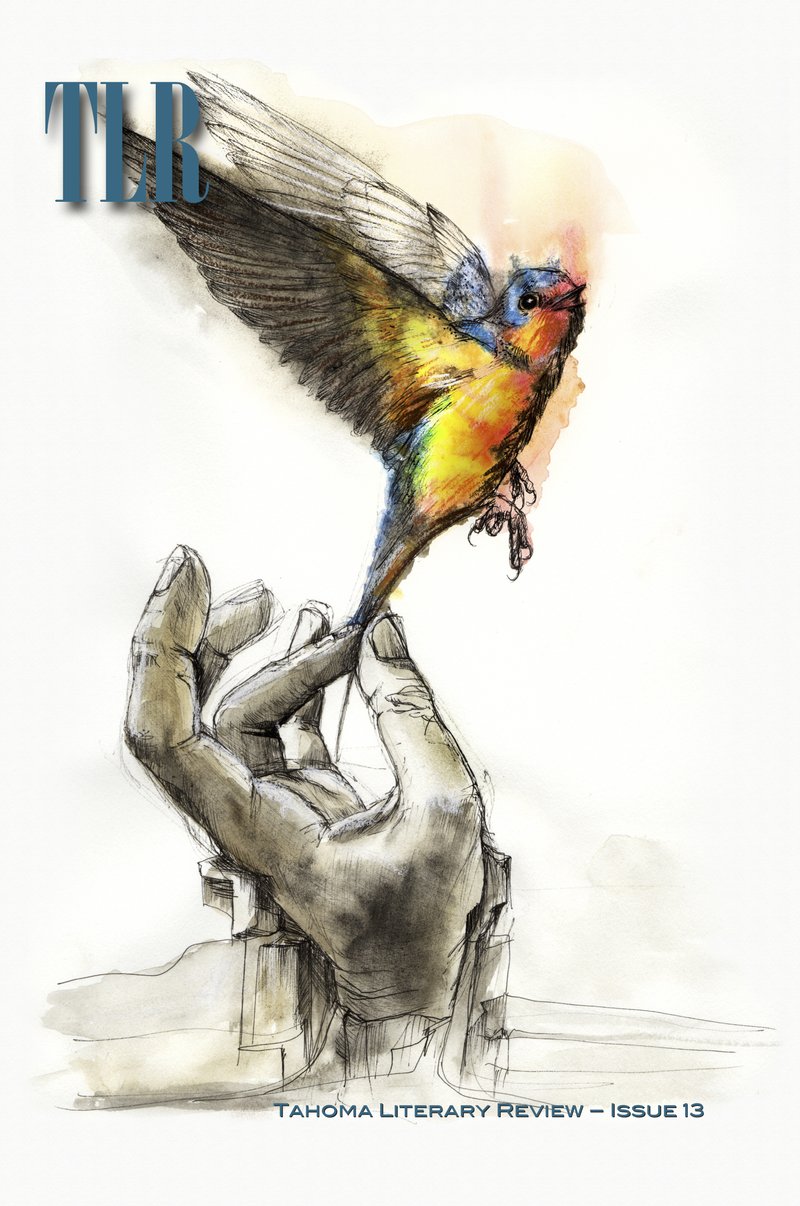
Banerjee’s Hindi / English poem “One Night” (एक रात में) is featured in Issue 13 (December 2018) of the Tahoma Literary Review.  You can order a copy of Issue 13 of The Tahoma Literary in print or on Kindle.

Rita Banerjee will judge the 2019 Spider Road Press Flash Fiction Prize

Rita Banerjee will judge the 2019 Spider Roard Press Flash Fiction Prize.  Spider Road Press is proud to sponsor the annual Spider’s Web Flash Fiction Prize to recognize unpublished flash fiction featuring a complex, female-identifying protagonist! Entries to the 2019 Spider’s Web Flash Fiction Prize will be accepted from February 17, 2019 to May 17, 2019. The contest is open to writers of all genders.  Writers can begin submitting their Flash Fiction entries to the contest on February 17 at: https://spiderroadpress.submittable.com/submit

About the Judge:

Rita Banerjee is the Director of the MFA in Writing & Publishing program at the Vermont College of Fine Arts.  As a writer, she is the co-editor (with Diana Norma Szokolyai) of CREDO: An Anthology of Manifestos and Sourcebook for Creative Writing (C&R Press, May 2018), and the author of the poetry collection Echo in Four Beats (Finishing Line Press, March 2018), which was named one of Book Riot’s “Must-Read Poetic Voices of Split This Rock 2018”, was nominated for the 2018 Kate Tufts Discovery Award, and was selected by Finishing Line Press as their 2018 nominee for the National Book Award in Poetry.  Banerjee is also the author of the novella “A Night with Kali” in Approaching Footsteps (Spider Road Press, 2016), and the poetry chapbook Cracklers at Night (Finishing Line Press, 2010).  As a filmmaker, she is the co-writer and co-director (with David Shields) of Burning Down the Louvre (April 2019), a documentary film about race, intimacy, and tribalism in the United States and in France.  Her work appears in Poets & Writers, Nat. Brut., Hunger Mountain, and elsewhere.  Her writing is represented by literary agents Jeff Kleinman and Jamie Chambliss of Folio Literary Management.

Rita Banerjee’s Hindi / English poem “One Night” (एक रात में) feat. in the Tahoma Literary Review

Rita Banerjee’s Hindi poem, “एक रात में” (“Ek Rāt Meṃ,” “One Night”) is featured in Issue 13 (December 2018) of the Tahoma Literary Review.  You can order a copy of Issue 13 of The Tahoma Literary in print or on Kindle.  On the poem, Banerjee writes:

“When I was a Visiting Scholar at UC Berkeley and working on my dissertation on South Asian literary modernisms, I took a wonderful Hindi Literature and Language course with the unforgettable Usha Jain.  In class, we read satirical and socially and psychologically subversive works by Premchand and Sa’ādat Hasan Manto in their original Hindi and in Hindi translation from Urdu. During class, Usha Jain encouraged us to write poems, essays, and stories, in Hindi, too. This poem, “One Night,” is meant to be a nod towards the dark humor Premchand and Manto espoused, especially during troubled times.”

You can read more about the featured poem here.

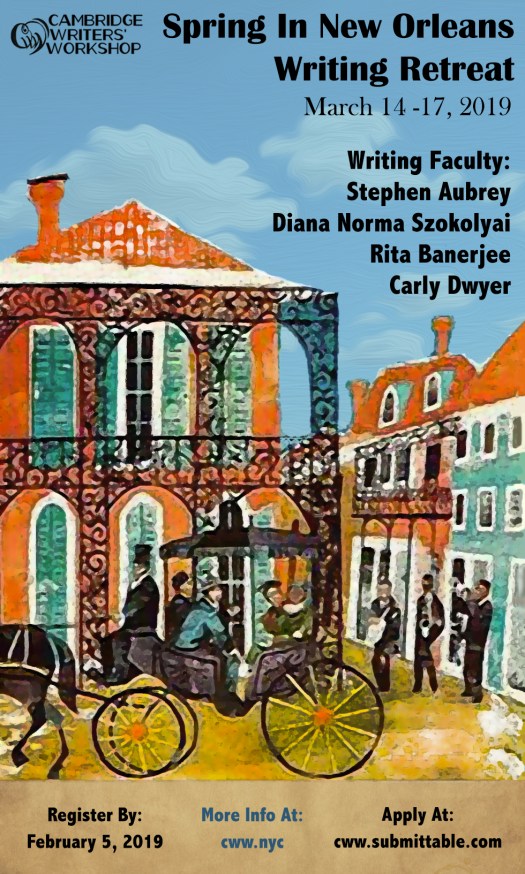
Applications Open for the Cambridge Writers’ Workshop Spring in New Orleans Writing Retreat (March 14-17, 2019)!

The Cambridge Writers’ Workshop Spring in New Orleans Writing Retreat will take place from March 17-22, 2019. Known for its Spanish and French architecture, live jazz, cajun food, and street festivals, New Orleans offers an inspirational and one-of-a-kind environment for creative writers. During the retreat, we will be staying in the lovely Algiers Point neighborhood, just a short ferry ride away from the Historic French Quarter.  The faculty includes award-winning writers & playwrights: Stephen AubreyCarly Dwyer, Rita Banerjee, and Diana Norma Szokolyai. All genres welcome. Genres include playwriting, nonfiction, fiction, and poetry. This year, we will also be exploring writing for live action roleplay (LARP) theater with an expert. If you’d like to join us in New Orleans, please apply online at cww.submittable.com by February 5, 2019. More info: cww.nyc 

Book Riot: Christina M. Rau Recommends CREDO: An Anthology of Manifestos and Sourcebook for Creative Writing

In Book Riot‘s “2 Contemporary Books to Get You Writing,” poet Christina M. Rau reviews and recommends Rita Banerjee and Diana Norma Szokolyai’s craft of writing book CREDO: An Anthology of Manifestos and Sourcebook for Creative Writing (C&R Press, May 2018).  In the review, Rau writes:

CREDO offers a more in-depth swell of writing craft.

For writers who want motivation by way of the profound, this anthology offers philosophical essays about writing. These essays address why we write and how we write creatively. The philosophy behind building the craft appears as a way to urge writers to hone their own skills.

For writers who are looking to be inspired by the creative writing of others, there are literary snippets. Read a poem by Camille Rankine. Read some prose by Caitlin Johnson. Then write your own poetry and prose.

For writers who want a more pragmatic approach, creative writing exercises also appear. These are prompts in various genres available to any writer looking to write in any way.  Both You/Poet and CREDO urge writers to continue to create through writing.”

You can read the full review of CREDO  on Book Riot here.

The Quarterly Conversation: Pauline Jansen van Rensburg reviews Echo in Four Beats

South African novelist and essayist Pauline Jansen van Rensburg reviews Rita Banerjee’s debut poetry collection Echo in Four Beats for current issue of The Quarterly Conversation.  In her review, she writes:

“Rita Banerjee´s debut poetry collection, Echo in Four Beats, published by Finishing Line Press, is a modern feminist re-interpretation of the myth of Echo and Narcissus from Ovid´s Metamorphoses. Echo in Four Beats performs at the intersection between classical Greek and Indic myth, gender politics, political oppression, Vedic and Buddhist philosophy, and deeply personal narratives through verse redolent with tonal originality. The collection is not exclusively centered on the rampant narcissism of our times, nor is it just an appeal to reclaim an authentic female narrative free of patriarchal heteronormative echoes—its contemporary topical significance also lies in its rally against the discourse of capitalistic ideologies and the damaging heritage of colonisation. The collection encourages the reader to ponder the transformative and transcendental power of art and spiritual consciousness.

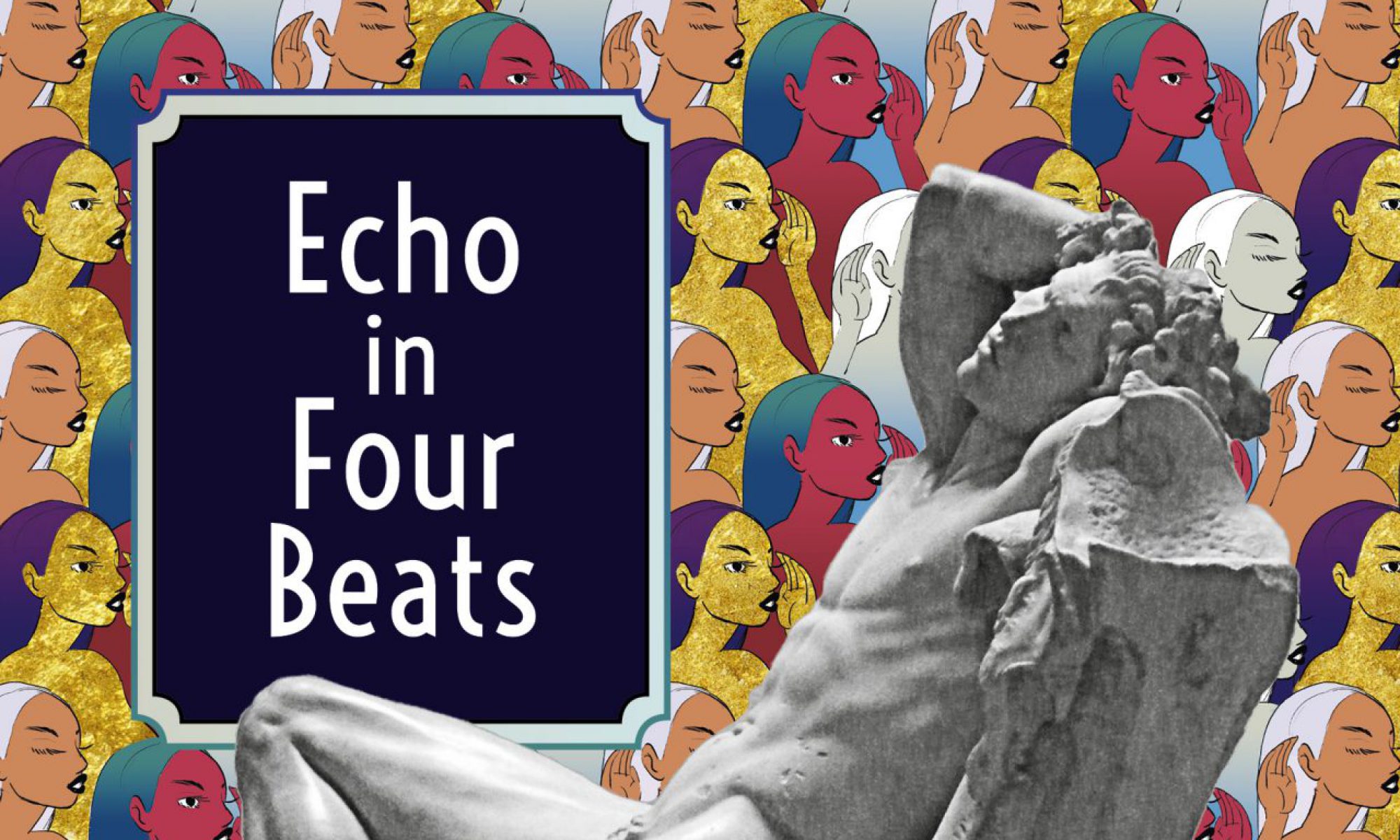
The title Echo in Four Beats alludes to the Greek myth and references the four distinct waves of feminism that have culminated into a global crescendo today. Hence, the fourth beat may be perceived as analogous with the fourth wave of feminism, which promises to become more intersectional, more open to debate, and more transformative than precedent waves. The cover is suggestive of The Women´s March in Washington, DC. It depicts a crowd of women cupping their hands to their mouths to enunciate and receive wisdom back. The women move and surround a reclining Satyr, the infamous Barberini Faun, from the entourage of the God of Ecstasy, Dionysus, who is narcissistically confident in his lascivious abandon and powerful aesthetic beauty. He is seemingly oblivious to the throngs of what could be revolutionary women around him, uniting to take back the mic and reclaim their own voices.

The fundamental Vedic and Buddhist religious concept of Saṃsāra, a Sanskrit word meaning ‘wandering,’ and denoting a spiritual journey towards enlightenment through the cycle of life-death-rebirth, acts as a blueprint for the structure of the collection. It transposes onto the first three beats, which correspond with: Brahma and creation, Vishnu as the preserver or sustenance in the second beat, and Shiva, the destroyer and destructive transformation in the third beat. The fourth beat explores what liberation from this cycle of creation, sustenance and destruction might look like and the poem ‘Beyond Saṃsāra’ ironically suggests the possibility of women regaining their freedom from past destructive cycles.”

Read the full review of Echo in Four Beats on The Quarterly Conversation here.

Kendrick Loo reviews Rita Banerjee’s “Echo in Four Beats” for Singapore Unbound

In Singapore Unbound, author and critic Kendrick Loo of the University of St. Andrews reviews Rita Banerjee’s debut poetry collection Echo in Four Beats (Finishing Line Press, March 2018).  He writes:

When Sandra Gilbert and Susan Gubar published The Madwoman in the Attic in 1979, their focus on how women writers were limited by patriarchal stereotypes of female embodiment represented a landmark recognition that writing is hardly apolitical or objective. Decades on, we understand that canonical writing was formed by predominantly male ecosystem of publishers, translators, and critics. However, tension remains in how to deal with the problematic legacy that our literary forebears have left us—how do we acknowledge ‘canonical texts’ as meriting analysis, while simultaneously remembering and honoring those rendered invisible and pushed to the margins by the historical prejudice. Out of this quagmire emerges Rita Banerjee’s debut collection, Echo in Four Beats. A reflective book that questions the status of canonical writing, its multilingual intertextuality belies a poetic voice that dances between criticism and innovation of poetry to restore female voices to literary canon. Concerned with language as political signifier—which is to say how language connotes, inscribes, and affects how one is perceived—it retains a feminist approach to historical texts.

Subdivided into four sections, Echo in Four Beats is, as suggested by its title, concerned about the Ovidian myth of Echo and Narcissus. In the classic tale, Echo’s misfortune begins when she tricks the goddess Juno so that her sisters—who had slept with Juno’s husband, Jupiter—can escape. Cursed by Juno to repeat only the words of others as punishment, Echo later fails to approach Narcissus, a beautiful man Echo has admired from a distance but never spoken with. Terrified, Narcissus runs away from Echo while Echo herself wastes away from heartbreak, leaving only her voice behind. In Banerjee’s collection, this myth is visited in a poetic sequence titled “Creation Hymn,” “Sustenance Hymn,” and “Destruction Hymn,” where a process of erasure is enacted upon a translation of Ovid’s The Metamorphoses to create a personal version of events. This technical restriction enables Banerjee to honor and resist simultaneously the restraints that Juno imposed, while creating a lyrical and haunting voice that speaks for both poet and muse. The reader is rewarded with thematically resonant poetry that can be easily attributed to the original myth such as the following fragment from “Sustenance Hymn I”:

Her voice, her bones,
shapes of stone heard
by everyone: sound lives in her

Based on the titles alone, one might say that the process of creation and destruction is a kernel around which the collection is formed. However, the hymnal sequence is compelling for other reasons, namely that of transformation. Consider how the detachment of the sequence vanishes when one reaches the segment titled “Destruction Hymn I,” where the introduction of a first-person perspective creates a personal voice, breathing life into the poem. Its immediacy and intimacy signals that a female voice has been discovered, delivering retrospective justice to Echo who was consigned by Ovid to a mute end, embedded within and serving Narcissus’ larger narrative. Banerjee’s I retrospectively fulfills the promise raised by the very first section of the sequence, “Creation Hymn I”:

she, who cannot be
silent, might learn how
to speak first herself

The desire to amend history, therefore, is an impulse that the poetic voice of Echo in Four Beats keeps central to its work, emerging from the feminist recognition of the marginalization of women in literary works. However, Banerjee never loses control of her grasp for reinvention: in the opening poem of the book, “The moon had jackknifed,” Ovid’s myth is given a new ending. Banerjee describes via the use of past tense a man who dissolves into “a lovely blank” at the touch of the moon. Such evocative imagery strengthens the poetry, as it does in the lines “the orbs splitting yellow/ spoke of oblivion,/ his eyes glimmered,/ the moon understood.” By suggesting the contours of the original myth, Banerjee positions her collection as an alternative chain of events, picking up where Ovid leaves off when the male figure fades away.

Nonetheless, Banerjee does not limit herself to interacting with creative works solely inspired by the myth of Narcissus and Echo. Echo in Four Beats is redolent with rich allusions to a wide range of writers and artists. The poem “Please Listen and Do Not Return,” for instance, critiques F. Scott Fitzgerald and John Steinbeck for their female characters, who are conceived as extensions of desire and utility to the narrative’s male protagonists. The title therefore is a blunt warning not to repeat the mistakes of these protagonists, situating the poem as a post-script to the original works. Yet, one might wonder why Banerjee engages in intertextuality and ekphrastic writing. This question is answered in Banerjee’s collection by a poem called “The Figure,” which asserts that despair results from the desire to quantify things that exist beyond our capacity for description. Instead of starting with a question that would premise, and therefore demarcate understanding, the persona of the poem singles out the act of enlightenment:

I only understood by casting you
first in flesh, then in clay,
and finally in frail, sea-water words.
You tendered there—
adrift on the tide

This process of creation in reverse, from flesh to water, generates solace while never revealing what the narrator knows. Only the foreword, with a line by the Japanese literary figure Jun-ichirō Tanizaki (“We find beauty not in the thing itself/ but in the patterns of shadows”), and a line on the repairing of old wounds (“…heal the lines/ between blue and continent”), suggests that the original question is about beauty and meaning that cannot be quantified by categorization and description. This explains why the poem quoted above focuses on the growing transience of the figure’s form, instead of explaining the figure’s gradual dissolution. Only by creating, not explicating, can the speaker grasp an elusive meaning.

The focus on blurring and subverting boundaries is why praise for Echo in Four Beats focuses on the “post-national” nature of the collection. In the second and third sections of the collection, for example, a large number of poems deal with foreign travel, going beyond America to engage with nations such as India or Japan. Some of these poems take a step further into the conceptual realm, when Banerjee translates into English a poem first written in another language by her own hand. These poems—namely “A Water’s Sound” and “One Night”—position Banerjee in the dual role of poet and translator, inviting us to consider how translation and writing are closely intertwined. While the work of the original poet is crucial, the inclusion of both translated and non-translated versions of the same poem makes the argument that lacking translation, we lose not only the basic contents of the poem but also the nuanced explanations of cultural signifiers and references that exist only in the original language. Some slippage is of course inevitable, but Banerjee reminds us that there is still value in attempting to translate.

Read the full review of Echo in Four Beats  on Singapore Unbound here.

Rita Banerjee will be featured on Goddard’s “Bon Mot” Radio Program on 91.1 / 91.7 FM Vermont – November 11, 2018

Rita Banerjee will be be featured on Goddard College’s “Bon Mot” radio program at 5 pm EST on Sunday, November 11, 2018.  The radio program will air on 91.1 and 91.7 FM Vermont. The show is hosted by Rick Argan and Banerjee will be be reading from her poetry collection Echo in Four Beats and her new nonfiction manuscript on race, sex, politics, and cool.  The show can be live-streamed here:   or listened to via podcast archive here: https://soundcloud.com/wgdr

July 26, 2018: Paris Lit Up feat. Rita Banerjee

The Cambridge Writers’ Workshop is delighted to have our writing faculty from our 2018 Summer in Paris Writing Retreat featured at SpokenWord Paris and Paris Lit Up this summer!

Paris Lit Up featuring Rita Banerjee
Culture Rapide * July 26, 2018 * 8:45 – 11:00 pm
103 rue Julien Lacroix, 75020 Paris, France

Paris Lit Up will host Rita Banerjee as their featured writer on July 26, 2018 from 8:45 – 11:00 pm!  Banerjee will read from her new poetry collection Echo in Four Beats (FLP, march 2018), which was selected by Finishing Line Press as their 2018 nominee for the National Book Award in Poetry, and her edited volume CREDO: An Anthology of Manifestos and Sourcebook for Creative Writing (C&R Press, May 2018).  Banerjee will also read from her new collection of essays on race, sex, politics, and everything cool, and her novel-in-progress about a Tamil-Jewish family in crisis during a post-authoritarian regime. 

Writers from the Cambridge Writers’ Workshop Summer in Paris (July 25-30, 2018) Writing Retreat will also read during the open mic portion starting at 8:45 pm.

Paris Lit Up  is a non-profit community organization that aims to intensify collaborative artistic practices through community events, performance and publication.  With emphasis on transnational writers, artists and musicians, Paris Lit Up promotes the importance of artistic synergy through transparent, democratic, consensus-based decision making.

ritabanerjeeRita Banerjee is the Executive Creative Director of the Cambridge Writers’ Workshop and editor of CREDO: An Anthology of Manifestos and Sourcebook for Creative Writing (C&R Press, May 2018).  She is the author of the poetry collection Echo in Four Beats (Finishing Line Press, March 2018),which was named one of Book Riot’s “Must-Read Poetic Voices of Split This Rock 2018”, was nominated for the 2018 Kate Tufts Discovery Award, and was selected by Finishing Line Press as their 2018 nominee for the National Book Award in Poetry.  Banerjee is also the author of the novella “A Night with Kali” in Approaching Footsteps (Spider Road Press, 2016), and the poetry chapbook Cracklers at Night (Finishing Line Press, 2010). She received her doctorate in Comparative Literature from Harvard and her MFA in Creative Writing from the University of Washington, and she is a recipient of a Vermont Studio Center Artist’s Grant, the Tom and Laurel Nebel Fellowship, and South Asia Initiative and Tata Grants. Her writing appears in the Academy of American PoetsPoets & Writers, Nat. Brut.The ScofieldThe Rumpus, Painted Bride Quarterly, Mass Poetry, Hyphen Magazine, Los Angeles Review of BooksElectric Literature, VIDA: Women in Literary Arts, AWP WC&C Quarterly, Queen Mob’s Tea House, Riot Grrrl Magazine, The Fiction Project, Objet d’Art, KBOO Radio’s APA Compass, and elsewhere. She is the Director of the MFA in Writing & Publishing program at the Vermont College of Fine Arts, an Associate Scholar at Harvard, and the judge for the 2017 Minerva Rising “Dare to Speak” Poetry Chapbook Contest. She is currently working on a novel, a documentary film about race and intimacy, a book on South Asian literary modernisms, and a collection of lyric essays on race, sex, politics, and everything cool.

More information about Rita Banerjee’s Echo in Four Beats and CREDO Book Tours available here!