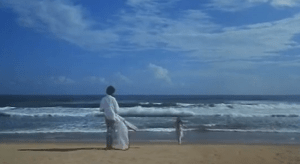
 Rita Banerjee will introduce and lead the discussion for Aparna Sen’s 1995 film, Yugant: The End of an Era (a.k.a. “What the Sea Said,” যুগান্ত), on Tuesday July 1, 2014 from 6-8:30 pm for the Institute for Indology and Tibetology at Ludwig-Maximilians-Universität München. The screening will take place in Seminar Room 427 (Ludwigstr. 31, Munich). The screening is part of the course Bengali 2: Introduction to the Bengali Language & Art House Film, II at LMU. Anyone interested in Bengali Cinema or South Asian Art House Film is welcomed to join the screening. The film focuses on the story of Deepak and Anasuya, who have been separated for eighteen months. Deepak works as a creative director of an advertising agency in Calcutta, while his wife, Anasuya, is a dancer who is managing her own dance school in Bhubaneshwar, Orissa. They agree to go on a vacation in the fishing village, where they had spent their honeymoon, in an attempt to salvage their marriage. However, each moment that they spend together seems to dredge up old quarrels and unhappiness. Both, having changed over the course of their seventeen years of marriage, must now decide if they can still find a reason to stay together. With a reference to the Gulf War, the director draws a parallel between the distance that has formed between the couple, the distance between mankind and nature, and the idea that mankind can no longer understand his own nature let alone the natural world. [Award/Festivals: National Award, 1995 for Best Photography and Best Feature Film In Bengali; Films From the South Festival, Oslo; Alexandria International Film Festival; Fribourg International Film Festival; Indian Film Week in Hong Kong.]
Summer 2014 Literature & Film Recommendations
 The Cambridge Writers’ Workshop published their Summer 2014 Literature & Film Recommendations list today! The list has been curated by Alex Carrigan and contributors include Rita Banerjee, Alex Carrigan, Gregory Crosby, Elissa Lewis, Jessica Reidy, Ian Singleton, Kathleen Spivack, Christine Stoddard, Diana Norma Szokolyai, Megan Tilley, and Roxy van Beek. Here are some Summer 2014 Film & Literature recommendations by Rita Banerjee. For the full list, please visit CWW Recommends!
Rita’s Summer 2014 Lit Picks:
 Gone Girl by Gillian Flynn
This is the novel I wish I had written. Gillian Flynn’s writing is stylistic, clever, and full of wit and menace. Every word of Flynn’s novel from her first sentence to her last is gorgeously crafted and razor-sharp. Gone Girl centers around the story of Amy and Nick Dunne, a supposedly happily married couple about to celebrate their 5th wedding anniversary. Following the 2008 Stock Market crash and the ensuing Great Recession, Amy and Nick are forced to move to North Carthage, Missouri after losing their jobs in the glittery, larger-than-life publishing world of New York City. The novel, told from alternating points of view follows the fairy tale beginning and then increasingly volatile relationship between Amy and Nick. Flynn does a masterful job of capturing Amy and Nick’s distinctive voices, psychology, and increasingly dark secrets, and her essay on the “Cool Girl” is a magnificent, and to-die-for moment in the novel. To add insult to injury, Amy’s parents are the perfect married partners and are in a decades-long happy romance. They are also authors of the children book series, Amazing Amy, which presents a parallel but laudable version of Amy’s own life, that is, “Amazing Amy” never makes the wrong decision or encounters grievous hardships whereas Amy Dunne’s life seem punctuated by increasingly harsher realities. The novel begins on the morning of Amy and Nick’s 5th wedding anniversary when everything seems normal, mundane, and annoyingly routine until Amy Dunne goes missing. And we find Nick, who spends too much of his free time contemplating size and permeability of the Amy’s skull, as the prime suspect.
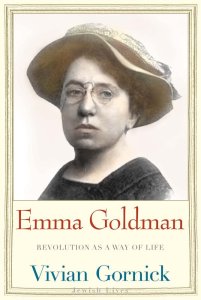 Emma Goldman: Revolution as a Way of Life by Vivian Gornick
For anyone who has read The Situation and the Story: The Art of the Personal Narrative, you know that Vivian Gornick is a rock-star in the contemporary creative writing scene. She is a master of the personal essay and definitely one of the most fluid, honestly intellectual, and vividly personal non-fiction writers out there. In Emma Goldman: Revolution as a Way of Life, Gornick traces the life and times of Emma Goldman and how Goldman, a young Russian Jewish émigré who came to the US in 1885, not knowing a word of English and only enough Yiddish and German to communicate with German and Jewish intellectuals in New York City, became the little anarchist that could. Under the tutelage of Johann Most and radicals from the Lower East Side, Goldman became a great orator, a supporter of worker rights and basic human rights for all, and most of all, a successful practitioner of civil disobedience. Her speeches in support of anarchy, free love, and ethical labor conditions drew hundreds of thousands of supporters in New York, Chicago, and even in California before she went on to stump in Europe, the UK, and Canada. Jailed for her anarchist sentiments, Goldman quickly learned to read, write, and orate in English while serving time. She also successfully subverted the hierarchical order of her prison and subtly promoted communal rights. Overall, Gornick’s biography of Goldman is witty, full of vivid imagery, and so well-crafted that the revolutionary zeitgeist of Emma Goldman’s life and times leaps off the page and completely surrounds the reader. Emma Goldman is intriguing as a character, a thinker, a revolutionary, and a refusenik. Perhaps what makes her so enchanting and so commanding can be summed by her own motto: “If I can’t dance, I’m not coming to your revolution.”
 Ann Veronica by H.G. Wells
H.G. Wells may be best known as a master of science fiction and stories which exam what seems ordinary but uncanny, but his novels of social realism and turn-of-the-century politics in England deserve much praise and definitely a favored spot on your shelf. H.G. Wells, who received Emma Goldman during her travels to England in the early 20th century, was part of the political left. Ann Veronica, which examines the consequences of capitalism, England’s suffragist movement of the 1900s, and emergence of the “New Woman” in British society, is undoubtedly one of Wells’s most radical, thought-provoking, feminist, and best novels. The novel centers on the story of Ann Veronica, a young 22-year-old woman, who studies biology at a university in London and who is continuously reprimanded for her exerting her own free will at her father’s house. Ann, thus, decides to leave the suburbs and her childhood home behind to carve out a career and independent life for herself in London. In London, Ann faces a series of increasingly terrifying social obstacles–from trying to rent an apartment on her own as a single woman, to securing a job for herself, to continuing to individually fund her college career, to her encounters with paramours and the well-meaning but chaotic world of radical suffragists. Ann takes each problem she faces in stride, and her choices and life story are unpredictable and incredibly refreshing. Ann, who may have been based on Wells’s own lover, Amber Reeves, demonstrates how well Wells can create feminist, complicated, and dynamic female characters who are both emotionally realistic and intellectually captivating. As E.M Foster notes on “[Wells’s] power of observation stronger – he photographs those he meets and agitates the photos.” With Ann Veronica, Wells has captured the dreams and desires of a young girl in the turn-of-the-century, and has found a away to agitate her narrative into a captivating, three-dimentional hero’s quest.
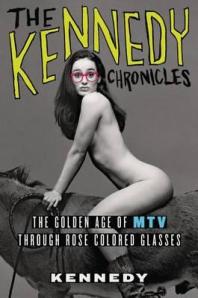 The Kennedy Chronicles: The Golden Age of MTV Through Rose-Colored Glasses by Kennedy
For anyone who grew up in the Golden Age of MTV when the network still used to air music videos and was a bastion for American alternative culture, new voices, and underground bands, this memoir by Kennedy, that in-your-face, pajama-d, combat-boot wearing, off-the-wall feminist VJ is a must read. In her memoirs, Kennedy takes shows us what life was like on Alternative Nation and behind the Moon Man. She gives us behind-the-scenes tours of MTV luminaries like Jon Stewart, Tabitha Soren, and Kurt Loder, and shares some amazing reveals about Trent Reznor and NIN, Billy Corgan, Radiohead, Björk, Nirvana, and Pearl Jam. In recalling her escapades, Kennedy writes, “I did all of these things because that’s what you do when you’re twenty and wild and living in the moment in a special universe where your future may be uncertain…and it sure as hell is fun to relive those passionate, earnest moments when music mattered and timed stopped.”
Rita’s Summer 2014 Film Picks:
 The Workhorse and the Bigmouth (2013, dir. Yoshida Keisuke, Japan)
The Workhouse and the Bigmouth, or Bashyauma-san to Biggumausu in Japanese, is a wonderful contemporary comedy-drama about two young screenwriters trying to making it big on the mean streets of the publishing and media worlds of Japan. The story centers on the aspirations of 34-year-old Michiyo Mabuchi and 26-year-old Yoshimi Tendo as they compete with one another and try to break into the screenwriting world of Japanese film and television. Michiyo, who has been taking creative writing workshops and screenwriting classes for the past ten years but has yet to be published or to be successful, is our frustrated, anti-hero workhorse. Yoshimi is the self-proclaimed screenwriting genius and Wunderkind, who finds himself facing a blank screen when he finally sits down to write his first screenplay. Together, they exchange diatribes, work philosophies, and ideas about what makes a good story work and what can make a writer fail. Overall, Yoshida Keisuke’s film gives us a wonderful insight into the contemporary creative writing world of the Japanese, the fierce competitiveness of the Japanese publishing and media industries, and how much courage and sheer determination it takes to become a noteworthy and successful writer. (Recommended for writers and dreamers everywhere).
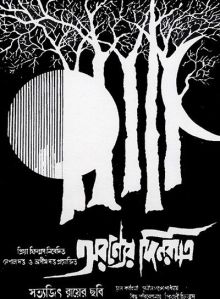 Days and Nights in the Forest (1970, dir. Satyajit Ray, India)
Aranyer Dinrātri, or Days and Nights in the Forest, is a comedic and lovely story on what can happen on lost weekends by Satyajit Ray. The film is based on a story by the Bengali modernist poet and historical novelist, Sunil Gangopadhyay, and focuses on the adventures and mishaps of four young male friends who decide to leave their stiff, box-wallah office jobs in Kolkata behind to spend a week-long vacation in the forests of Bihar. The four men, who come from middle-class backgrounds, transpose their classist views onto the Santhal communities they meet in the forest. They also meet two lovely young women who are vacationing in their summer cottage nearby, and missed connections, summer picnics, and one very memorable memory game ensue. Ray, who is known for his socially realist films and participation in the Parallel Cinema movement of South Asia, is a masterful storyteller and lyrical cinematographer in this film. Days and Nights in the Forest is a must-see of anyone who has wandered out in the wilderness in the middle of the night, contemplating a mid-summer night’s dream.
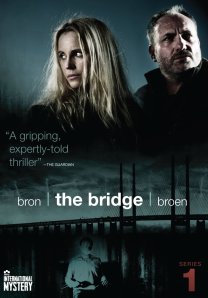 The Bridge (2011-, dir. Bjorn Stein and Charlotte Sieling, Denmark/Sweden)
The Bridge was recommended to me by my partner, and is a thrilling mini-series that’s perfect for summer nights. The story begins at midnight when the lights on the bridge between Sweden and Denmark suddenly go out, stopping all traffic. The black out is unexpected but ordinary, until the police notice a woman lying on the road, directly in the center of the bridge. On closer inspection, it appears to be a dead body, and there’s surveillance footage indicating that a black car dropped her off on the bridge precisely at the time when the lights went out and traffic had to be halted. It looks like an ordinary murder, and the commuters, stuck on the bridge, become more agitated as they wait to be let across to the other side. A woman is in an ambulance trying to rush her husband from Denmark to Sweden but is stuck behind the traffic barrier lines, and as she yells towards the detectives to hurry up, the wind begins to pick up. That’s when the detectives from Denmark and Sweden note that the dead woman’s body has been sawed in half directly across the invisible cartographic line that separates Sweden from Denmark.
 The Master and Margarita (2005, dir. Vladimir Bortko, Russia)
If you haven’t read Mikhail Bulgakov’s novel, The Master and Margarita, go out to your local library, bookstore, ebook dealer, etc., and grab a copy now! The novel focuses on three intersecting storylines. The first narrative involves the atheist, political dissenter, and editor Mikhail Alexandrovich and his young friend, Ivan Nikolayevich, a poet who goes under the pen-name Homeless. The second narrative is set in the ancient Roman Empire and follows the conflict between Pontius Pilate and Jesus Christ, a young, charismatic political and religious dissenter. The third follows the story of a writer, simply called the Master, and his muse and married lover, Margarita. Thrown into this mix is the strange, foreign “Professor W,” his oddly attired traveling companion, and a vodka-drinking black cat that seems to be able to do magic tricks and perform menacing acts. Set during 1920s and 1930s during Russia’s Soviet reign, this novel and mini-series blend political satire, commentary on ethics and spirituality, the writers’ role in society, and elements of the uncanny and the fantastic into a witty, comedic tale. The mini-series stars a wonderful cast of talented actors, and is a must-see for anyone who’s a fan of modern Russian literature and theatre.
 Her (2013, dir. Spike Jonze, USA)
Finally, one last must-see film for the summer. Her, directed and written by Spike Jonze, is a visually stunning and emotionally lyrically film about what happens to human beings when they literally fall in love with technology. The lush warm hues of the film, gorgeously crafted sets, and lit panels, which mimic the shades of camera filters, draw the viewer into the protagonist’s emotionally vulnerable world. Set in a beautifully designed, architectural near-future, Her centers on the story of Theodore Twombly, who has separated from his wife and is facing an imminent divorce, and who works full-time writing personal letters for clients who cannot write anything personal themselves. Lonely and disenchanted, one day Theo stumbles upon an exhibit advertising an even more personal operating system–something that’s more than a computer or secretary, but promises to be an avid companion and close friend. Intrigued, Theo buys this new OS, which after asking him a series of too-close-to-home questions, installs itself into Theo’s life as the with the voice of Scarlet Johansson as the OS named “Samantha.” Soon Theo and “Samantha” start developing a closer bond, and Theo finds himself falling in love, not with a machine, or a piece of code meant to replicate a human being, but with a persona and human being that cannot really exist.
Rita Banerjee interviewed in Quail Bell Magazine
 Jessica Reidy, Pushcart Nominee, member of VIDA and Quail Bell Magazine, novelist, and yoga practitioner, interviews Rita Banerjee, Diana Norma Szokolyai, and Elissa Joi Lewis for her new piece on the Cambridge Writers’ Workshop Summer Yoga & Writing Retreat at the Château de Verderonne in Picardy, France in Quail Bell Magazine. In the article, Jessica Reidy discusses how daily yoga, craft of writing seminars, and workshops go hand in hand to spark creativity, encourage relaxation, and produce good writing habits. Jessica Reidy writes, “The Château de Verderonne feels like a sumptuous two week ritual. Yoga in the gardens or, weather not permitting, in our private salon, is led twice a day, before breakfast and dinner, by the wonderfully gifted Elissa Joi Lewis, who also teaches art classes. Outside of yoga class, there are allotted times for free-writing, workshops, and craft talks, all of which made me realize how much I needed a non-judgmental writing community. An MFA is a lot of great things, but most MFA workshops don’t necessarily give you room to make (many) mistakes. That’s what your community of writers is for—they are the friends you can trust (inside and outside an MFA) to look at your messy, fragile baby bird novel, as ugly and wet as it is, and not to smash it into the ground. Instead, they’ll give you advice to help it grow up into some more presentable stage of bird. And whether I was in yoga class or workshop at the retreat, I had room to experiment and could trust gentle yet wise guidance. Yoga asks the practitioner to sacrifice her ego, just as the writer must surrender her ego in order to allow herself the space to draft and try out those imperfect ideas.” (Read the article & interview at Quail Bell Magazine)
Revision Workshop at the Munich Readery – June 8
 Revision Workshop
Sunday, June 8, 2014 * 14:00-16:00
The Munich Readery, Augustenstraße 104, 80798 München
The last two creative writing workshops on Evocative Objects and Literary Taboo were huge successes at the Munich Readery. And thanks to Lisa and John, a follow-up creative workshop has been scheduled for Sunday June 8 from 2-4 pm at the Munich Readery. This workshop will focus on the topic of revision and will feature the writing begun for the Literary Taboo and Evocative Objects workshop. Participants are also welcomed to bring in some of the writing they are currently working on at home. Feedback will be provided on all the writing that has been sent to the Munich Readery before June 4. Workshop fee: €25. To register, send an email and revised to store@themunichreadery.com by June 4.
Screening of Satyajit Ray’s The Adversary – June 3
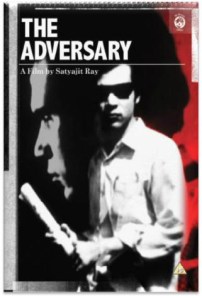 Rita Banerjee will introduce and lead the discussion for Satyajit Ray’s 1970 film, The Adversary (প্রতিদ্বন্দী), on Tuesday June 3, 2014 from 6-8:30 pm for the Institute for Indology and Tibetology at Ludwig-Maximilians-Universität München. The screening will take place in Seminar Room 427 (Ludwigstr. 31, Munich). The screening is part of the course Bengali 2: Introduction to the Bengali Language & Art House Film, II at LMU. Anyone interested in Bengali Cinema or South Asian Art House Film is welcomed to join the screening. Created amid the growing social unrest and political violence of India (and the world) post-1969, and specifically responding to Bengal’s armed Naxalite radical movement, The Adversary is Ray at his most openly political, yet also Ray at his most compassionate and even humorous. A young college graduate seeks employment (or at least respect) in Calcutta, “that nightmare city” (as Ray described it at the time), and finds neither. Indifferent to joining polite society, his younger brother chooses revolution instead. “This is Ray’s funniest, most piercing film,” wrote Pauline Kael; “its humanism is like the quality of Olmi’s Il Posto.” – Jason Sanders [The Adversary is based on a story by the Bengali Modernist writer, Sunil Gangopadhyay]
Screening of Satyajit Ray’s Days and Nights in the Forest – May 13
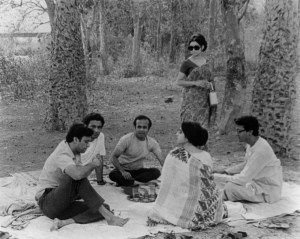 Rita Banerjee will introduce and lead the discussion for Satyajit Ray’s 1970 film, Days and Nights in the Forest (অরণ্যের দিনরাত্রি ), on Tuesday May 13, 2014 from 6-8:30 pm for the Institute for Indology and Tibetology at Ludwig-Maximilians-Universität München. The screening will take place in Seminar Room 427 (Ludwigstr. 31, Munich). The screening is part of the course Bengali 2: Introduction to the Bengali Language & Art House Film, II at LMU. Anyone interested in Bengali Cinema or South Asian Art House Film is welcomed to join the screening. Ray’s most overtly Renoir-ish film, this might almost be a remake of Une Partie de Campagne, transposed to another time and place and through another sensibility. Instead of the French bourgeois family setting off for a picnic, four young men leave Calcutta for a few days in the country, trailing their westernized careerist attitudes, a middle class indifference to the lower orders, a self-satisfaction that leaves them closed to experience. Out of a series of delightfully funny mishaps as the visitors eagerly try to pursue acquaintance with their two promisingly attractive neighbors, Ray gradually distills a magical world of absolute stasis: a shimmering summer’s day, a tranquil forest clearing, the two women strolling in a shady avenue, wistful yearnings as love and the need for love echo plangently. Elsewhere jobs have to be won or lost, problems faced and solved, but not here; an illusion of course, revealed as time lifts its suspension but leaves one of the quartet a changed man, the other three assailed by tiny waves of self-doubt. Beautifully shot and acted, it’s probably Ray’s masterpiece. – Time Out [Days and Nights in the Forest is based on a story by Bengali modernist writer, Sunil Gangopadhyay]
Literary Taboo Workshop at the Munich Readery – April 27
 Literary Taboo Creative Writing Workshop
Sunday, April 27 * 14:00-16:00
The Munich Readery, Augustenstraße 104, 80798 München
Come join Rita Banerjee and the Munich Readery for an afternoon of literary games, riddles and creative writing! Get ready to play Literary Taboo. During the game, you may be asked to describe a person, idea, object, or phenomenon without using certain taboo words. You are welcomed to create poems, short stories, theatrical sketches, first-person narratives, and riddles about the topics you encounter during the game, and everyone is invited to become a true literary detective! So join us for an afternoon filled with creative writing, sensorial riddles, and literary taboos! Workshop fee: €20. To register, send an email to store@themunichreadery.com
Feature in Poets & Writers Magazine
 Rita Banerjee, Diana Norma Szokolyai, Elissa Lewis, and Jessica Reidy are featured in the March/April 2014 Writers Retreats Issue of Poets & Writers Magazine for their instruction in the 2014 Yoga & Writing Retreat at the Château de Verderonne. In this special issue of Poets & Writers, the “Conferences & Residencies” section features the Cambridge Writers’ Workshop 2014 Summer Retreat in France. The 2014 Cambridge Writers’ Workshop Summer Yoga & Writing Retreat will be held from August 7 to August 20 at the Château de Verderonne in Picardy, France, located approximately 50 miles north of Paris. The conference features workshops in poetry, fiction, and creative nonfiction, as well as craft seminars, art classes, time to write, and daily yoga and meditation classes. Optional excursions to Paris and Chantilly are also available to participants. The faculty includes poets Rita Banerjee and Diana Norma Szokolyai, fiction writer Jessica Reidy, and yoga and arts instructor Elissa Lewis. – P&W
Vanguard Seattle Featured Event – Feb 28 – A Night at the Victrola Reading
 A special thanks to Vanguard Seattle, an arts, culture, and fashion journal, for featuring the Cambridge Writers’ Workshop’s “A Night at the Victrola” #AWP14 Reading as one of their featured #Seattle events for the week of February 25 – March 2. The Cambridge Writers’ Workshop presents many poets from both coasts and several grads of UW’s MFA program. The lienup includes Peter Mountford, Rita Banerjee, Diana Norma Szokolyai, Pattabi Seshadri, Nancy Jooyoun Kim, Kevin Skiena, Jessica Day, Anca Szilágyi, Talia Shalev, Carrie Kahler, Dena Rush Guzman, Leah Umansky, Susan Parr and Johnny Horton. Check out more information here.
A Night at the Victrola, AWP 2014 Reading
 Friday February 28, 2014* 8:30-10:00pm
Victrola Coffee & Art
411 15th Ave E, Seattle, WA 98112
The Cambridge Writers’ Workshop presents “A Night at the Victrola,” an AWP 2014 Reading, featuring the talents of Peter Mountford, Rita Banerjee, Diana Norma Szokolyai, Pattabi Seshadri, Nancy Jooyoun Kim, Kevin Skiena, Jessica Day, Anca Szilágyi, Talia Shalev, Carrie Kahler, Dena Rush Guzman, Leah Umansky, Susan Parr, & Johnny Horton. Join us as we celebrate some of Seattle, New York, & Boston’s best writers, and graduates from the University of Washington MFA program.
 Rita Banerjee