
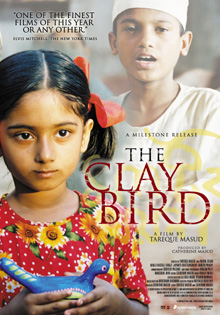
 Rita Banerjee will introduce and lead the discussion for Tareque Masud’s 2002 film, The Clay Bird (মাটির ময়না), on Tuesday, January 13 from 6-8:30 pm for the Institute for Indology and Tibetology at Ludwig-Maximilians-Universität München. The screening will take place in Seminar Room 427 (Ludwigstr. 31, Munich). The screening is part of the course Bengali 3: Intermediate Bengali Language and Literature at LMU. Anyone interested in Bengali Cinema or South Asian Art House Film is welcomed to join the screening. In The Clay Bird (Māṭir Maynā), Tareque Masud follows the increasing religious, linguistic, and political tensions leading up to Bangladesh’s War of Liberation from Pakistan in 1971. The film is based on Masud’s childhood experience in a madrasa (Islamic seminary) during the late 1960s in the then East Pakistan (now Bangladesh). This was a very turbulent period in Bangladesh’s history, when as the eastern wing of the greater Islamic state of Pakistan, the country was torn between a strong secular and democratic movement and a pro-Islamic military junta bent on stifling dissent and reform. Although there are oblique references to the historical events of that time, the story Masud tells is an essential human one, told through the eyes of a child. Māṭir Maynā became the first feature film from Bangladesh to be selected for presentation at Cannes Film Festival. At Cannes, it was given the honor of being the opening film of the Directors Fortnight section of the festival, and won the International Critics Prize for best film in that section. However, even as the French and international press were lauding the film for its positive portrayal of Bangladesh and its tolerant traditions, the Bangladesh Censor Board gave their own verdict: the film was banned from public screening because it was deemed too religiously sensitive.
Screening of Satyajit Ray’s The Big City – December 5
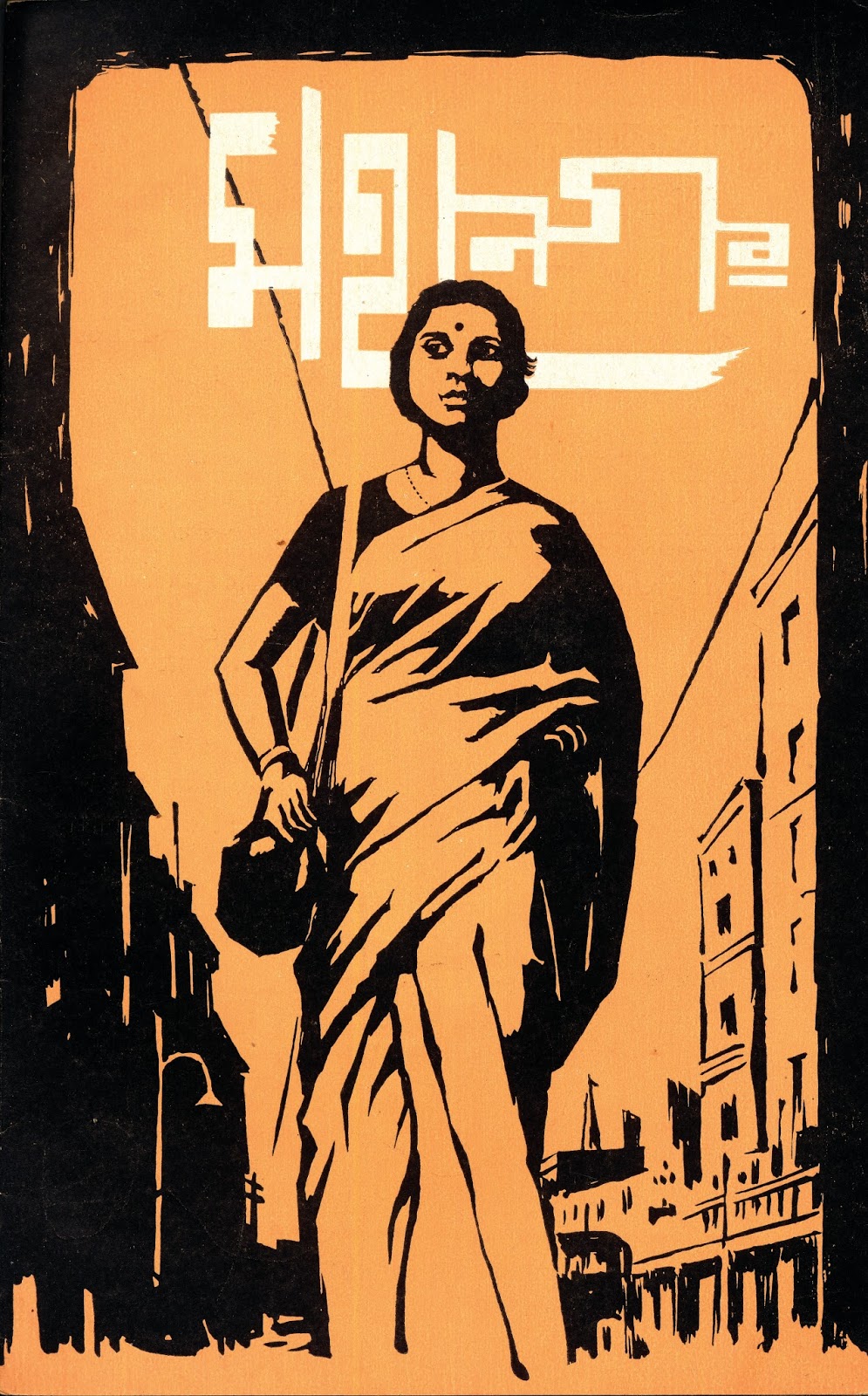 Rita Banerjee will introduce and lead the discussion for Satyajit Ray’s 1963 film, The Big City (মহানগর), on Friday December 5, 2014 from 6-8:30 pm for the Institute for Indology and Tibetology at Ludwig-Maximilians-Universität München. The screening will take place in Seminar Room 427 (Ludwigstr. 31, Munich). The screening is part of the course Bengali 3: Intermediate Bengali Language and Literature at LMU. Anyone interested in Bengali Cinema or South Asian Art House Film is welcomed to join the screening. “In The Big City (Mahānagar), Ray sets his ironic and humorous eye on the plight of the Bengali middle class, caught amid the changing moralities of city life. The cultural crossfire is internalized in each individual. Focusing in particular on the role of women in this metamorphosis, Ray tells a story that is both minutely particular to Calcutta and universally recognizable. Madhabi Mukherjee gives a beautifully unfolding performance as the timorous housewife who finds her strength when she takes a job—selling knitting machines door to door—in order to help support her family and her husband’s extended family, all of whom resist the move. ‘Few directors can match Ray’s facility for observation or his perceptiveness in registering those tiny moments of conflict when a casual nuance can drop like a bomb.’” —David Wilson, Monthly Film Bulletin. The screenplay for The Big City (Mahānagar) was written by Satyajit Ray and adapted from a story by Narendra Nath Mitra.
Rita Banerjee’s Mis/Translation poems featured in Quail Bell Magazine
 Over the next few weeks, Quail Bell Magazine will be curating and publishing a series of “Mis/Translations” poems by Rita Banerjee and Diana Norma Szokolyai. Rita Banerjee and Diana Norma Szokolyai are the founders and directors of the Cambridge Writers’ Workshop (CWW). You can read about the CWW’s upcoming Pre-Thanksgiving Yoga, Writing, and Juice Cleanse Retreat in Quail Bell Magazine. In the interview, the CWW shares tips on creating a creative discipline of writing, yoga, and self-care. Rita also discusses the creative writing invention exercise “Mis/Translations” and how it can help kick-start your writing. Rita’s poem, “Who Lamb” was inspired by a Mis/Translation exercise at the last CWW Verderonne retreat. Norma read her own poem, “hullám/wave” in Hungarian and Rita “Mis/Translated” based entirely on the sound and feel of words that were foreign to her. – Jessica Reidy
Rita Banerjee Interviewed in Quail Bell Magazine
 Jessica Reidy, Pushcart Nominee, member of VIDA and Quail Bell Magazine, novelist, and yoga practitioner, interviews Rita Banerjee, Diana Norma Szokolyai, Elissa Joi Lewis, Alex Carrigan and Megan Tilley for her article Writing through Holiday Stress: Cambridge Writers’ Workshop Pre-Thanksgiving Retreat in Quail Bell Magazine. In the article, Jessica Reidy discusses how daily yoga, craft of writing seminars, and workshops go hand in hand to spark creativity, encourage relaxation, and produce good writing habits. Jessica Reidy writes,“No matter how cozy your family is, the holidays are stressful. Writers need their time, space, and routine to create and sustain their work, and these necessities fall by the wayside as Thanksgiving marches nearer. Then add the surplus of heavy food, sugar-packed nostalgic treats, and the stress-eating, and you’re feeling like a hot mess and your manuscript is still unfinished. The Cambridge Writer’s Workshop (CWW) knows this all too well, which is why the Pre-Thanksgiving Yoga & Creative Writing Juice Cleanse was born. On Saturday November 22 and Sunday November 23rd, from 2-4 PM, at Ashtanga Yoga Shala in New York City, we will be hosting an afternoon of creative writing classes, yoga classes, and juice for writers who need to decompress and write their hearts out, all with a little raw juice kick.” (Read the article & interview at Quail Bell Magazine, register for Pre-Thanksgiving Yoga & Creative Writing Cleanse at Cambridge Writers’ Workshop)
Character Development Revision Workshop at the Munich Readery – November 16
 Sunday, November 16, 2014 * 14:00-16:30
The Munich Readery, Augustenstraße 104, 80798 München
Femme fatales, gumshoe detectives, star-crossed lovers, wicked stepmothers, wise fools, empathetic anti-heroes: dynamic and archetypal characters can be key to making a good story or lyrical piece tick and pulling in the reader deeper into your creative work. In this revision workshop, we’ll pick up where our Character Development workshop left off, and will focus on putting dynamic and archetypal characters in action. During workshop, we will review and revise the writing begun for the Character Development and Playing with Persona Workshop. Participants are also welcomed to bring in the character sketches, stories, poems, and performance pieces they are currently working on which utilize dynamic and archetypal characters. Workshop fee: €25. To register, send an email and writing to review (1000 words or less) to store@themunichreadery.com by November 12.
Screening of Satyajit Ray’s Company Limited – November 11
 Rita Banerjee will introduce and lead the discussion for Satyajit Ray’s 1971 film, Company Limited (সীমাবদ্ধ), on Tuesday November 11, 2014 from 6-8:30 pm for the Institute for Indology and Tibetology at Ludwig-Maximilians-Universität München. The screening will take place in Seminar Room 427 (Ludwigstr. 31, Munich). The screening is part of the course Bengali 3: Intermediate Bengali Language and Literature at LMU. Anyone interested in Bengali Cinema or South Asian Art House Film is welcomed to join the screening. “In Company Limited, the hero is the amiable, self-satisfied, and ambitious young sales manager of a factory manufacturing electric fans, comfortably married and nicely set up in a smart apartment. The arrival from the country of his beautiful, intelligent, naive young sister-in-law unsettles him at the same moment as a crisis in his department awakens him to his own ability to fight dirty. He gets his directorship and emerges from the experience a good deal wiser and rather less certain of himself… This is one of Ray’s best films. The domestic relationship—the unrealized triangle of the man and the two girls—is revealed more by what is left out than by what is shown. At the same time it is one of Ray’s most richly comic films, with shrewd satire on the American-styled business world of Calcutta.” —David Robinson, London Times
Screening of Satyajit Ray’s The Hero – October 28
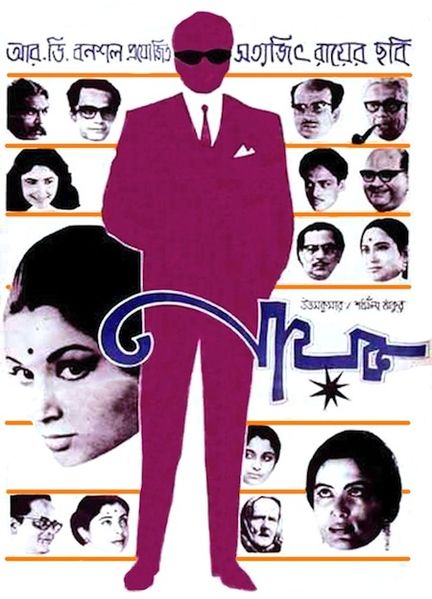 Rita Banerjee will introduce and lead the discussion for Satyajit Ray’s 1966 film, The Hero (নায়ক), on Tuesday October 28, 2014 from 6-8:30 pm for the Institute for Indology and Tibetology at Ludwig-Maximilians-Universität München. The screening will take place in Seminar Room 427 (Ludwigstr. 31, Munich). The screening is part of the course Bengali 3: Intermediate Bengali Language and Literature at LMU. Anyone interested in Bengali Cinema or South Asian Art House Film is welcomed to join the screening. In Satyajit Ray’s The Hero (Nāyak), a sharp-witted, serious young journalist finds herself stuck on a train with a movie superstar in Ray’s surprising examination of “intellectual” and “popular” cultures. Collisions are expected when the bespectacled intellectual (Sharmila Tagore) and the blustery movie star (Uttam Kumar, himself a Bengali matinee idol) wind up sharing tales and time on the train together, but soon the star finds himself revealing a surprising intelligence and self-doubt, as well as secrets from the past. And for the journalist, what begins as the hope of a star exposé turns into the glimpse of one man’s failures and dreams, as well as cinema’s (and fame’s) capability to destroy itself. Many believed the intellectual Ray was anticommercial or antipopular cinema, but The Hero offers a perceptive, empathetic look at that world’s dreams, hopes, and artistic dilemmas. Critic Albert Johnson described it best: it is “a realistic film about the unreality of dreams.” —Jason Sanders
Character Development Workshop at the Munich Readery – October 12
 Sunday, October 12, 2014 * 14:00-16:30
The Munich Readery, Augustenstraße 104, 80798 München
Femme fatales, gumshoe detectives, star-crossed lovers, wicked stepmothers, wise fools, empathetic anti-heroes: dynamic and archetypal characters can be key to making a good story or lyrical piece tick and pulling in the reader deeper into your creative work. In this workshop, we will discuss how dynamic and archetypal characters can help structure stories, propel narratives forwards, and how they can provide interesting ethical dilemmas and emotional spectrums to narratives and verse. We will learn about the building blocks of creating strong, unforgettable characters, and learn how playing with persona can help liberate nonfictional stories and lyrical poems. So if you’re currently working on a short story, novel, screenplay, theatre play, lyrical essay, memoir, or poem which has a strong and unique character at is heart, come stop by the Munich Readery on Sunday October 12 for our next creative writing workshop led by Rita Banerjee. Workshop fee: €25. To register, send an email to store@themunichreadery.com by October 8.
LitCawl Manhattan: Literary Masquerade – Sept 13, 8:15pm
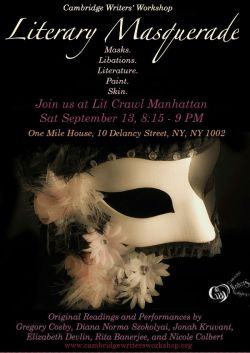 The Cambridge Writers’ Workshop will host a literary masquerade with writers and performance artists Gregory Crosby, Diana Norma Szokolyai, Jonah Kruvant, Elizabeth Devlin, Rita Banerjee, and Nicole Colbert at LitCrawl Manhattan. Original readings and performances will be intermingled with musings on masks from Pessoa, Kierkegaard, Descartes, Dickinson, de Beer, and more. There will be masks. There will be libations. Join us at LitCrawl Manhattan.
Cambridge Writers’ Workshop’s LITERARY MASQUERADE
SAT. SEPTEMBER 13 * 8:15-9:00 p.m. | One Mile House, 10 Delancey St., NY, NY 10002
Cambridge Writers’ Workshop 2014 Yoga & Writing Retreat at the Château de Verderonne


The Cambridge Writers’ Workshop 3rd Annual Yoga & Writing Retreat was held from August 7 -20, 2014 at the Château de Verderonne in Picardy, France, located approximately 50 miles north of Paris. The conference featured workshops in poetry, fiction, and creative nonfiction, as well as craft of writing seminars, art classes, free time to write, and daily yoga and meditation classes. The faculty includes writers Rita Banerjee, Diana Norma Szokolyai, and Jessica Reidy, and yoga instructor Elissa Lewis. The retreat was a wonderful time to generate new writing, revise longer manuscripts, enjoy French cultural excursions and countryside life, and practice relaxing sessions of yoga. Photo Galleries of the 2014 Yoga & Writing Retreat are now up on the CWW Website as are blog posts of daily activities as recorded by Rita Banerjee, Diana Norma Szokolyai, Elissa Lewis, Victor Pachas, Jessica Reidy, and Meghan Tilley:
August 7 | August 8 | August 9 | August 10 | August 11 | August 12 | August 13 |
August 14 | August 15 | August 16 | August 17 | August 18 | August 19 | August 20
 Rita Banerjee