Sabor y Cultura: Cambridge Writers’ Workshop AWP 2016 Reading – April 1

CWW-AWP2016ReadingThe Cambridge Writers’ Workshop is coming to Los Angeles for the AWP Conference (March 30 – April 2, 2016)!  Last year’s AWP  was a success with our bookfair table and reading at Boneshaker Books.  This year, you’ll be able to find us at Table 1157 and find information regarding our upcoming Spring in Newport, Rhode Island (April 22-25, 2016) Summer in Narbonne & Barcelona (July 18-26, 2016), and Summer in Granada, Spain (July  28-August 5, 2016) Writing Retreats.

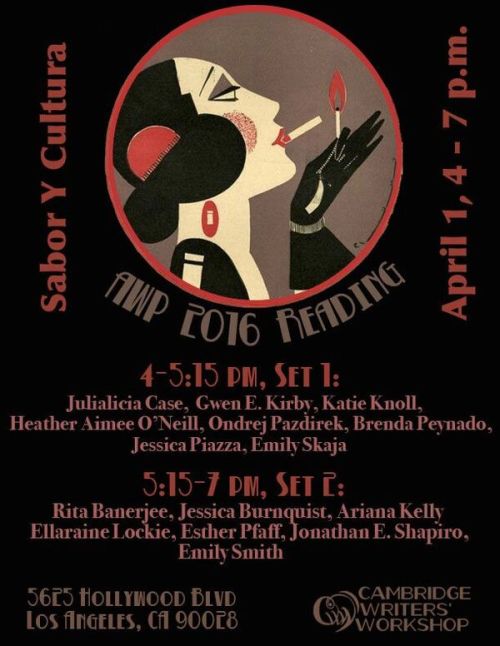
We’ll also be hosting our AWP Reading at Sabor y Cultura (located at 5625 Hollywood BlvdLos Angeles, CA 90028) on Friday, April 1, 2016 from 4-7 pm.  Featured Readers include Rita BanerjeeJess BurnquistJulialicia CaseAriana KellyGwen E. KirbyKatie KnollEllaraine LockieOndrej PazdirekHeather Aimee O’NeillBrenda Peynado, Esther Pfaff, Jessica PiazzaJonathan ShapiroEmily Skaja, and Emily Smith.


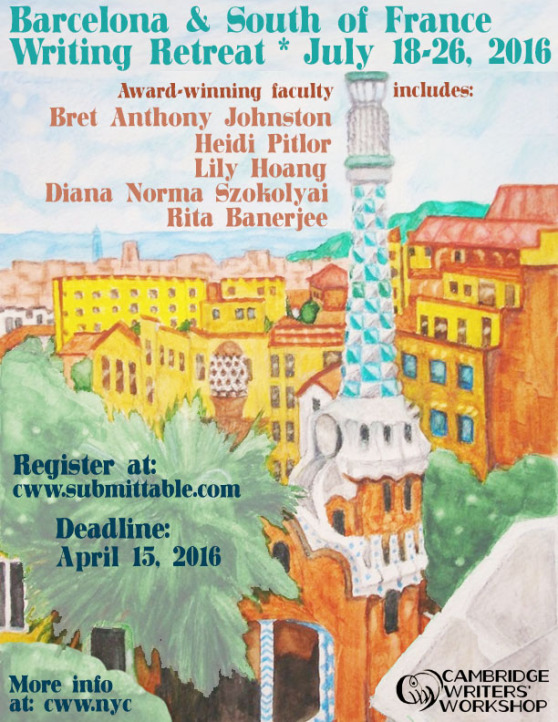
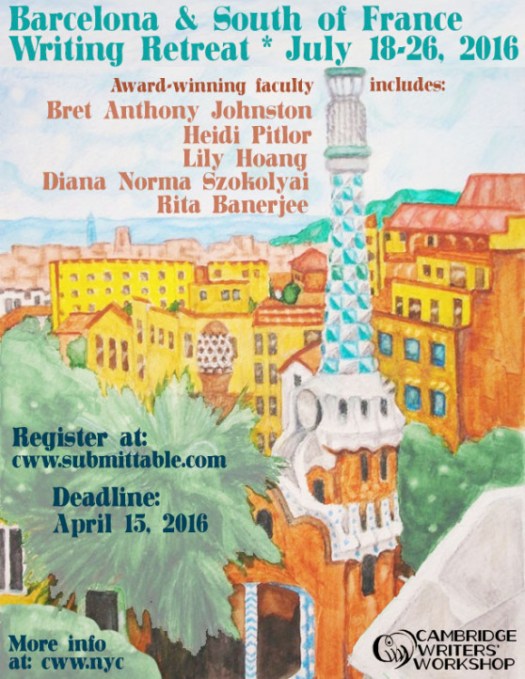
Register for CWW Summer Writing Retreat in Barcelona & South of France by April 15!


The Cambridge Writers’ Workshop Summer in Barcelona & Southern France Writing Retreat will take place from July 18-26, 2016.  The retreat will begin in Barcelona, Spain. There, you can engage in writing workshops while also taking in the Gaudi architecture, eating tapas, and enjoying the Spanish culture. After that, we’ll travel to Narbonne in the South of France. Located near the Mediterranean Sea, our writers will be able to enjoy the French summer and continue their writing projects in the picturesque town.  Faculty includes Bret Anthony Johnston(fiction), Heidi Pitlor (fiction, publishing), Lily Hoang (nonfiction, poetry), Diana Norma Szokolyai (poetry, nonfiction), and Rita Banerjee (poetry, fiction).  If you’d like to join us in Granada, please apply online at cww.submittable.com by April 15, 2015More info: cww.nyc 

Featured Faculty:

baj-bio-pic 2Bret Anthony Johnston is the author of the internationally best-selling novel Remember Me Like This, and author of  the award-winning Corpus Christi: Stories, which was named a Best Book of the Year by The Independent (London) and The Irish Times, and the editor of Naming the World and Other Exercises for the Creative Writer. His work appears in The Atlantic Monthly, Esquire, The Paris Review, Glimmer Train Stories, Virginia Quarterly Review, The Best American Short Stories, and elsewhere.  His awards include the Pushcart Prize, the Glasgow Prize for Emerging Writers, the Stephen Turner Award, the Cohen Prize, a James Michener Fellowship, the Kay Cattarulla Prize for short fiction, and many more. His nonfiction has appeared in The New York Times, the New York Times Magazine, The Wall Street Journal, Tin House, The Best American Sports Writing, and on NPR’s All Things Considered.  A graduate of the Iowa Writers’ Workshop, he’s the recipient of a National Endowment for the Arts Literature Fellowship and a 5 Under 35 honor from the National Book Foundation. He wrote the documentary film Waiting for Lightning, which was released in theaters around the world by Samuel Goldwyn Films. He teaches in the Bennington Writing Seminars and at Harvard University, where he is the Director of Creative Writing.

49zoqdckHeidi Pitlor received her B.A. from McGill University in Montreal and her M.F.A. in Creative Writing from Emerson College. She eventually became an editor and later a senior editor at Houghton Mifflin (now Houghton Mifflin Harcourt). She has been the series editor of The Best American Short Stories since 2007. Her writing has appeared in such publications as Ploughshares, The Huffington Post, and Labor Day: True Birth Stories by Today’s Best Women Writers.


lilyLily Hoang is the author of five books, including A Bestiary (winner of the inaugural Cleveland State University Poetry Center’s Nonfiction Contest) and Changing (recipient of a PEN Open Books Award). With Joshua Marie Wilkinson, she edited the anthology The Force of What’s Possible: Writers on Accessibility and the Avant-Garde. She is Director of the MFA program at New Mexico State University. She serves as Prose Editor at Puerto del Sol and Editor for Jaded Ibis Press.


DianaNormaDiana Norma Szkoloyai is author of the poetry books Roses in the Snow and Parallel Sparrows (Finishing Line Press). Her writing and hybrid art have appeared in Lyre Lyre, Dr. Hurley’s Snake Oil Cure, The Fiction Project, Teachers as Writers, Polarity, The Boston Globe, The Dudley Review, Up the Staircase, Area Zinc Art Magazine, Belltower & the Beach, and Human Rights News. Founding Literary Arts Director of Chagall Performance Art Collaborative and co-director of the Cambridge Writers’ Workshop, she holds an Ed.M from Harvard and an M.A. in French Literature from the University of Connecticut.


RitaBanerjeeRita Banerjee received her doctorate in Comparative Literature from Harvard and her MFA in Creative Writing from the University of Washington.  Her writing has been published or is forthcoming in The Rumpus, Los Angeles Review of BooksElectric Literature, VIDA: Women in Literary Arts, AWP WC&C Quarterly, Queen Mob’s Tea House, Riot Grrrl Magazine, Poets for Living Waters, The Monarch Review, The Fiction Project, Quail Bell Magazine, Jaggery, Catamaran, The Crab Creek Review, The Dudley Review, Objet d’Art, Amethyst Arsenic, Vox Populi, Dr. Hurley’s Snake-Oil Cure, Chrysanthemum, and on KBOO Radio’s APA Compass in Portland, Oregon.  Her first collection of poems, Cracklers at Night, was published by Finishing Line Press and received First Honorable Mention for Best Poetry Book of 2011-2012 at the Los Angeles Book Festival, and her novella, A Night with Kali, is forthcoming from Spider Road Press in 2016.  Creative Director of the Cambridge Writers’ Workshop, she is currently working on a novel and a book of lyric essays.


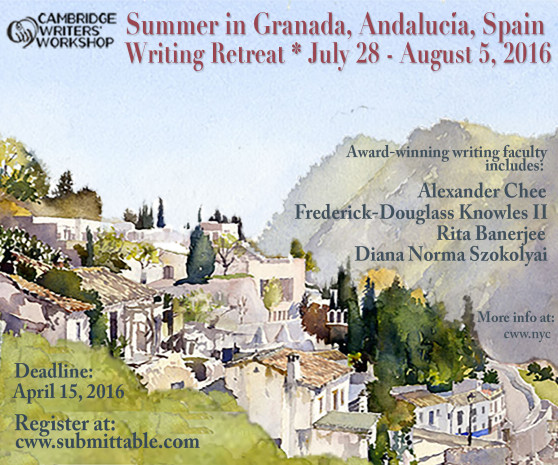
Register for CWW Summer Writing Retreat in Granada, Andalucía, Spain by April 15!


The Cambridge Writers’ Workshop Summer in Granada Writing Retreat will take place from July 28 – August 5, 2015 in Spain. Located at the foot of the Sierra Nevada mountains in Andalucía, Granada is one of the gems of Spain and has inspired writers from Washington Irving to Salman Rushdie to Ali Smith. Let the old city stimulate your writing with its winding streets, Moorish history, and evocative landscapes. Or, indulge in delicious Andalucían cuisine and traditional Arab baths. Work on your existing manuscript, or look to the beauty and warmth of Granada to inspire all-new projects.  The retreat offers the opportunity for writers of all genres and levels to work alongside award-winning authors & editors to hone their craft and expand their writing skills, while working on new or existing projects.  Faculty includes Alexander Chee (fiction), Frederick-Douglass Knowles II (poetry, performance), Rita Banerjee (poetry, fiction), and Diana Norma Szokolyai (poetry, nonfiction).  If you’d like to join us in Granada, please apply online at cww.submittable.com by April 15, 2015,  More info: cww.nyc 

Featured Faculty:
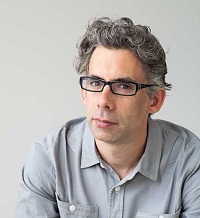
cheeAlexander Chee was born in Rhode Island, and raised in South Korea, Guam and Maine. He is a recipient of the 2003 Whiting Writers’ Award, a 2004 NEA Fellowship in Fiction, and residency fellowships from the MacDowell Colony, the VCCA, Ledig House, the Hermitage and Civitella Ranieri. His first novel, Edinburgh (Picador, 2002), is a winner of the Michener Copernicus Prize, the AAWW Lit Award and the Lambda Editor’s Choice Prize, and was a Publisher’s Weekly Best Book of the Year and a Booksense 76 selection. In 2003, Out Magazine honored him as one of their 100 Most Influential People of the Year. His essays and stories have appeared in Granta.com, Out, The Man I Might Become, Loss Within Loss, Men On Men 2000, His 3 and Boys Like Us. He has taught fiction and nonfiction writing at the New School University, Wesleyan University, Amherst College, and the Fiction program at the Iowa Writers’ Workshop. He lives in New York City and blogs at Koreanish.

Frederick-Douglass Knowles IIFDK is a poet, educator and activist involved in community education and the performing arts. He has competed on two National Poetry Slam Teams and served as the 2011 Connecticut Slam Team coach. His works have been featured in Poems on the Road to Peace: A Collective Tribute to Dr. King Volume 2Peabody Museum of Natural History by Yale University Press, The East Haddam Stage Company of Connecticut, The 13th Annual Acacia Group Conference at California State University, Folio –a Southern Connecticut State University literary magazine, Lefoko –a Botswana, Southern Africa Hip-Hop magazine and Fingernails Across the Chalkboard: Poetry and Prose on HIV/AIDS from the Black Diaspora by Third World Press. Frederick-Douglass is currently an Assistant Professor of English at Three Rivers Community College where he infuses English Composition with social injustice.

RitaBanerjeeRita Banerjee received her doctorate in Comparative Literature from Harvard and her MFA in Creative Writing from the University of Washington.  Her writing has been published or is forthcoming in the Los Angeles Review of BooksElectric Literature, VIDA: Women in Literary Arts, AWP WC&C Quarterly, Queen Mob’s Tea House, Riot Grrrl Magazine, Poets for Living Waters, The Monarch Review, The Fiction Project, Quail Bell Magazine, Jaggery, Catamaran, The Crab Creek Review, The Dudley Review, Objet d’Art, Amethyst Arsenic, Vox Populi, Dr. Hurley’s Snake-Oil Cure, Chrysanthemum, and on KBOO Radio’s APA Compass in Portland, Oregon.  Her first collection of poems, Cracklers at Night, was published by Finishing Line Press and received First Honorable Mention for Best Poetry Book of 2011-2012 at the Los Angeles Book Festival, and her novella, A Night with Kali, is forthcoming from Spider Road Press in 2016.  Creative Director of the Cambridge Writers’ Workshop, she is currently working on a novel and a book of lyric essays.

DianaNormaDiana Norma Szkoloyai is author of the poetry books Roses in the Snow and Parallel Sparrows (Finishing Line Press). Her writing and hybrid art have appeared in Lyre Lyre, Dr. Hurley’s Snake Oil Cure, The Fiction Project, Teachers as Writers, Polarity, The Boston Globe, The Dudley Review, Up the Staircase, Area Zinc Art Magazine, Belltower & the Beach, and Human Rights News. Founding Literary Arts Director of Chagall Performance Art Collaborative and co-director of the Cambridge Writer’s Workshop, she holds an Ed.M from Harvard and an M.A. in French Literature from the University of Connecticut.
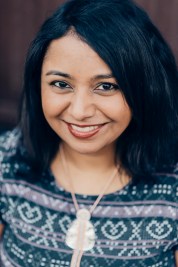
Queen Mob’s Tea House features Rita Banerjee’s Poem, “Birds on Blue”

QueenMobs-RitaBanerjee“Is it not sweet to think that, if only you have patience,
all that has ever been will come back to you?” —Isak Dinesen

The current issue of Queen Mob’s Tea House features Rita Banerjee’s jazzy atomic-age poem, “Birds on Blue.”

Rita Banerjee received her doctorate in Comparative Literature from Harvard and her MFA in Creative Writing from the University of Washington.  Her writing has been published or is forthcoming in the Los Angeles Review of BooksElectric Literature, VIDA: Women in Literary Arts, AWP WC&C Quarterly, Riot Grrrl Magazine, Objet d’Art, and on KBOO Radio’s APA Compass in Portland, Oregon.  Her first collection of poems, Cracklers at Night (Finishing Line Press) received First Honorable Mention for Best Poetry Book of 2011-2012 at the Los Angeles Book Festival, and her novella, A Night with Kali (Spider Road Press), is forthcoming in 2016.  Creative Director of the Cambridge Writers’ Workshop, she is currently working on a novel, a book on translation and modernisms, and a book of lyric essays.

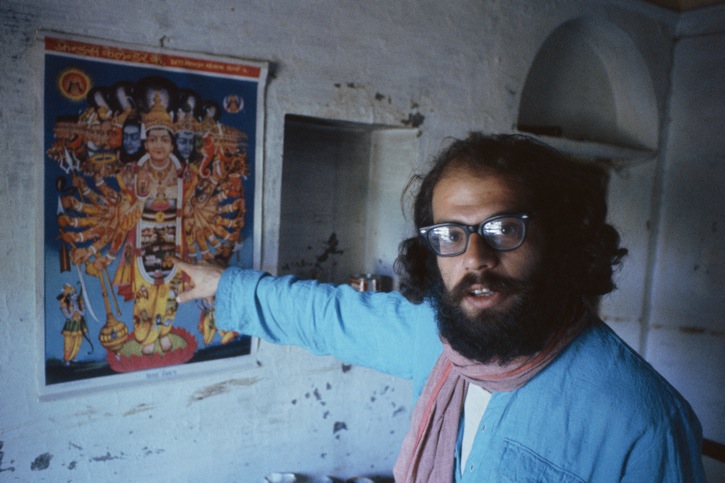
“Encountering Allen Ginsberg: The South Asian Avant-Garde Response to the Beats” – ACLA, Harvard University – March 18

BENARES, INDIA - FEBRUARY 1963: Beat poet Allen Ginsberg points at art poster during February 1963 in his tenement apartment near the banks of the Ganges river in Benaras, India. Ginsberg explored Eastern philosophies with Peter Orlovsky and other founders of the Beat movement during his March '62 - May '63 stay. (Photo by Pete turner/Getty Images)

Presented by Dr. Rita Banerjee
Cross-Cultural Values: Confluences and Conflicts
Friday March 18, 2016 * 2:00 – 3:45 pm
Emerson Hall, Room 307, Harvard University

In the early 1960s, Allen Ginsberg, Peter Orlovsky, Gregory Corso, and Gary Snyder travelled extensively across India and met with several avant-garde South Asian writer groups such as the Krittibās and Hungry Generation writers in Bengali, the Nayī Kavitā poets in Hindi, and with P. Lal’s English-language Writers Workshop group. This paper will examine the ways in which the South Asian avant-garde interpreted, welcomed, and/or challenged the Asia-oriented gaze of Allen Ginsberg and his fellow Beats. The complicated South Asian response to the Beat Generation will be investigated through examples of literary criticism, translation, and first-hand accounts of the Beats as produced by modernist, Hungry Generation, and post-Independence confessionalist writers in Hindi, Bengali, and Indian English.

“Amrita Pritam: Sexual Politics and Publishing in Mid-20th Century India” – VIDA: Women in Literary Arts Exclusive

AP2

Rita Banerjee’s article, “Amrita Pritam: Sexual Politics and Publishing in mid-20th Century India” is now live as a VIDA Exclusive on VIDA: Women in Literary Arts.  In the article, Banerjee translates Pritam’s poem, “Night” from Hindi into English, and writes:

Writing from a minority perspective as an American, it’s often hard to find creative and intellectual predecessors who are writing from your culture of origin but who aren’t necessarily writing in English or just trying to be celebrities in the global Anglophone literary marketplace.  For South Asian writers, for women in the literary arts, and for writers who are looking to challenge the patriarchal hegemony of Anglo-American literature, Amrita Pritam is a must-know writer.  In the 1940s, she came to prominence as a political and feminist writer in India, first in Punjabi literature, then in Hindi and Urdu translation, and finally internationally.  By the 1950s, like Simone de Beauvoir and Bretty Friedan in the West, Pritam was challenging patriarchal values at home, redefining gender roles and narratives assigned to women, and openly challenging heteronormative sexual politics.  In doing so, she ushered in a new wave of feminist literature in mid-20th century India even as she faced criticism for her work from her male counterparts and from within the Punjabi, Hindi, Urdu, and South Asian publishing industries at large.

That was our tryst, yours and mine.
We slept on a bed of stones,
and our eyes, lips and finger tips,
became the words of your body and mine,
they then a made translation of this first book.

The Rig Veda was compiled much later.

– Amrita Pritam, “First Book”

In Pritam’s poetry, one is not born, but rather becomes a woman.  Her unflinching gaze at sex, her exploration of emotional and psychological nakedness, and a sense of self-irony and self-knowledge underwrite several of her poems.  In her poem, “First Book,” quoted above, Pritam explores how the very act of physical, sexual love, unbound by the mores of society, collapses the distances between the sacred and the profane.  And in her poem, “Amrita Pritam,” the poet takes a hard look at the mythos of her own public identity and the narratives of victimization ascribed to it.  She writes: “Pain: / I inhaled it, / quietly like a cigarette. // Song: / I flicked off / like ash / from the cigarette.” (Singh 29).

Read the full article on VIDA: Women in Literary Arts.

Bandopadhyay’s The Song of the Road and Satyajit Ray’s Pather Pānchālī – February 2

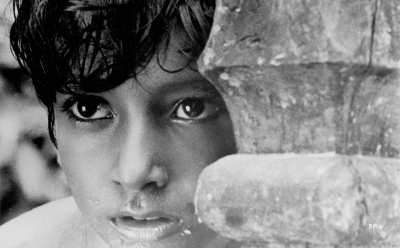
Rita Banerjee will introduce and lead the discussion for Satyajit Ray’s 1955 film, Pather Pānchālī, on Tuesday February 2 from 6-8:30 pm for the Institute for Indology and Tibetology at Ludwig-Maximilians-Universität München, (Ludwigstr. 31, Seminarraum 427).  The screening is part of the course Translation and Modern South Asian Literatures at LMU.  Anyone interested in translation studies, Modern South Asian literature, or art house film is welcomed to join the screening.  Satyajit Ray’s Pather Pānchālī is based on Bibhutibhushan Bandopadhyay’s 1929 Bengali novel, The Song of the Road.

“[Pather Pānchālī] was the birth of a cinema, certainly the birth of a new kind of Indian cinema. On the first day of the shoot, the director had never directed, the cameraman had never shot a scene, the children in the leading roles hadn’t been tested and the soundtrack was composed by a then obscure sitarist (the great Ravi Shankar). Perhaps this inexperience gave everyone involved the freedom to create something new. Certainly director Satyajit Ray and cinematographer Subrata Mitra showed a miraculous gift for lighting scenes, coaxing intimate and utterly convincing performances from children and other non-professional actors, and allowing narrative to grow seamlessly – just as happened in the best of the films by Ray’s western mentor, Jean Renoir…It’s a film that blindsides the viewer by showing a child’s perspective on the world: it is Apu and Durga’s perspective on a train passing by, their discovery of their aunt’s body or their excitement at the sound of the sweet-seller’s bells that captivate us jaded adults. This is the first of a trilogy in which Apu leaves childish things behind and goes into a world every bit as confounding as the one his father could not master.” – Stuart Jeffries, The Guardian

“Calcutta, Marwaris, and the World of Hindi Letters” – Dissertation Reviews

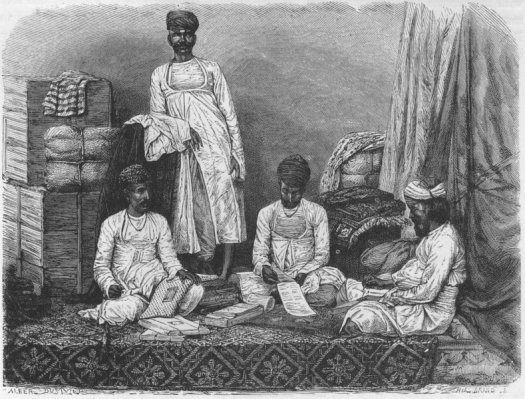
india-marwari-merchants-kolkata-antique-print-1878In January 2016, Rita Banerjee’s review of The Bazaar and the Bari: Calcutta, Marwaris, and the World of Hindi Letters, a dissertation by Rahul Bjørn Parson, was published in Dissertation Reviews.  Banerjee writes,  “The premise of Rahul Bjørn’s Parson’s dissertation, The Bazaar and the Bari: Calcultta, Marwaris, and the World of Hindi Letters, is an intriguing one. In the dissertation, Parson examines the history and reception of Hindi literary texts, particularly those produced about Marwaris and by Marwari writers from the 19th to early 21st centuries in Kolkata. In the latter half of his dissertation, Parson calls attention to the rise of Marwari women writers, and their role in shaping representations of their community, which had been historically, linguistically, and socially marginalized within the cultural metropole of Kolkata.

In the introduction, Parson makes a distinction between the Bengali concept of ‘baṛi’ or home and the Marwari notion of ‘deś’ or homeland. He notes that often in traditional Marwari households, the bazaar or market was part and parcel of the Marwari home, or baṛi. But neither the marketplace nor the home gave a fully accurate representation of the modern Marwari, whose identity and imagination was closely linked to a separation from the homeland, or deś. Moreover, Parson argues, the Marwaris, who were a merchant community from Rajasthan, ‘attracted a fair amount of resentment. The insular nature of their networks and the community contributed to the stigma of clannishness that was computed with a host of other stereotypes that attend to moneylenders’ (5). He notes that texts such as the Hindi journal Chānd capitalized on stereotypes of the Marwari community in order to push concepts of gender, education, and capitalist reform. Parson also notes how narratives of victimhood and social marginalization were automatically attributed to Marwari women until Marwari female writers such as Prabha Kethan, Alka Saraogi, and Madhu reclaimed their own authorial voice in texts such as Pīlī Āndhī, Kalikathā: Via Bypass, and Khule Gagan ke Lāl Sitāre in the mid-1990s and early 2000s. In order to interrogate these stereotypes of the Marwari community within the Bengali-dominated cultural milieu of Kolkata and within the rising world of Hindi letters at the fin-de-siècle, Parson emphasizes the roles that Marwaris, a heterogeneous community, played in the economies of colonial and late capitalism as well as in the development of Hindi language newspapers, presses, libraries, and authors in Kolkata…”  

Read the full review here.