

Disobedient Futures: An Anthology (UPK, May 4, 2027) Cover Reveal & Pre-Order Page Launches

We are delighted to present the cover reveal and pre-order page for DISOBEDIENT FUTURES: AN ANTHOLOGY (University Press of Kentucky, May 4, 2027).

DISOBEDIENT FUTURES, edited by Rita Banerjee, Diana Norma Szokolyai, and Corrine Previte, is a speculative literature anthology that imagines what the future cultures of America and the world might look like through a diverse, inclusive, and multi-genre lens. The anthology includes fiction, poetry, nonfiction, hybrid work, art, and photography that explore utopian, dystopian, and alternative realities, futuristic places, and parallel histories through the perspectives of disobedient gender, disobedient identities, disobedient class, disobedient borders, and disobedient environmentalism. DISOBEDIENT FUTURES aims to foster new modes of critical inquiry and invites readers to play and imagine thought-provoking and more inclusive possibilities for the future.

Cover Art Credits: Shanta Lee Honeycutt* & Jamie McKee

*The image featured on the cover, “Take Me To Where Souls Get Snatched” (2021), is original photography by Shanta Lee Honeycutt within her series and previous exhibition, Dark Goddess. Learn more by visiting Shantalee.com.

Featured Authors & Artists:

George Abraham | Thommy Ahneesan | Kazim Ali | Kenzie Allen | Paul Daniel Ash | Madeleine Barnes | Rita Banerjee | Zeina Hashem Beck | Alyssa Beckitt | Oliver Baez Bendorf | Emma Bolden | Frances Cannon | Alex Carrigan | Marianne Chan | Kholoud Charaf | Marlena Chertock | Kristina Marie Darling | JJJJJerome Ellis | Ayokunle Falomo | Carlos Andrés Gómez | Dipika Guha | Robin Hemley | Candace Jensen | Shanta Lee Honeycutt | Shirley Jones-Luke | Ilya Kaminsky | Liz Kellebrew | Raphaël Amahl Khouri | Samuel Kọ́láwọlé | Oksana Marafioti | Adam McOmber | Sebastian Merrill | Rajiv Mohabir | Neha Mulay | Ukamaka Olisakwe | Matthew Olzmann | January Gill O’Neil | Josiah Patterson | Diana Norma Szokolyai | Corrine Previte | Ruben Quesada | Thaddeus Rutkowski | Nneka Samuel | Jason Schneiderman | Kyle Scott | Dayton Shafer | Dennis Shafer | David Shields | Erin Stalcup | Margo Taft Stever | Bianca Stone | Anca L. Szilágyi | Brian Teare | Ella Voss | David Heska Wanbli Weiden | Cecilia Woloch

Preorder DISOBEDIENT FUTURES: AN ANTHOLOGY here now: https://www.kentuckypress.com/9781985905245/disobedient-futures/

About the Editors:

Rita Banerjee is associate professor of creative writing and director of the MFA Program for Writers at Warren Wilson College. She is coeditor of CREDO: An Anthology of Manifestos and Sourcebook for Creative Writing and author of Echo in Four Beats, A Night with Kali, and Cracklers at Night. Banerjee is also cowriter of the documentary film Burning Down the Louvre. She cofounded and serves as executive creative director of the Cambridge Writers’ Workshop.

Diana Norma Szokolyai is a writer, teacher, and interdisciplinary artist. She is coeditor of CREDO: An Anthology of Manifestos and Sourcebook for Creative Writing and author of Parallel Sparrows and Roses in the Snow. Her poetry has appeared in The Boston Globe, Critical Romani Studies, and The Poetry Miscellany. She cofounded and serves as executive artistic director of the Cambridge Writers’ Workshop.

Corrine Previte is a writer and educator living inBoston’s North Shore. Her work has appeared in Wanderlust Journal.Previte holds an M.Ed in English as a Second Language and Structured Literacy from Gordon College and serves as manager of the Cambridge Writers’ Workshop. She is currently working on her first children’s book.

#DisobedientFutures #Anthology #CoverReveal #AmReading #SpeculativeLiterature #SpeculativeFiction #SpeculativeNonfiction #Poetry #Fiction #CreativeNonfiction #Theatre #Plays #Art #Photography #IllustratedLiterature #GlobalPerspectives #Disobedience #CreativeWriting #RitaBanerjee #DianaNormaSzokolyai #CorrinePrevite #ShantaLeeHoneycutt #UniversityPressofKentucky #CambridgeWriterWorkshop
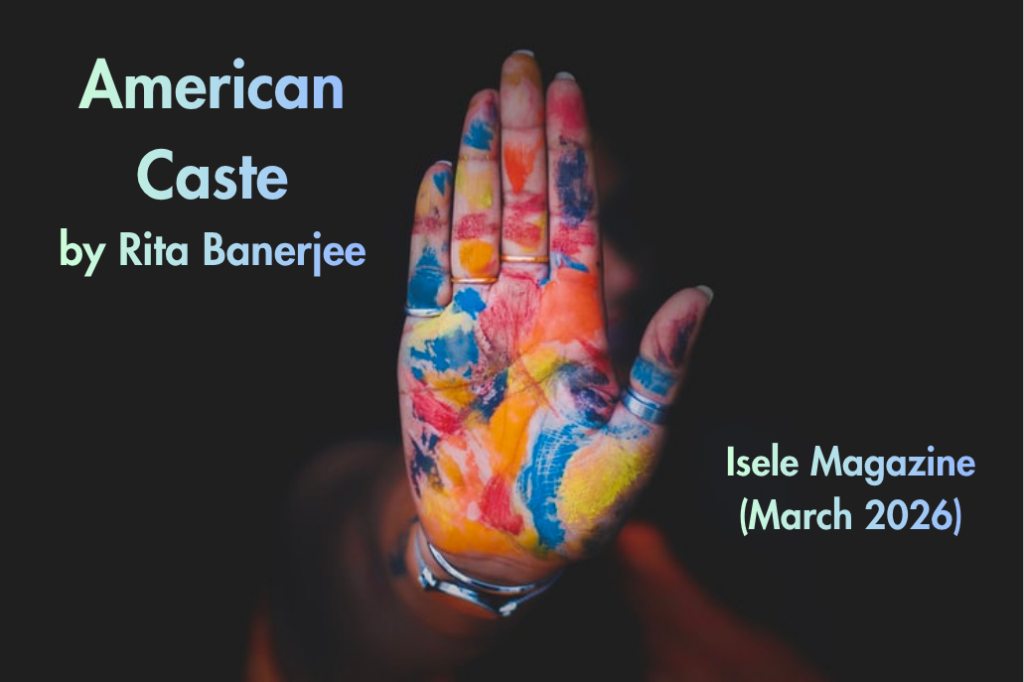
Rita Banerjee’s essay “American Caste” debuts in Isele Magazine (March 2026)

Rita Banerjee’s essay “American Caste” debuts in Isele Magazine’s first special issue of 2026. The essay will also be featured and anthologized in Disobedient Futures (University Press of Kentucky, 2027).

Founded in July 2020 by Nigerian novelist Ukamaka Olisakwe, Isele Magazine publishes notable fiction, poetry, essays, interviews, art/photography, and reviews from writers on the African continent and around the world. Isele believes that literature and the arts are an integral part of the daily conversations that uplift and/or shape our thinking. Isele publishes writers and artists who hold a mirror to our society, who challenge conventional expectations about ways of being, how to be, and who decides who should be.

Rita Banerjee’s essay “American Caste” explores the various kinds of caste systems, or social hierarchies, which invisibly structure, stratify, and thus, harm American society. In the essay, she writes:

There’s an old saying in India: “If you move across oceans, you lose all caste.” The dictum is meant to be a presage, a warning to those who seek the riches and adventures of outside worlds and once there, lose their foothold in society, or when returning home, find themselves a stranger in a stranger’s land.

Cross the dark waters and lose all varṇa—lose all indication of status, wealth, social rank, prestige, privilege, and power. Lose the language of home, lose its logic, lose the understanding of supremacy and subordination, lose the sense of right action, lose wrong thought.

When my father moved to the United States in 1973 as a young graduate from engineering school and then married my mother in 1976 and brought her back to New York with him (thus, abruptly halting her graduate studies and what might have been a prosperous career in academia), I like to think, in some sort of unconscious, subversive, maybe even self-destructive way, what my parents were fleeing was not war or communism or difficult financial circumstances or a democracy trying to grow through the stinging shards of post-colonialism, but what they subconsciously were escaping was caste.

To be a Brahmin in India was to acknowledge (if one dared) both your great privilege as keepers of sacred knowledge (as conveyers of grammar, astronomy, mathematics, statecraft, social mores, philosophy, and theories of art and human behavior) across generations, and your incredible complicity in the social violence that is the Indian caste system.

The first acknowledgement celebrated high culture and the triumph of Brahmanism across millennia in the face of challenges from Buddhism, Jainism, Cārvāka materialism, and Bhaktism (all of which sought to dismantle caste), and in the face of Zoroastrianism, Islam, Sikhism, Christianity, and Judaism (which offered South Asians alternative models to achieve enlightenment). The second asked Brahmins to interrogate what was behind their lofty, aspirational, and supposedly innocuous ideal of “knowledge is power.”

* * *

In Caste Matters, Suraj Yengde writes, “caste should no longer be invisible” (35).

Caste, in its most basic form and intent, identifies, venerates, and calcifies social hierarchies. By capitalizing on the fear of the other, caste systems hinder social mobility and aim to prevent people from mixing across tribal, class, gender, religious, linguistic, and ability categories. By being encoded into social stigmas and taboos and being systemic in nature, caste often functions as an “invisible” force that makes us fear anyone who is unlike us. Caste makes us suspect anyone who exists outside of our spectrum of knowledge, culture, or kin. By consolidating socio-political power to those who have the most cultural capital or are perceived to be of the highest social rank, caste allows the few to benefit from the oppression, exploitation, and sacrifices of the many.

Read the full version of Rita Banerjee’s essay “American Caste” in Isele Magazine here.

Disobedient Futures – Call for Submissions

The Cambridge Writers’ Workshop welcomes submissions of poetry, fiction, nonfiction, mixed-genre work, plays, and screenplays on the topic of “Disobedient Futures” for our new speculative literature anthology. Writers are encouraged to imagine what the future cultures of America and the world might look like, and submit their work on the following topics:

Disobedient Women: How might women, feminists, and/or non-binary individuals disobey and reconfigure our understandings of power and femininity and masculinity in the future?

Disobedient Tribes: What if Americans found a way to subvert racial categories and challenge tribalism and cultures of fear? How might tribes disobey the rules of the game and create new types of community identities and cultural bridges?

Disobedient Class: Could Americans in the future overcome systems of class oppression and capitalist gluttony? How might individuals in the future subvert class hierarchies?

Disobedient Futures: Tell us what the future cultures of America and the world have in store. How might the emerging generations of today and tomorrow reconfigure today’s value systems, challenge today’s modes of violence, oppression, and power, and create new visions of society? Give us your best speculative writing which explores the possibilities and disruptions of disobedient futures.

Writers are welcome to submit utopian, dystopian, parallel history, futuristic, alternative reality, speculative essay, and even purely speculative fiction, nonfiction, poetry, and theatre. Optimistic and pessimistic tales of the future are welcome in equal measure, but gratuitous violence and discrimination are not. Poetry submissions should be 3-5 pages in length. Prose submissions can be 10-20 pages in length.  Excerpts from longer works with synopses are welcome. Visual art related to these categories of Disobedient Futures is also welcome.  Submit your retelling of the future today!

Submit your work at cww.submittable.com
Deadline: February 14, 2019