
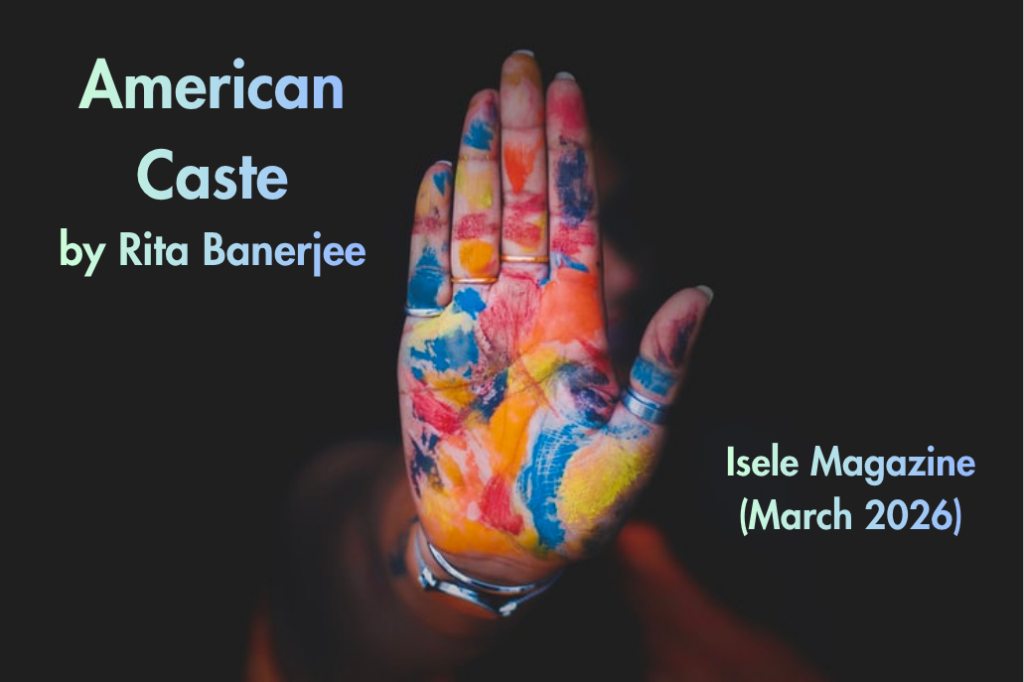
Rita Banerjee’s essay “American Caste” debuts in Isele Magazine’s first special issue of 2026. The essay will also be featured and anthologized in Disobedient Futures (University Press of Kentucky, 2027).
Founded in July 2020 by Nigerian novelist Ukamaka Olisakwe, Isele Magazine publishes notable fiction, poetry, essays, interviews, art/photography, and reviews from writers on the African continent and around the world. Isele believes that literature and the arts are an integral part of the daily conversations that uplift and/or shape our thinking. Isele publishes writers and artists who hold a mirror to our society, who challenge conventional expectations about ways of being, how to be, and who decides who should be.
Rita Banerjee’s essay “American Caste” explores the various kinds of caste systems, or social hierarchies, which invisibly structure, stratify, and thus, harm American society. In the essay, she writes:
There’s an old saying in India: “If you move across oceans, you lose all caste.” The dictum is meant to be a presage, a warning to those who seek the riches and adventures of outside worlds and once there, lose their foothold in society, or when returning home, find themselves a stranger in a stranger’s land.
Cross the dark waters and lose all varṇa—lose all indication of status, wealth, social rank, prestige, privilege, and power. Lose the language of home, lose its logic, lose the understanding of supremacy and subordination, lose the sense of right action, lose wrong thought.
When my father moved to the United States in 1973 as a young graduate from engineering school and then married my mother in 1976 and brought her back to New York with him (thus, abruptly halting her graduate studies and what might have been a prosperous career in academia), I like to think, in some sort of unconscious, subversive, maybe even self-destructive way, what my parents were fleeing was not war or communism or difficult financial circumstances or a democracy trying to grow through the stinging shards of post-colonialism, but what they subconsciously were escaping was caste.
To be a Brahmin in India was to acknowledge (if one dared) both your great privilege as keepers of sacred knowledge (as conveyers of grammar, astronomy, mathematics, statecraft, social mores, philosophy, and theories of art and human behavior) across generations, and your incredible complicity in the social violence that is the Indian caste system.
The first acknowledgement celebrated high culture and the triumph of Brahmanism across millennia in the face of challenges from Buddhism, Jainism, Cārvāka materialism, and Bhaktism (all of which sought to dismantle caste), and in the face of Zoroastrianism, Islam, Sikhism, Christianity, and Judaism (which offered South Asians alternative models to achieve enlightenment). The second asked Brahmins to interrogate what was behind their lofty, aspirational, and supposedly innocuous ideal of “knowledge is power.”
* * *
In Caste Matters, Suraj Yengde writes, “caste should no longer be invisible” (35).
Caste, in its most basic form and intent, identifies, venerates, and calcifies social hierarchies. By capitalizing on the fear of the other, caste systems hinder social mobility and aim to prevent people from mixing across tribal, class, gender, religious, linguistic, and ability categories. By being encoded into social stigmas and taboos and being systemic in nature, caste often functions as an “invisible” force that makes us fear anyone who is unlike us. Caste makes us suspect anyone who exists outside of our spectrum of knowledge, culture, or kin. By consolidating socio-political power to those who have the most cultural capital or are perceived to be of the highest social rank, caste allows the few to benefit from the oppression, exploitation, and sacrifices of the many.
Read the full version of Rita Banerjee’s essay “American Caste” in Isele Magazine here.

 Rita Banerjee