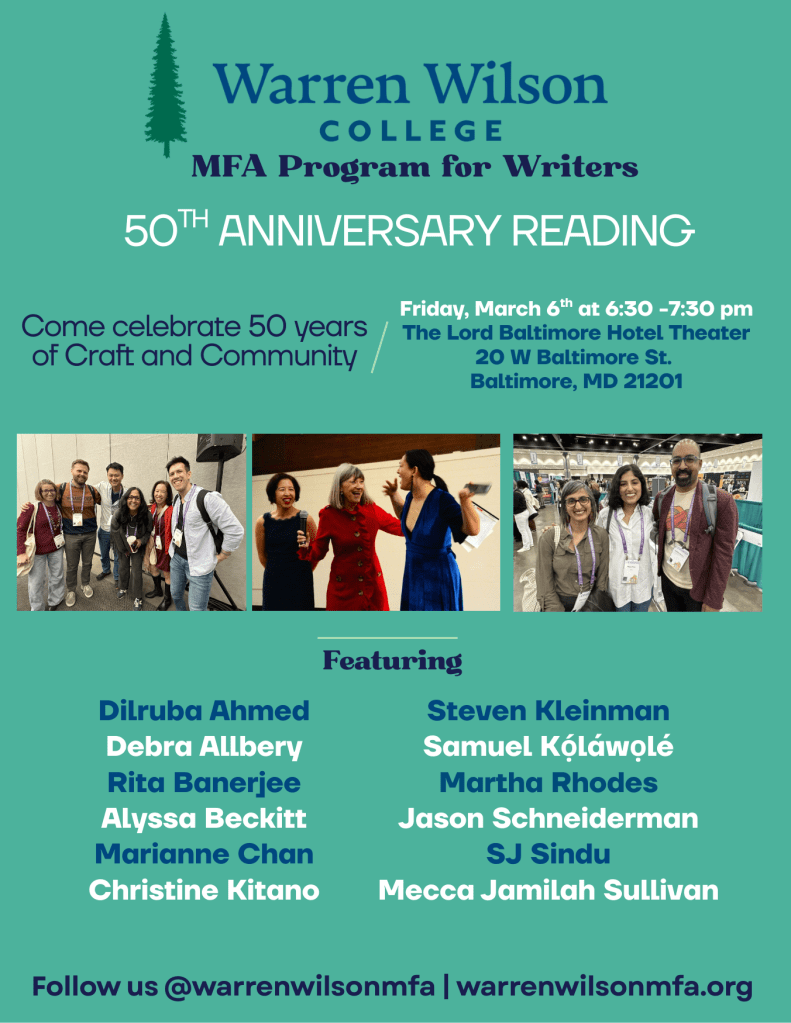
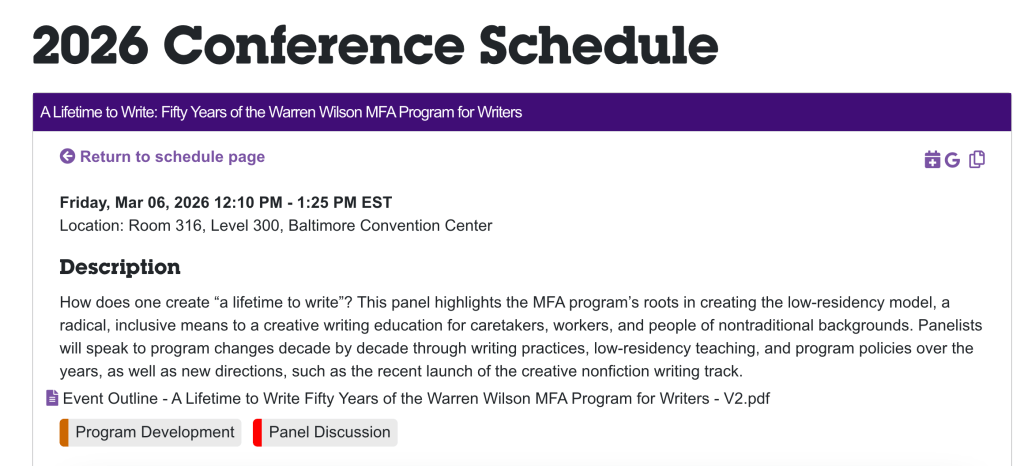
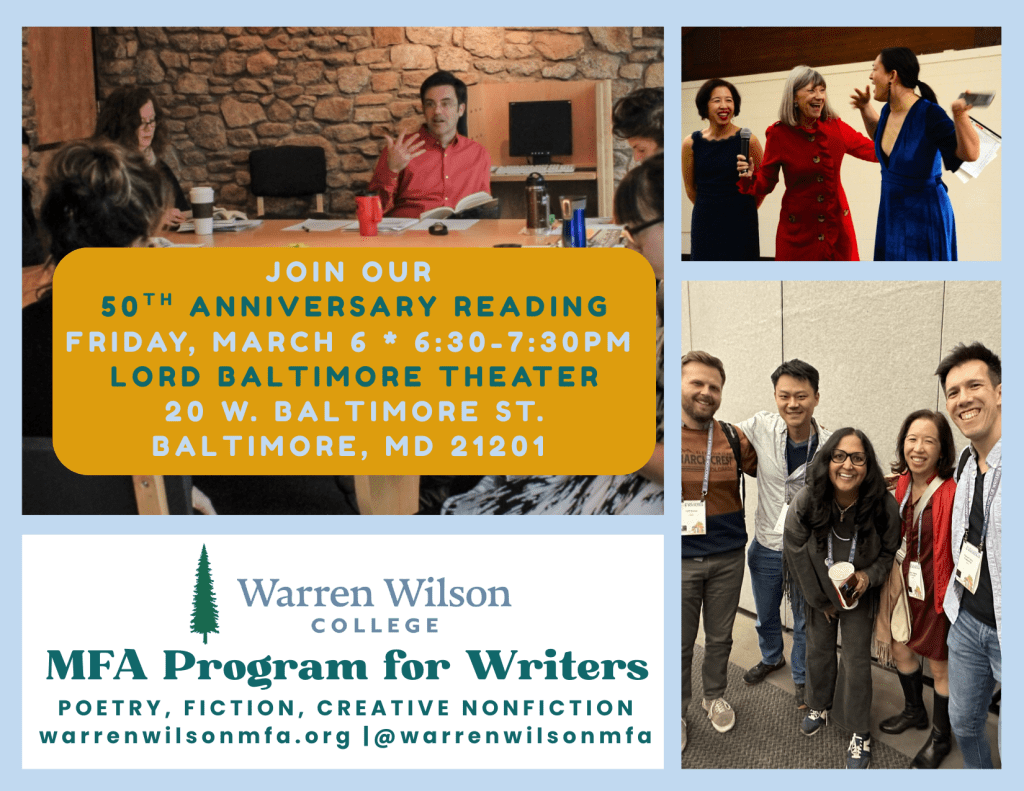
If you are planning to attend the AWP 2026 Conference in Baltimore, MD from March 4-7, 2026, stop by these events featuring Rita Banerjee and the MFA Program for Writers at Warren Wilson College! The MFA Program for Writers will be celebrating its 50th Anniversary at a variety of events on March 6, 2026. And to learn more about the MFA Program for Writers at Warren Wilson College, stop by the Warren Wilson MFA Booth (#T492) at the AWP 2026 Conference!
During the Innovation & Empowerment: A Workshop for Writers (July 10-28, 2026), Rita Banerjee will be teaching a lecture and workshop for writers on “Classical Greek and Indian Approaches to Poetry, Dramaturgy, and Storytelling” on July 18-19, 2026, followed by a faculty reading with Dr. Kristina Marie Darling on July 18, 2026 at 6 pm. More information about the course follows below:
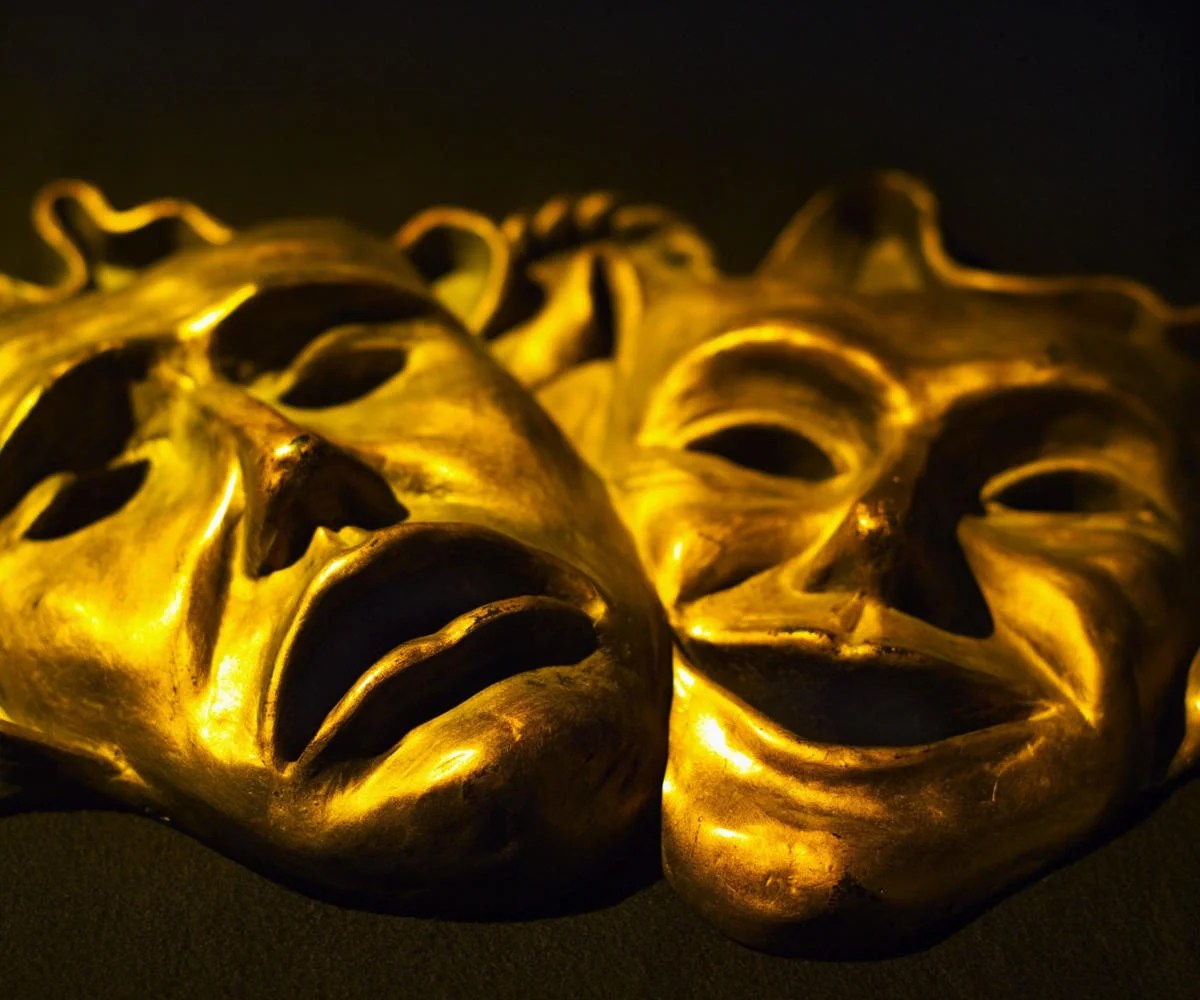
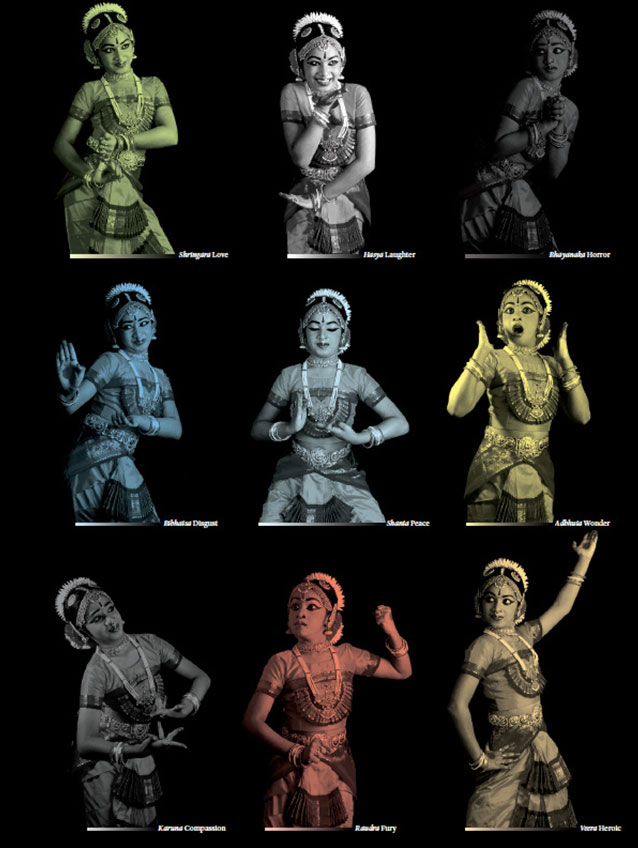
In The Republic (ca. 375 BCE), Plato states, “the tragic poet is an imitator, and therefore, like all other imitators, he is thrice removed from the king and from the truth.” Plato wants to kick the poet out of the republic because the poet does not answer to the king, and because poets challenge the ready-made truths of the status quo. In the Sanskrit tradition, the poet (kavī) is depicted as a wise seer (rishi), and one who holds up the heavens from the earth and thus serves as a translator of the celestial and the spiritual in the Rig Veda (ca. 1500 BCE). In response to his tutor Plato, Aristotle composes a defense of poetry in the Poetics (ca. 335 BCE), and argues that poetry, theatre, and literature are critically necessary for audiences as literature, and tragic theatre in particular, allows audiences to undergo catharsis. Aristotle maps how effective narratives can be built and how literature can be separated into the categories of comedy and tragedy. In contrast, in the Nāṭyaśāstra(ca. 200 BCE), Bharata outlines the eight main emotional states that are required to make any work of art become a classic. Bharata’s development of rasa theory provides a new way of considering narrative design which centers emotion, as do his discussions of bindus (turns) and how characters and plot develop in literary texts where emotion gives rise to action. In this class, we will study how literary theorists and dramaturgs such as Plato, Aristotle, Bharata, and Abhinavagupta offer different but intriguing approaches to poetry, dramaturgy, and storytelling and how we might use these classical Greek and Indian approaches to poetry and narrative design in our own creative work.
In the 21st Century, creative writers in the United States are facing unprecedented challenges to their discipline, craft, and survival. In 2025 alone, writers have witnessed large cuts in government funding for universities and humanities departments, the suspension of the NEA Fellowship for Creative Writers, and a number of class-action lawsuits against Artificial Intelligence companies, such as Bartz vs. Anthropic, in which A.I. companies are accused of illegally downloading 7.5 million literary and scholarly books and 81 million research papers to train their Large Language Model systems.[1] In this era of late capitalism, how can writers find viable ways to maintain and grow in their craft, seek the education in the humanities they desire, and create sustainable careers and communities in creative writing? As a multi-genre writer who is deeply inspired by world literature and transnationalism, Dr. Rita Banerjee will discuss her journey as a writer and literary citizen, and will share resources on how creative writers can create sustainable, nurturing, and viable careers, writing practices, and literary communities despite the pressures of American capitalism.
About the Author:
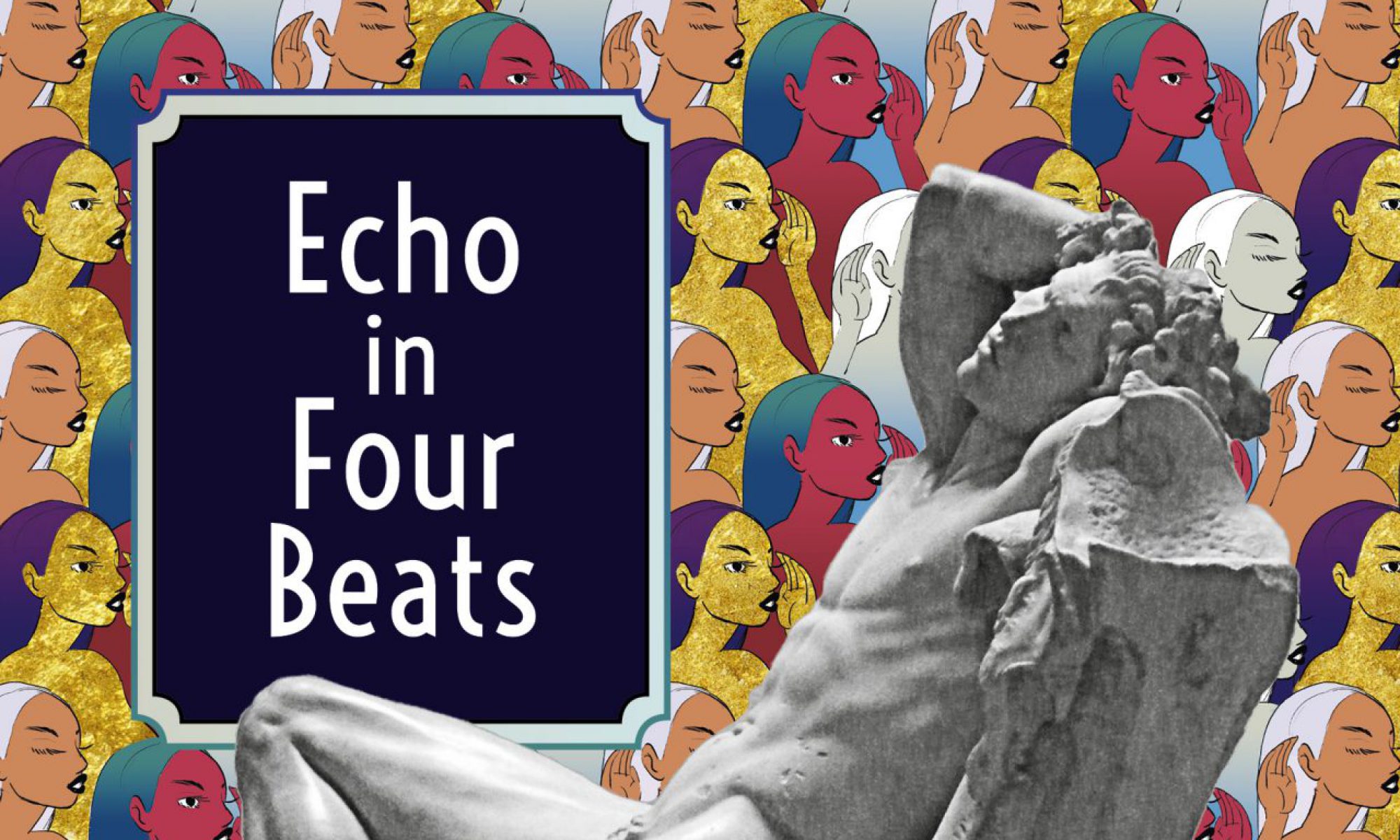
Rita Banerjee is an Assistant Professor of Creative Writing and Director of the MFA Program for Writers at Warren Wilson College. She received her doctorate in Comparative Literature from Harvard University and her MFA in Creative Writing from the University of Washington. She is editor of the forthcoming anthology Disobedient Futures (University Press of Kentucky) in which writers imagine what the future cultures of the United States and the world could look like if folks disobeyed gender, tribal, and class paradigms, and explored disobedient forms of environmentalism and borders. She is also the author of CREDO: An Anthology of Manifestos and Sourcebook for Creative Writing, the poetry collections Echo in Four Beats and Cracklers at Night, the novella “A Night with Kali” in Approaching Footsteps, and is co-writer of Burning Down the Louvre, a forthcoming documentary film about race, tribalism, and intimacy in the United States and in France. Her work appears in Sign & Breath: Voice and the Literary Tradition,Academy of American Poets, Poets & Writers, PANK, Nat. Brut., Hunger Mountain, Tupelo Quarterly, Isele, Vermont Public Radio, and elsewhere. She serves as Senior Editor of the South Asian Avant-Garde and Executive Creative Director of the Cambridge Writers’ Workshop, which she co-founded at Harvard in 2008. She received a Vermont Arts Council Creation Grant for her new memoir and manifesto on female cool, and one of the book’s opening chapters “Birth of Cool,” was a Notable Essay in the 2020 Best American Essays, and another chapter, “The Female Gaze,” was a Notable Essay in the 2023 Best American Essays.
[1] Reisner, Alex. “The Unbelievable Scale of AI’s Pirated Book Problem.” The Atlantic. Online. March 20, 2025.
On September 18, 6:30 pm EDT, Shanta Lee and Philip Brady, the editors of Sign & Breath: Voice and the Literary Tradition, will be celebrating the launch of their new anthology with a reading featuring their Sign & Breath Authors. Featured authors will include Tim Seibles, Rita Banerjee, Diana Whitney, Ru Freeman, Diane Raptosh, Philip Metres, Haleh Gafori, Claire Bateman, Carolyn Finney, and Bruce Smith. Please register on Zoom to attend the reading at 6:30 pm EDT.
Rita Banerjee will be reading from her flash essay “The Spirit Door” during the Sign & Breath Reading Launch.
Featuring a range of contemporary artists, many of whom work across different mediums and genres, Sign & Breath introduces the reader to one page that sings in any genre – prose, fiction, poetry, spoken word, hybrid forms, and song – across diverse traditions. Rather than define poetry as a genre with conventions, traditions, codes, and modalities, this book features poetry as a faculty that thrums in all written and spoken art. Readers are introduced to a text followed by a discussion with the author about creating the piece, ties to creative lineage, and the definition of voice through their practice. This anthology contributes to the dialogue among genres which will reframe understanding of poetry as an aesthetic experience of language. With one page that sings in any genre, Sign & Breath presents a new, inclusive perspective on poetry while two questions remain: Do we have a clearer understanding of what defines poetry? Do we have a clearer understanding of voice?
Sign & Breath: Voice and the Literary Tradition debuted on August 26, 2025. You can order Sign & Breath here and read Rita Banerjee’s personal flash essay “The Spirit Door” and interview, which are featured in the anthology.
Poet Michael Mercurio hosts and curates “What the Universe Is,” a poetry reading series featuring poets and writers Rita Banerjee and Amanda Shaw reading at 7:30 pm EST on Tuesday, February 11, 2025. Register for the reading on Zoom and join the reading live at: bit.ly/WTUIFeb2025! And here’s more information about the reading & writers below:
Make some time for poetry during this shortest of months. Come hear two exceptional poets read for you on Zoom, so you don’t have to leave the house in these cold & dark days. Let these poets bring you light & warmth!
Rita Banerjee is an Assistant Professor of Creative Writing and Director of the MFA Program for Writers at Warren Wilson College. She is author of Disobedient Futures,CREDO: An Anthology of Manifestos and Sourcebook for Creative Writing, Echo in Four Beats, “A Night with Kali” in Approaching Footsteps, and Cracklers at Night, and co-writer of the documentary Burning Down the Louvre. Her work appears in Academy of American Poets,Poets & Writers, PANK, Nat. Brut., Hunger Mountain, Tupelo Quarterly, Isele, Vermont Public Radio, and elsewhere. She serves as Senior Editor of the South Asian Avant-Garde and Executive Creative Director of the Cambridge Writers’ Workshop. She received a Vermont Arts Council Creation Grant for her new memoir and manifesto on female cool, and one of the book’s opening chapters “Birth of Cool,” was a Notable Essay in the 2020 Best American Essays, and another chapter, “The Female Gaze,” was a Notable Essay in the 2023 Best American Essays.
Amanda Shaw is the author of It Will Have Been So Beautiful (Lily Poetry Review Books, 2024). Based in Washington, DC, she is a teacher and editor at the World Bank and other international organizations. Her poems have appeared in LEON Literary Review, Spoon River Poetry Review, The Mid-Atlantic Review, and Lily Poetry Review, which she recently joined as the reviews editor. Over the last 25 years, she has taught students of all ages and backgrounds in New York, Boston, Detroit, and Rome, Italy.
It’s very easy to register at bit.ly/WTUIFeb2025 — make sure you don’t miss out!
Join Friends of Writers on October 26th at 7:00 PM ET for FOW Fall Fête, a celebration and fundraiser honoring the work of Friends of Writers in Hillsborough, North Carolina presented by FOW and House Party Reading Series. The evening will feature readings by alumni and faculty from the MFA Program for Writers at Warren Wilson College including Sarah Audsley, Rita Banerjee, Megan Pinto, Carter Sickels, and Connie Voisine.
The event is free and open to the public. Limited edition broadsides made by Trish Marshall will be available for sale. Audio recording will be available after the event to registrants. RSVP required.
Sarah Audsley is the author of Landlock X (Texas Review Press). A Korean American adoptee, a graduate of the MFA Program for Writers at Warren Wilson College, and a member of The Starlings Collective, Audsley lives and works in northern Vermont. She is the Writing Program Director at Vermont Studio Center.
Rita Banerjee is an Assistant Professor of Creative Writing and Director of the MFA Program for Writers at Warren Wilson College. She is the author of the poetry collections Echo in Four Beats, which was named one of Book Riot’s “Must-Read Poetic Voices of Split This Rock 2018,” and Cracklers at Night. She is also editor of CREDO: An Anthology of Manifestos and Sourcebook for Creative Writing, and author of the novella “A Night with Kali” in Approaching Footsteps. She received her doctorate in Comparative Literature from Harvard University and her MFA in Creative Writing from the University of Washington, and her work appears in Academy of American Poets, Poets & Writers, PANK, Nat. Brut., Hunger Mountain, Tupelo Quarterly, Isele Magazine, Los Angeles Review of Books, VIDA, Vermont Public Radio, and elsewhere. She serves as Editor-at-Large of the South Asian Avant-Garde and Executive Creative Director of the Cambridge Writers’ Workshop, and she is the co-writer and co-director of Burning Down the Louvre, a forthcoming documentary film about race, intimacy, and tribalism in the United States and in France. She received a 2021-2022 Creation Grant from the Vermont Arts Council for her new memoir and manifesto on female cool, and one of the opening chapters of this new memoir, “Birth of Cool” was a Notable Essay in the 2020 Best American Essays, and another chapter from her new memoir, “The Female Gaze,” was a Notable Essay in the 2023 Best American Essays.
Megan Pinto’s debut collection, Saints of Little Faith, is forthcoming with Four Way Books in September 2024. The winner of the 2023 Halley Prize from the Massachusetts Quarterly Review, Megan’s poems can be found or are forthcoming in the Los Angeles Review of Books, Guernica, Ploughshares, Lit Hub, and elsewhere. Megan has received scholarships and fellowships from the Bread Loaf Writers’ Conference, the Martha’s Vineyard Institute of Creative Writing, the Port Townsend Writers’ Conference, Storyknife, The Peace Studio and an Amy Award from Poets & Writers. She lives in Brooklyn and holds an MFA in Poetry from Warren Wilson. http://www.meganpinto.com
Carter Sickels is the author of the novel The Prettiest Star (Hub City, 2020), winner of the Ohioana Book Award in Fiction, the Southern Book Prize, and the Weatherford Award, and selected as a Kirkus Best Book of 2020 and a Best LGBT Book by O Magazine. His debut novel The Evening Hour (Bloomsbury, 2012) was a Lambda Award and Triangle Publishing Award finalist, and adapted into a feature film that premiered at the Sundance Film Festival in 2020. His writing has appeared in publications including The Kenyon Review, The Atlantic, Oxford American, Poets & Writers, BuzzFeed, and Guernica. Carter has received fellowships from the Bread Loaf Writers’ Conference, the Virginia Center for the Creative Arts, and MacDowell. He is an assistant professor of English and Creative Writing at North Carolina State University. You can find more information at http://www.cartersickels.com.
Connie Voisine is the author of the recent book of poems, The Bower, begun on a Fulbright Fellowship to Northern Ireland. A previous book, Rare High Meadow of Which I Might Dream, was a finalist for the Los Angeles Times Book Award. Her first book, Cathedral of the North, won the Associated Writing Program’s Award in Poetry. She has poems published in The New Yorker, Ploughshares, Poetry Magazine, Black Warrior Review, The Threepenny Review, and elsewhere. Educated at Yale University, University of California at Irvine, and University of Utah, Voisine directs the creative writing program at New Mexico State University and teaches in Warren Wilson College’s MFA for Writers. She was a 2021-2022 Guggenheim Fellow.
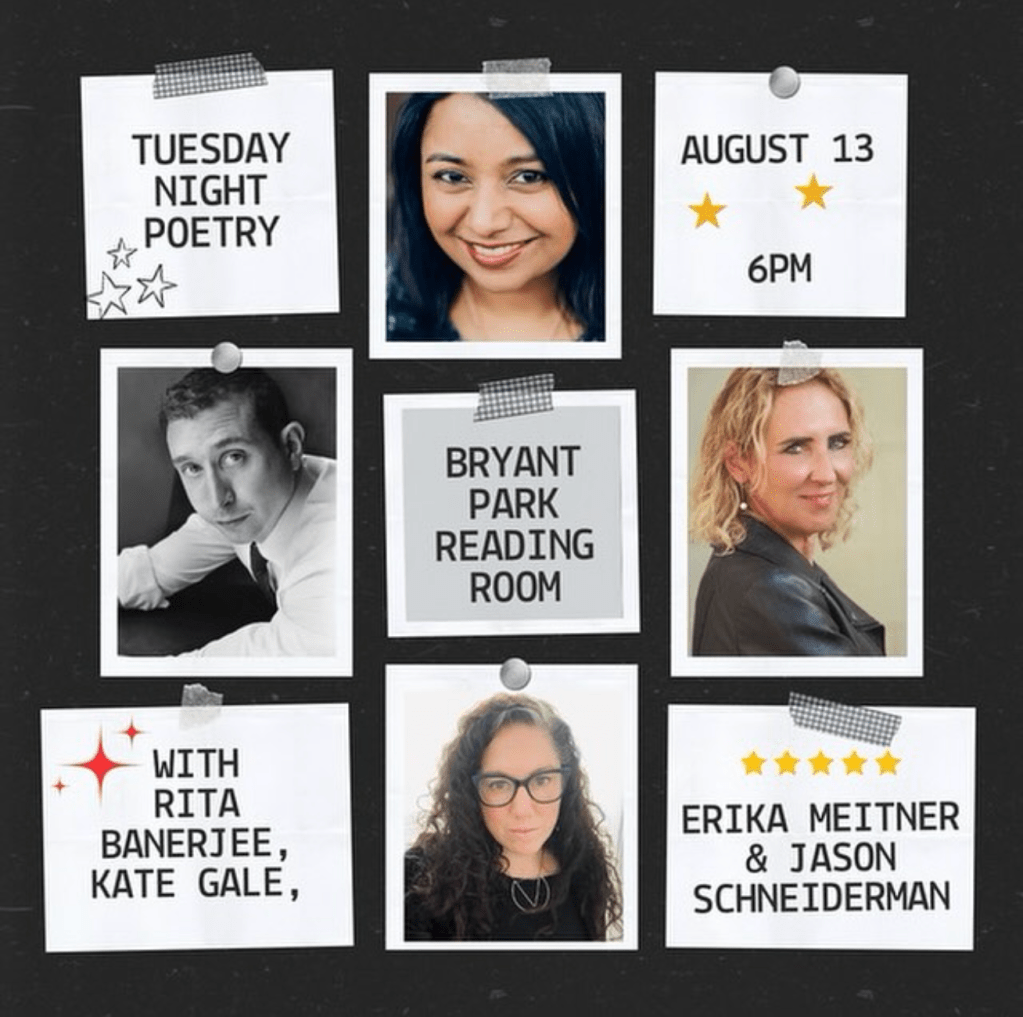
On August 13, the Bryant Park Reading Room (curated by Jason Schneiderman) will feature poets Rita Banerjee, Kate Gale, Erika Meitner, and Jason Schneiderman for a reading from 6:00-7:00 pm EDT.
Rita Banerjee is an Assistant Professor of Creative Writing and Director of the MFA Program for Writers at Warren Wilson College. She is author of Disobedient Futures, CREDO: An Anthology of Manifestos and Sourcebook for Creative Writing, Echo in Four Beats, the novella “A Night with Kali” in Approaching Footsteps, and Cracklers at Night. She received her doctorate in Comparative Literature from Harvard and her MFA from the University of Washington. Her work appears in Hunger Mountain, Isele, Nat. Brut., Poets & Writers, Academy of American Poets, Los Angeles Review of Books, Vermont Public Radio, and elsewhere. She received a VAC Creation Grant for her new memoir and manifesto on female cool, and one of the opening chapters of this memoir, “Birth of Cool” was a Notable Essay in the 2020 Best American Essays, and another chapter, “The Female Gaze,” was a Notable Essay in the 2023 Best American Essays.
Dr. Kate Gale is co-founder and publisher of Red Hen Press. She is the author of Under a Neon Sun from Three Rooms Press and The Loneliest Girl from the University of New Mexico Press and of seven books of poetry including The Goldilocks Zone and six librettos including Rio de Sangre, a libretto for an opera with composer Don Davis, which had its world premiere at the Florentine Opera in Milwaukee. Her opera on Esther was written for the singer Hila Plitmann and is in process with the composer Mark Abel.
Erika Meitner is the author of six books of poems, including Useful Junk (BOA Editions, 2022), and Holy Moly Carry Me (BOA Editions, 2018)–winner of the 2018 National Jewish Book Award and a finalist for the National Book Critics Circle Award in poetry. Her poems have been published most recently in Electric Literature, Oxford American, The New Yorker, Orion, The New Republic, Virginia Quarterly Review, and The Rumpus. Meitner is currently a professor of English and MFA program director at the University of Wisconsin-Madison.
Jason Schneiderman is the author of five poetry collections, most recently Hold Me Tight (Red Hen, 2020), and including the forthcoming Self Portrait of Icarus as a Country on Fire (Red Hen, 2024). He edited the anthology Queer: A Reader for Writers (Oxford UP 2016). His poems and essays have appeared in numerous journals and anthologies. His awards include the Emily Dickinson Award, the Shestack Award and a Fulbright Fellowship. He is longtime co-host of the podcast Painted Bride Quarterly Slush Pile and a guest host for The Slowdown. He is Professor of English at the Borough of Manhattan Community College and teaches in the MFA Program for Writers at Warren Wilson College.
If you are planning to attend the AWP 2024 Conference in Kansas City, MO from February 7-10, 2024, stop by these events featuring Rita Banerjee and the MFA Program for Writers at Warren Wilson College!To learn more about the MFA Program for Writers at Warren Wilson College, stop by the Warren Wilson MFA Booth (#3225) at the AWP 2024 Bookfair from February 7-10, 2024!!
Thursday, February 8, 2024:
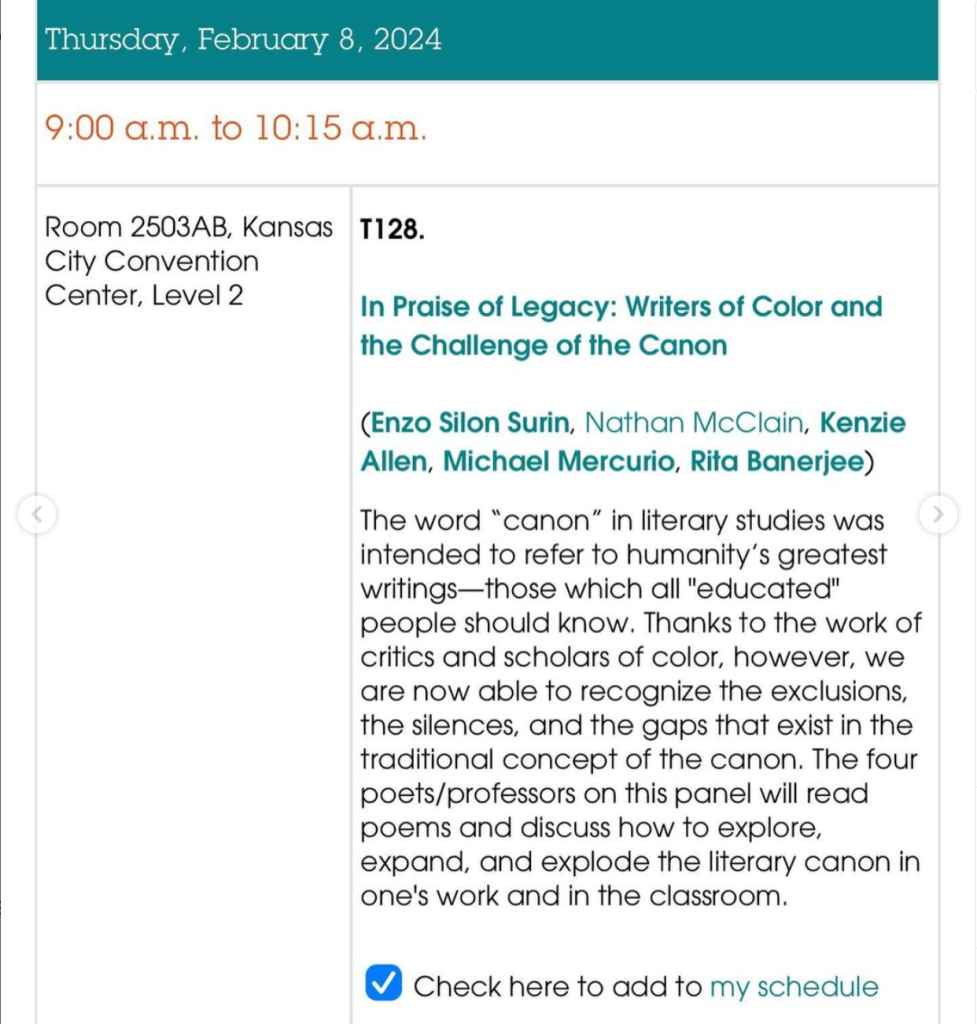
In Praise of Legacy: Writers of Color and the Challenge of the Canon feat. Michael Mercurio, Rita Banerjee, Kenzie Allen, Enzo Silon Surin, & Nathan McClain February 8, 2024 * 9:00 am – 10:15 am CST Room 2503AB, Kansas City Convention Center, Level 2 AWP 2024 Conference, Kansas City, MO
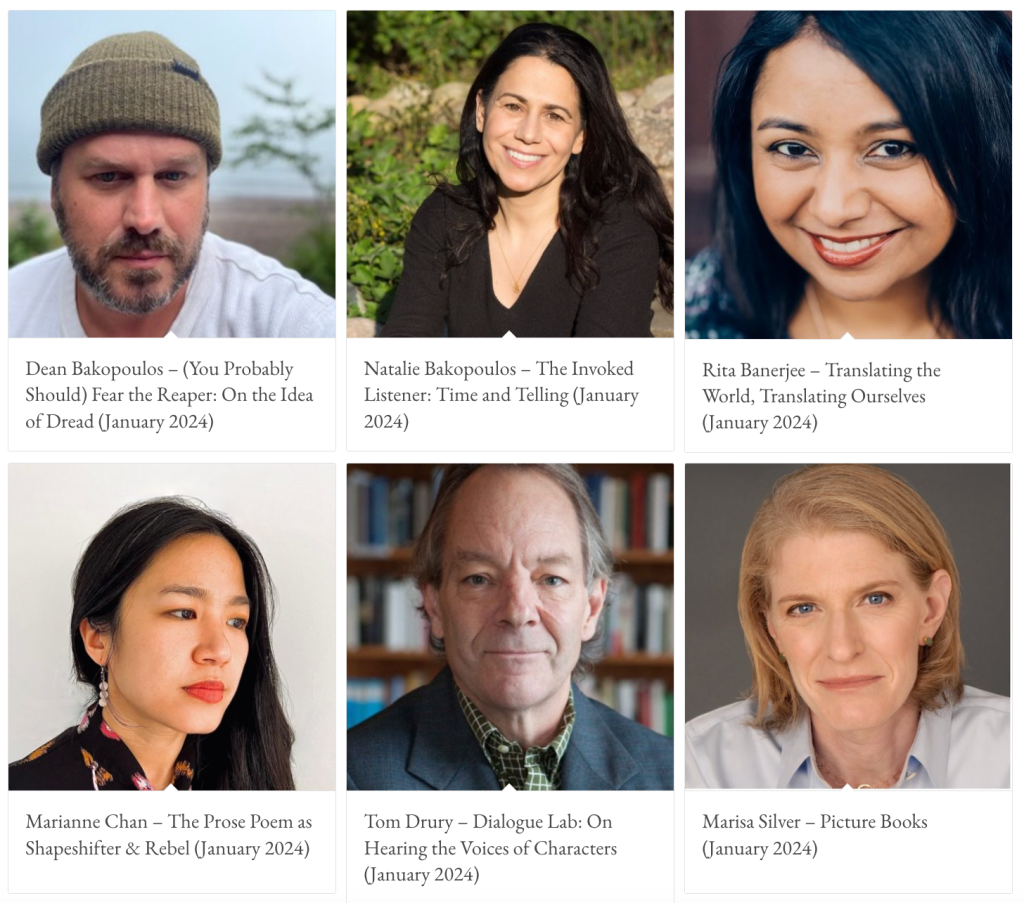
TheMFA Program for Writers recently celebrated its annual winter residency at the Blue Ridge Assembly, the site of the original Black Mountain College in Black Mountain, North Carolina. The residency featured inspiring lectures and classes from both faculty and graduating students. And writers and readers can access the wonderful craft discussions and lectures from the MFA Program for Writers faculty online here. Rita Banerjee’s Opening Lecture, “Translating the World, Translating Ourselves,” explores why translation is such a vital aesthetic, psychic, and embodied craft tool for creative writers. In translating our experiences and ourselves onto the page, we as writers become more aware of the metaphors we live by and can ask ourselves “What is the story behind my story, essay, or poem?” Some authors studied in the talk include Basho, Agyeya, Allen Ginsberg, Elizabeth Bishop, Rudyard Kipling, James Baldwin, Yoko Tawada, and Jhumpa Lahiri.
The Warren Wilson MFA Program for Writers store features a rich archive of faculty lectures and craft discussions from January 1992 – January 2024, and can be accessed here: https://www.wwcmfa.org/store/
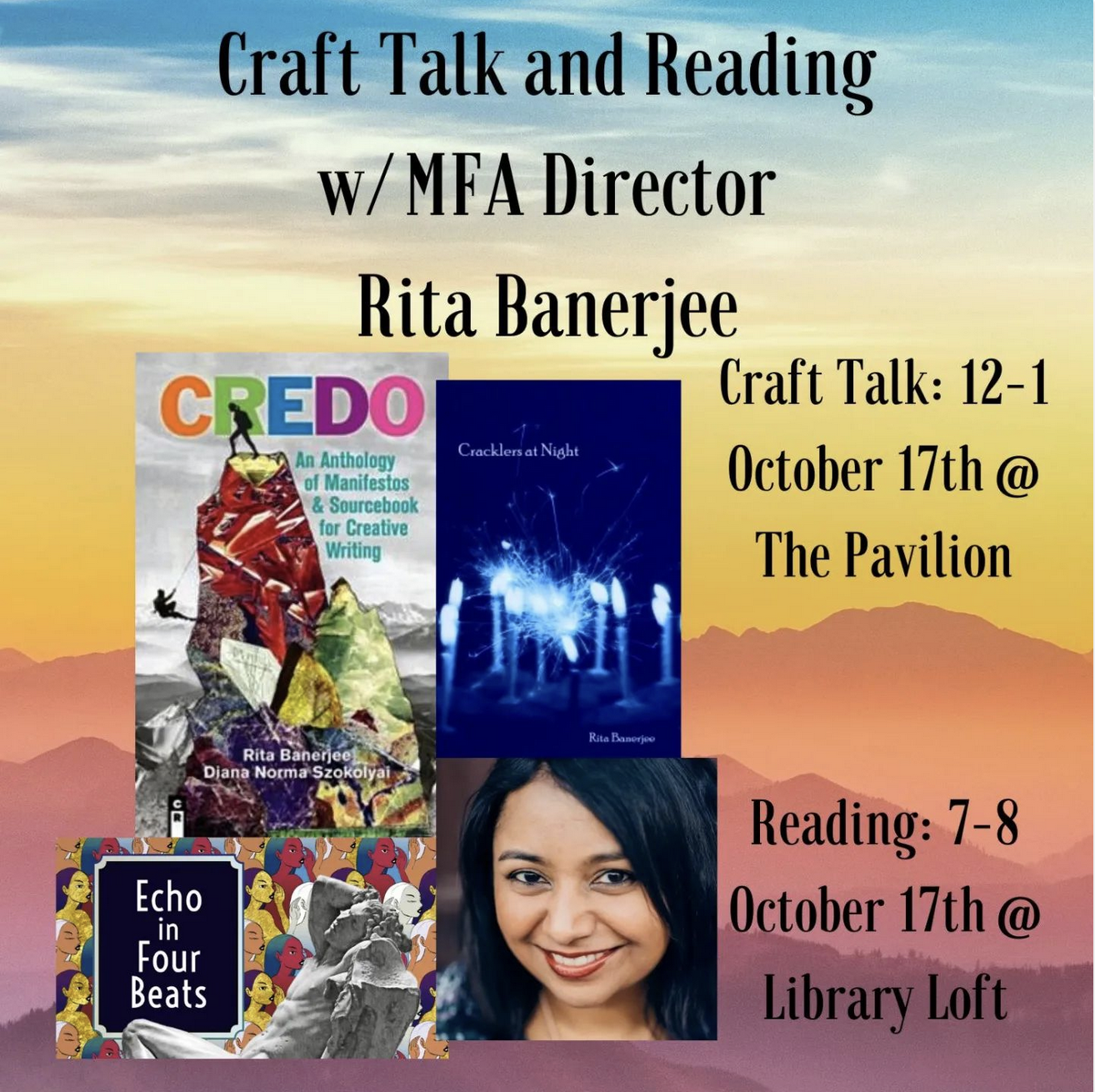
The MFA Program for Writers Director, Dr. Rita Banerjee will be a Visiting Writer in the undergraduate Creative Writing program at Warren Wilson College and will be teaching the creative writing workshop “Narrative Forms from World Literature: Kishōtenketsu and Rasa Theory” on Tuesday, October 17 from 12-1 pm EDT. The workshop’s open to anyone on campus and more details follow below as does information about Dr. Banerjee’s reading on campus on the evening of October 17 from 7-8 pm EDT:
In contemporary American creative writing, theatre, and screenwriting classes, the narrative structures and forms most centered are derived from the Western literary canon. Aristotle’s definition of comedy, tragedy, and catharsis from the Poetics and Gustav Freytag’s “plot triangle” from Die Technik des Dramas are seen as the conventional and standard way by which we analyze and structure storytelling. However, in our workshop on Narrative Forms from World Literature, we will study and learn from narrative structures, forms, aesthetic theories, and storytelling techniques from a variety of world literatures. We will delve into storytelling forms beyond the plot triangle and will highlight Nonwestern narrative techniques like the kishōtenketsu narrative form from Japanese. This workshop will also discuss rasa theory, which centers nine major emotional states to make the connection between viewer and character stronger. Rasa theory derives from Bharata’s Nāṭyaśāstra, which acts as a counterpoint to Aristotle’s demarcation of tragedy and comedy from the Poetics. By studying Narrative Forms from World Literature, students will diversify and strengthen their craft knowledge and technique, and will gain access to storytelling structures, forms, and aesthetic traditions beyond the Anglo-American canon.


 Rita Banerjee