TheMFA Program for Writersat Warren Wilson College recently celebrated its annual winter residency in Black Mountain, NC this July. The residency featured inspiring lectures and classes from both faculty and graduating students. And writers and readers can access the wonderful craft discussions and lectures from the MFA Program for Writers faculty online here. All MFA Store proceeds directly support graduate student scholarships in the MFA Program for Writers.
Rita Banerjee’s Opening Lecture “Weaving, Braiding, Spinning: Art of the Lyrical, Nonlinear Narrative” challenges the dominance of the plot triangle, hero’s journey, and Aristotelian ideal of “plot as action” by exploring three approaches to narrative design that are derived from what was historically considered women’s work: weaving, braiding, and spinning. These structural forms, which help acknowledge the context of a text and make room for nonlinear, polyvocal narratives, move storytelling away from an egocentric, “masculo-sexual” plot triangle, to what Jane Alison calls a more communal, “allocentric” narrative design. Authors studied in this talk include Jane Alison, Elissa Washuta, Theresa Warburton, Ovid, Goethe, M. NourbeSe Philip, Lidia Yuknavitch, and Kate Morton.
The Warren Wilson MFA Program for Writers store features a rich archive of faculty lectures and craft discussions from January 1992 – January 2026, and can be accessed here: warrenwilsonmfa.org/store/
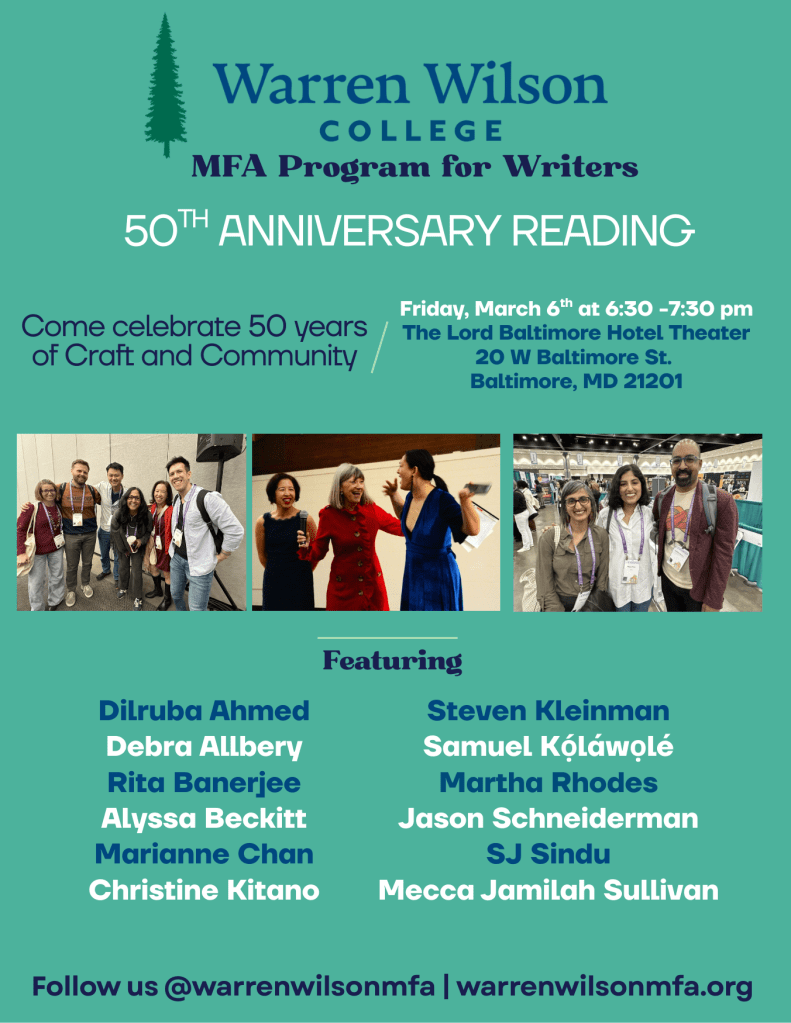
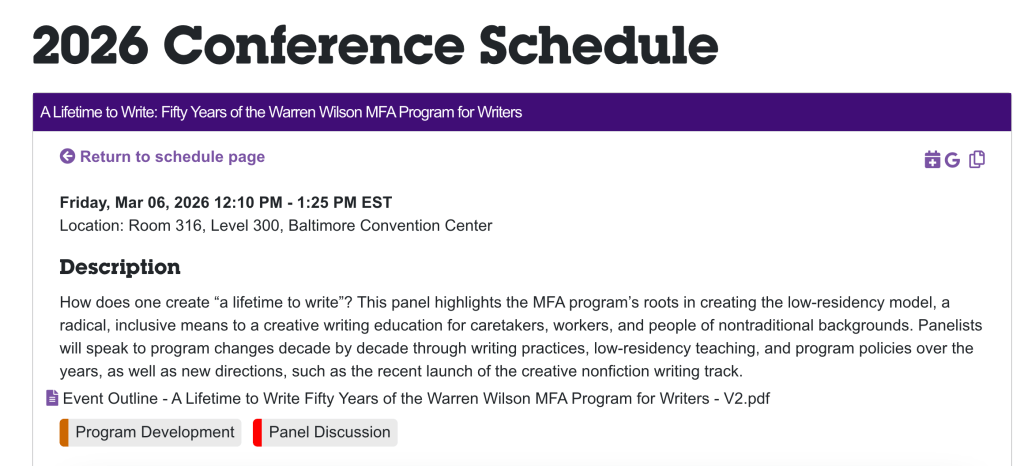
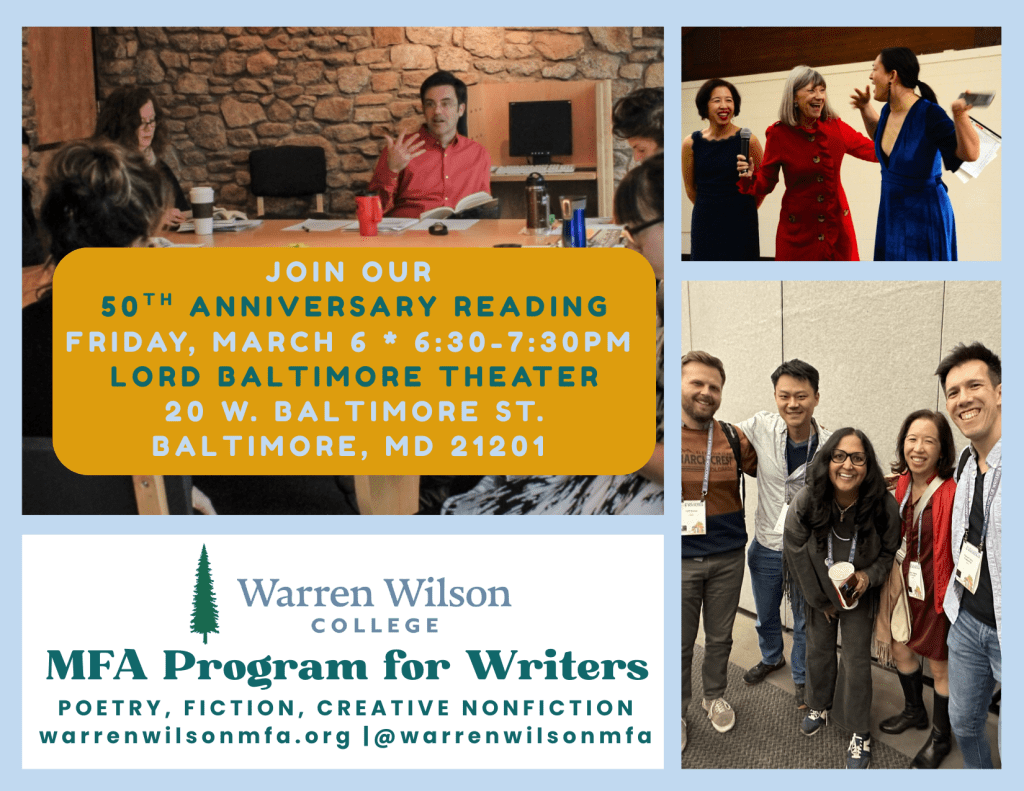
If you are planning to attend the AWP 2026 Conference in Baltimore, MD from March 4-7, 2026, stop by these events featuring Rita Banerjee and the MFA Program for Writers at Warren Wilson College! The MFA Program for Writers will be celebrating its 50th Anniversary at a variety of events on March 6, 2026. And to learn more about the MFA Program for Writers at Warren Wilson College, stop by the Warren Wilson MFA Booth (#T492) at the AWP 2026 Conference!
During the Innovation & Empowerment: A Workshop for Writers (July 10-28, 2026), Rita Banerjee will be teaching a lecture and workshop for writers on “Classical Greek and Indian Approaches to Poetry, Dramaturgy, and Storytelling” on July 18-19, 2026, followed by a faculty reading with Dr. Kristina Marie Darling on July 18, 2026 at 6 pm. More information about the course follows below:
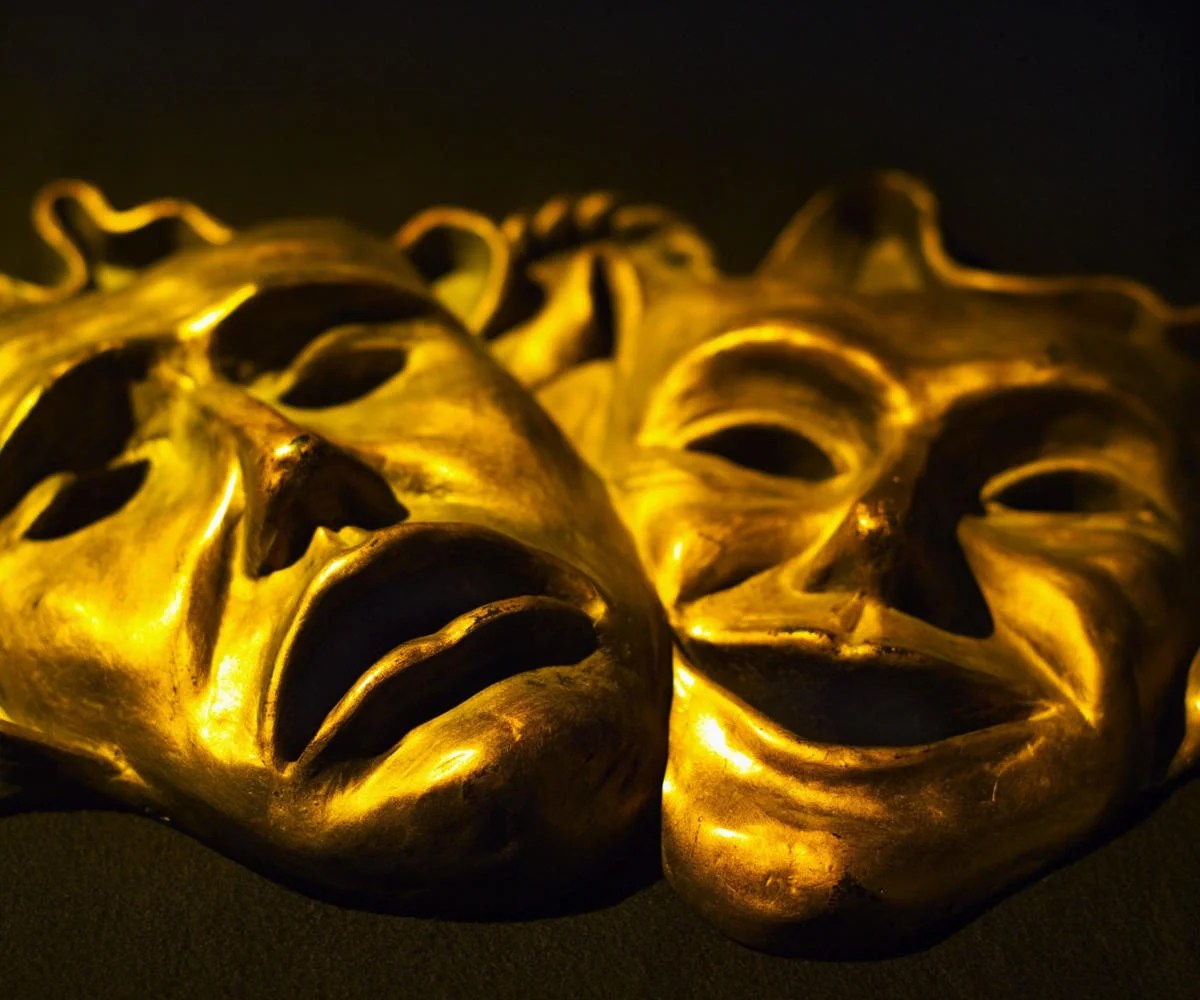
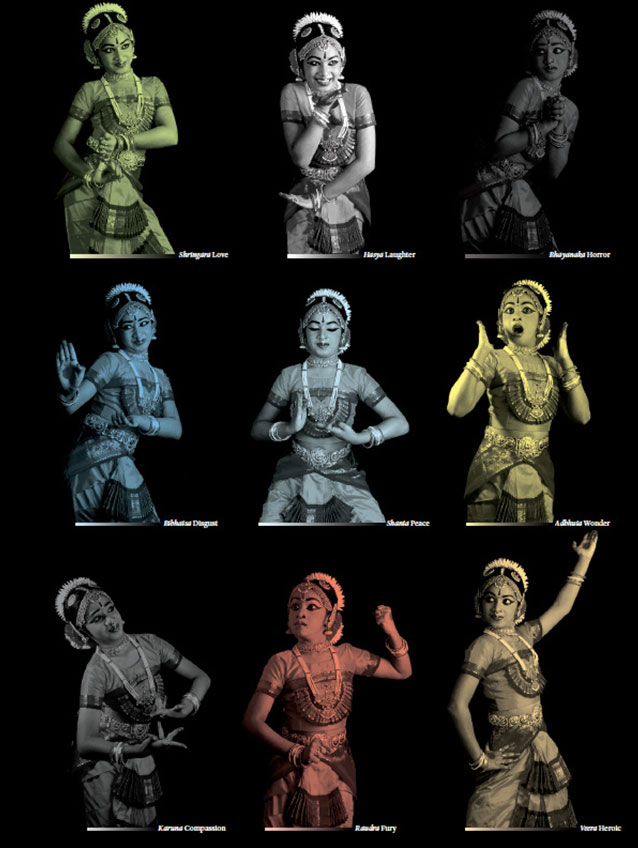
In The Republic (ca. 375 BCE), Plato states, “the tragic poet is an imitator, and therefore, like all other imitators, he is thrice removed from the king and from the truth.” Plato wants to kick the poet out of the republic because the poet does not answer to the king, and because poets challenge the ready-made truths of the status quo. In the Sanskrit tradition, the poet (kavī) is depicted as a wise seer (rishi), and one who holds up the heavens from the earth and thus serves as a translator of the celestial and the spiritual in the Rig Veda (ca. 1500 BCE). In response to his tutor Plato, Aristotle composes a defense of poetry in the Poetics (ca. 335 BCE), and argues that poetry, theatre, and literature are critically necessary for audiences as literature, and tragic theatre in particular, allows audiences to undergo catharsis. Aristotle maps how effective narratives can be built and how literature can be separated into the categories of comedy and tragedy. In contrast, in the Nāṭyaśāstra(ca. 200 BCE), Bharata outlines the eight main emotional states that are required to make any work of art become a classic. Bharata’s development of rasa theory provides a new way of considering narrative design which centers emotion, as do his discussions of bindus (turns) and how characters and plot develop in literary texts where emotion gives rise to action. In this class, we will study how literary theorists and dramaturgs such as Plato, Aristotle, Bharata, and Abhinavagupta offer different but intriguing approaches to poetry, dramaturgy, and storytelling and how we might use these classical Greek and Indian approaches to poetry and narrative design in our own creative work.
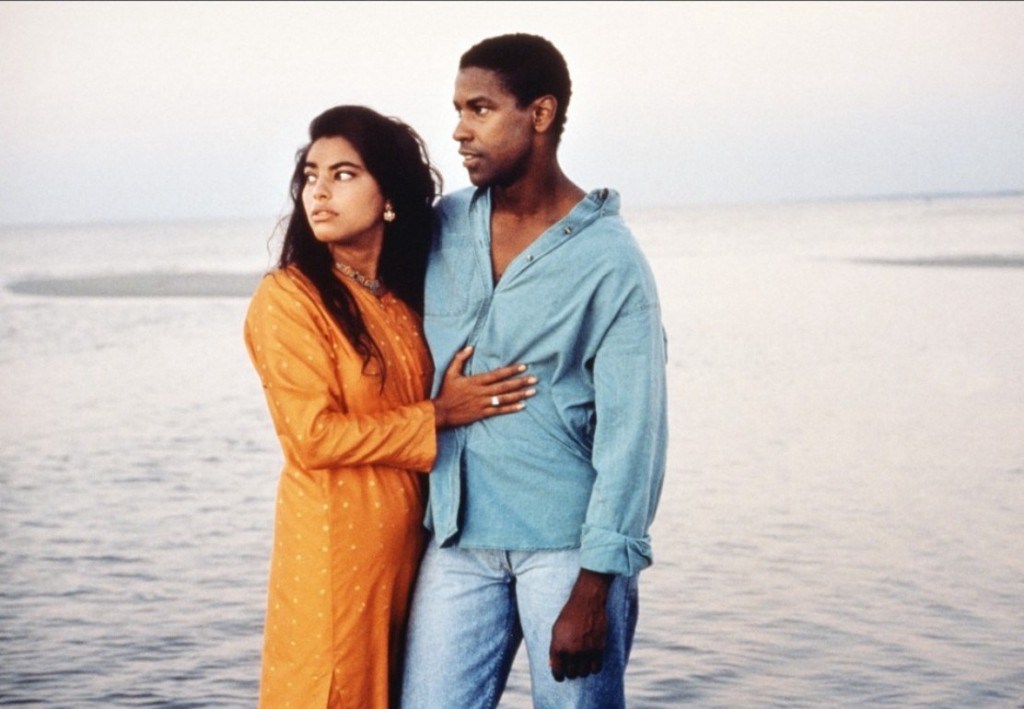
Rita Banerjee will introduce and lead the discussion for Mira Nair’s 1991 film, Mississippi Masala, staring Denzel Washington and Sarita Choudhury, on June 16, 2026 from 6:15-8:30 pm at the Institute for Indology and Tibetology at Ludwig-Maximilians-Universität München, (Ludwigstr. 31, Seminarraum 427). Anyone interested in translation studies, Modern South Asian literature, or art house film is welcome to join the screening.
“Mississippi Masala vividly dramatizes the uncertain, frequently comic progress of the love affair of Mina, a spirited young Indian who has never seen India, and Demetrius, a conscientious, upwardly mobile black American who has never seen Africa. The landscape of Mississippi Masala is brown and black and white. The blacks and whites have been in Greenwood for generations. The browns are newcomers. They are the Indian immigrants who have somehow found their way to Greenwood and, for reasons not entirely clear, have wound up owning most of the motels. The Indian innkeepers are fastidious about their own manners and morals, but they are equally willing to rent rooms by the night, day or hour. It’s recognized as a respectable business. Yet the so-called New South remains a network of social and cultural taboos that almost wreck the lives of Mina and Demetrius.” – Vincent Canby, The New York Times
Rita Banerjee is an Assistant Professor of Creative Writing and Director, MFA Program for Writers at Warren Wilson College.
Rita Banerjee will introduce and lead the discussion for Nandita Das’s 2018 film, Manto, about the life and trials of the modernist Urdu writer Saadat Hasan Manto, on December 16, 2025 from 6:00-8:30 pm at the Institute for Indology and Tibetology at Ludwig-Maximilians-Universität München, (Ludwigstr. 31, Seminarraum 427). Anyone interested in translation studies, Modern South Asian literature, or art house film is welcome to join the screening.
“Born in Punjab in 1912, Manto was one of most controversial writers of the age, eloquently crafting empathetic and shocking short stories about those living on the edges of society. Many of his best tales were inspired by his time in what is now Mumbai between 1936 and 1948. He would recall these years as the happiest of his short life, with stories that portrayed a very different side to India, embracing both beauty and ugliness… While best known for his tales of partition such as ‘Toba Tek Singh,’ he also masterfully captured the underbelly of [Mumbai], telling stories of pimps, gangsters, salon madams, and prostitutes living in cramped chawls. His stories were frank, forthright and imbued with a sense of moral outrage that aimed to give a voice to the voiceless. Notoriety inevitably followed him, and Manto faced trial six times on charges of obscenity for his short stories…
“‘He’s so relevant to today, and it is my way of responding to what is happening now,’ explains [Director Nandita] Das, speaking from Mumbai. ‘His empathy was very deep for those that exist on the margins of society – especially for women and sex workers – and no one in India was writing about that at the time’… Das was fascinated by the fact that Manto wrestled with the theme of identity all his life. It was this that inspired her to make the film. He was a Muslim living in a cosmopolitan city also populated by Sikhs, Christians, and Jews. It was a place where textile workers huddled in cramped tenements while film producers puffed on fat cigars in luxurious surroundings. Manto lived and breathed a city of contrast and contradiction, much of which is still reflected in its modern incarnation, Mumbai.” – Joseph Walsh, The Guardian
Rita Banerjee is an Assistant Professor of Creative Writing and Director, MFA Program for Writers at Warren Wilson College.
In the 21st Century, creative writers in the United States are facing unprecedented challenges to their discipline, craft, and survival. In 2025 alone, writers have witnessed large cuts in government funding for universities and humanities departments, the suspension of the NEA Fellowship for Creative Writers, and a number of class-action lawsuits against Artificial Intelligence companies, such as Bartz vs. Anthropic, in which A.I. companies are accused of illegally downloading 7.5 million literary and scholarly books and 81 million research papers to train their Large Language Model systems.[1] In this era of late capitalism, how can writers find viable ways to maintain and grow in their craft, seek the education in the humanities they desire, and create sustainable careers and communities in creative writing? As a multi-genre writer who is deeply inspired by world literature and transnationalism, Dr. Rita Banerjee will discuss her journey as a writer and literary citizen, and will share resources on how creative writers can create sustainable, nurturing, and viable careers, writing practices, and literary communities despite the pressures of American capitalism.
About the Author:
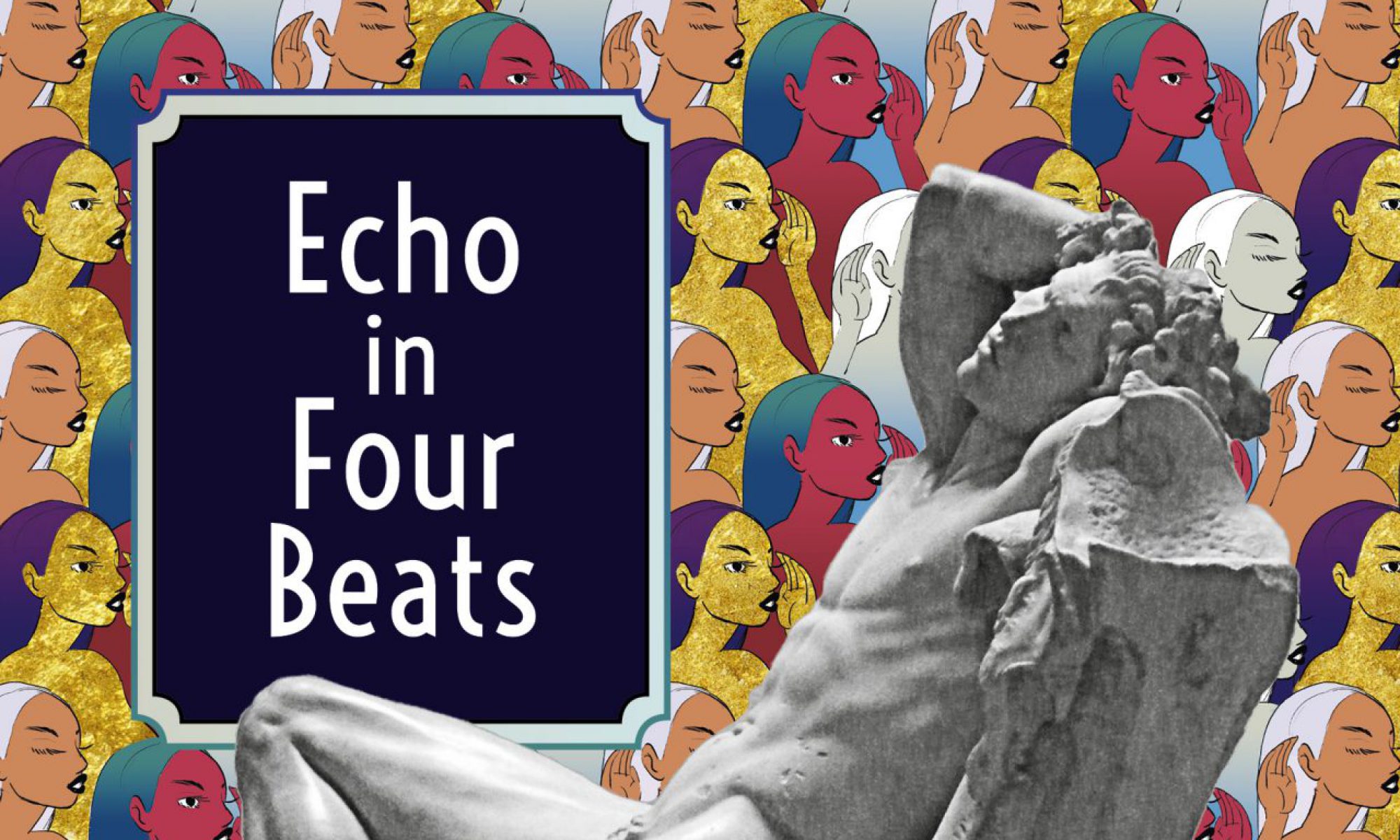
Rita Banerjee is an Assistant Professor of Creative Writing and Director of the MFA Program for Writers at Warren Wilson College. She received her doctorate in Comparative Literature from Harvard University and her MFA in Creative Writing from the University of Washington. She is editor of the forthcoming anthology Disobedient Futures (University Press of Kentucky) in which writers imagine what the future cultures of the United States and the world could look like if folks disobeyed gender, tribal, and class paradigms, and explored disobedient forms of environmentalism and borders. She is also the author of CREDO: An Anthology of Manifestos and Sourcebook for Creative Writing, the poetry collections Echo in Four Beats and Cracklers at Night, the novella “A Night with Kali” in Approaching Footsteps, and is co-writer of Burning Down the Louvre, a forthcoming documentary film about race, tribalism, and intimacy in the United States and in France. Her work appears in Sign & Breath: Voice and the Literary Tradition,Academy of American Poets, Poets & Writers, PANK, Nat. Brut., Hunger Mountain, Tupelo Quarterly, Isele, Vermont Public Radio, and elsewhere. She serves as Senior Editor of the South Asian Avant-Garde and Executive Creative Director of the Cambridge Writers’ Workshop, which she co-founded at Harvard in 2008. She received a Vermont Arts Council Creation Grant for her new memoir and manifesto on female cool, and one of the book’s opening chapters “Birth of Cool,” was a Notable Essay in the 2020 Best American Essays, and another chapter, “The Female Gaze,” was a Notable Essay in the 2023 Best American Essays.
[1] Reisner, Alex. “The Unbelievable Scale of AI’s Pirated Book Problem.” The Atlantic. Online. March 20, 2025.
TheMFA Program for Writersrecently celebrated its annual winter residency this past January. The residency featured inspiring lectures and classes from both faculty and graduating students. And writers and readers can access the wonderful craft discussions and lectures from the MFA Program for Writers faculty online here. All MFA Store proceeds directly support graduate student scholarships in the MFA Program for Writers.
Rita Banerjee’s Opening Lecture, “The Poetry and Power of Witness” asks, “How do we as writers process the various kinds of social trauma that inform and affect our daily lives?” In Against Forgetting, Carolyn Forché argues against an easy descent into forgetfulness or a culture of oblivion as espoused a constant carousel of rotating news headlines. She instead introduces the notion of “poem as trace, poem as evidence” and how the work of a writer can serve as a witness to and record of history. And in her introduction to Playing in the dark, Toni Morrison writes that, “Writing and reading mean being aware of the writer’s notions of risk and safety, the serene achievement of, or sweaty fight for, meaning and response-ability.” Some authors, studied in this talk, who wrestle with both their response and responsibility as witness to their particular social and historical moment, include Carolyn Forché, Solmaz Sharif, Fatimah Ashgar, Paul Celan, George Abraham, Noor Hindi, Jo Ann Beard, Yoko Tawada, Julio Cortázar, Agyeya, James Baldwin, Carvell Wallace, and Carl Phillips.
The Warren Wilson MFA Program for Writers store features a rich archive of faculty lectures and craft discussions from January 1992 – January 2025, and can be accessed here: https://www.wwcmfa.org/store/
Rita Banerjee will introduce and lead the discussion for Vishal Bhardwaj’s 2014 film, Haider, an adaptation of Shakespeare’s Hamlet, on December 10, 2024 from 6:15-8:45 pm for the Institute for Indology and Tibetology at Ludwig-Maximilians-Universität München, (Ludwigstr. 31, Seminarraum 427). Anyone interested in translation studies, Modern South Asian literature, or art house film is welcomed to join the screening.
“The Bollywood director Vishal Bhardwaj has made his name by adapting Shakespeare into film, using the plays to reflect the violence and vicissitudes of modern India. Maqbool, an adaptation of Macbeth, was set in the Mumbai underworld; Omkara transported Othello to the feudal badlands of northern India. His latest effort, a loose adaptation of Hamlet called Haider that takes place in Kashmir during the turbulent 1990s, has become one of the most acclaimed and contentious Bollywood movies of the year…[In the film] Haider is sent away by his parents to Aligarh, a university town in north India, to shelter him from the violence overtaking Kashmir. The movie’s plot is set in motion when he returns to his homeland to search for his father, who has been abducted by the military. Through Haider’s search, the movie plunges into a looking-glass world, where lies and deception are common, and the government has abandoned human rights and the rule of law to crush the armed insurgency.” – Vaibhav Vats, The New York Times
Rita Banerjee is an Assistant Professor of Creative Writing and Director, MFA Program for Writers at Warren Wilson College.
TheMFA Program for Writersrecently celebrated its annual summer residency at Warren Wilson College in Swannanoa, North Carolina. The residency featured inspiring lectures and classes from both faculty and graduating students. And writers and readers can access the wonderful craft discussions and lectures from the MFA Program for Writers faculty online here. Rita Banerjee’s Opening Lecture, “Narrative Design from World Literature: the Kishōtenketsu and West African Griot Tradition,” explores how we can expand our craft knowledge and technique as writers by studying narrative design from world literature. The Japanese kishōtenketsu offers a new way to compose a poem or story beyond the Western emphasis on the plot triangle or Aristotelian idea of “plot is action.” Likewise, the West African Griot Tradition emphasizes the communal aspect of storytelling and notes the import of the storyteller and listener in the creation of a tale the sustains the history of a community and imagines its future. Some authors studied in the talk include Ryūnosuke Akutagawa, E.J. Koh, Ocean Vuong, Samuel Kọ́láwọ́lé, Yaa Gyasi, Teju Cole, and JJJJJerome Ellis.
The Warren Wilson MFA Program for Writers store features a rich archive of faculty lectures and craft discussions from January 1992 – July 2024, and can be accessed here: https://www.wwcmfa.org/store/
Rita Banerjee will introduce and lead the discussion for Saim Sadiq’s 2022 film, Joyland, on Tuesday, May 14, 2024 from 6-8:30 pm for the Institute for Indology and Tibetology at Ludwig-Maximilians-Universität München. The screening will take place in Seminar Room 427 (Ludwigstr. 31, Munich), and anyone interested in South Asian aesthetics, literary theory, or art-house film is welcome to join the screening.
“This year’s Queer Palme winner, and the first ever Pakistani film in the Cannes official selection, Saim Sadiq’s debut impresses with its sensitive storytelling and vibrant visuals… Tartly funny and plungingly sad in equal measure, this is nuanced, humane queer filmmaking, more concerned with the textures and particulars of its own intimate story than with grander social statements — even if, as a tale of transgender desire in a Muslim country, its very premise makes it a boundary-breaker.” – Guy Lodge, Variety
Rita Banerjee is an Assistant Professor of Creative Writing and Director, MFA Program for Writers at Warren Wilson College.




 Rita Banerjee