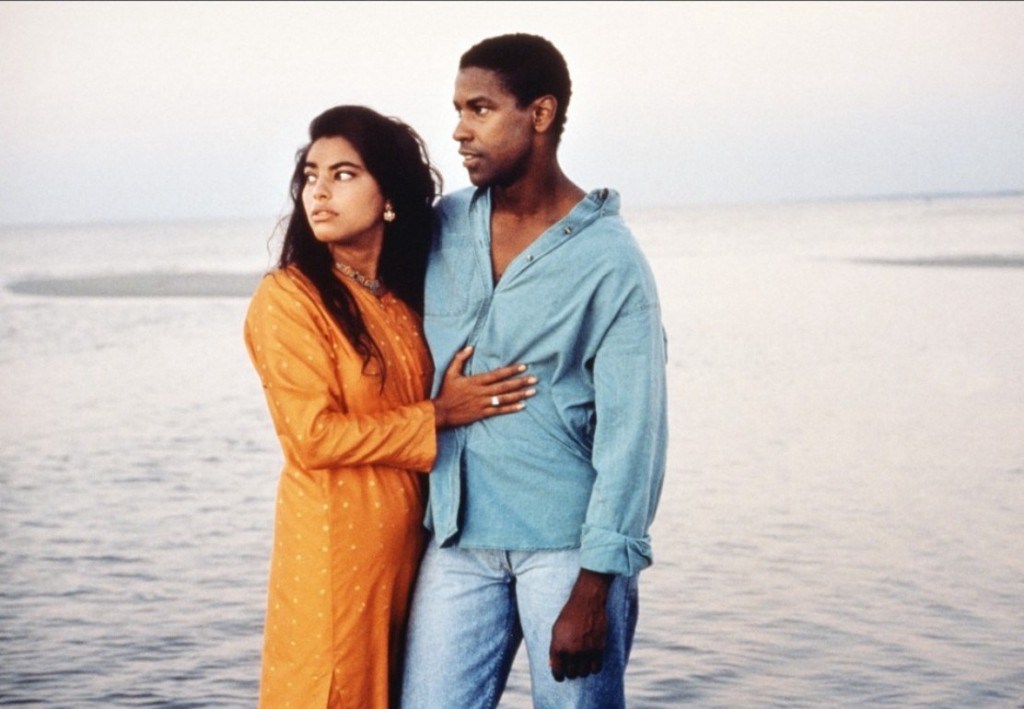
Rita Banerjee will introduce and lead the discussion for Mira Nair’s 1991 film, Mississippi Masala, staring Denzel Washington and Sarita Choudhury, on June 16, 2026 from 6:15-8:30 pm at the Institute for Indology and Tibetology at Ludwig-Maximilians-Universität München, (Ludwigstr. 31, Seminarraum 427). Anyone interested in translation studies, Modern South Asian literature, or art house film is welcome to join the screening.
“Mississippi Masala vividly dramatizes the uncertain, frequently comic progress of the love affair of Mina, a spirited young Indian who has never seen India, and Demetrius, a conscientious, upwardly mobile black American who has never seen Africa. The landscape of Mississippi Masala is brown and black and white. The blacks and whites have been in Greenwood for generations. The browns are newcomers. They are the Indian immigrants who have somehow found their way to Greenwood and, for reasons not entirely clear, have wound up owning most of the motels. The Indian innkeepers are fastidious about their own manners and morals, but they are equally willing to rent rooms by the night, day or hour. It’s recognized as a respectable business. Yet the so-called New South remains a network of social and cultural taboos that almost wreck the lives of Mina and Demetrius.” – Vincent Canby, The New York Times
Rita Banerjee is an Assistant Professor of Creative Writing and Director, MFA Program for Writers at Warren Wilson College.
Founded in 1982 by independent filmmaker and Cinema Studies Professor Al Nigrin, the Rutgers Film Co-op/NJMAC draws thousands of viewers from throughout New Jersey by providing an alternative media culture. The Rutgers Film Co-op/NJMAC is dedicated to the noncommercial exhibition of independent, classic, international, and experimental films and videos. Not only do Film Co-op audiences have the opportunity to view many independently produced films, but also the added benefit of meeting with the filmmakers, actors, screenwriters and other members of production crew. As an undergraduate student at Rutgers College, New Brunswick, Rita Banerjee served as a projectionist, usher, ticket clerk, public speaker, and judge of the United States Super 8 Film Festival at the Rutgers Film Co-Op. In 2022, the Rutgers Film Co-op and Cinema Studies program have created featured profiles of their acclaimed alumnx. In the Rutgers Film Co-Op Profile on Rita Banerjee, Banerjee recalls:
“Growing up, our house was filled with popular music in Bengali, Hindi, Urdu, and Punjabi, Curry Westerns and Golden Age Bollywood films, Bengali Art House Cinema, feminist Pakistani television serials, and recitations of Sanskrit poetry and Rabindra-sangeet whenever my extended family would get together and try to impress or outwit each other during their āḍḍā sessions.
My family gave me a peak into how multicultural, multilingual, mirthful, and messy South Asian culture across languages, religions, nations, and the diaspora could be. They also loved British comedy, sketch shows like The Carol Burnett Show, and bumbling but persistent detectives like Columbo and Inspector Jacques Clouseau. It felt like every time I came home from college to visit my parents for a weekend, there would be an image of James Bond, Sharmila Tagore, Jackie Chan, Uttam Kumar, Edie Murphy, Shah Rukh Khan, or Lucille Ball gracing their Saturday evening movie screen.
And when I began my studies at Rutgers, this picture of a larger, more complicated world was something I was seeking… It was during my first year of college that I met Professor Al Nigrin and fell in love with the NJ Film Festival and Rutgers Film Co-op. I joined the Co-op during the end of my freshman year when I took Susan Martin-Márquez’s thought-provoking and memorable World Cinema II class in which we screened films like Akira Kurosawa’s Rashōmon, Satyajit Ray’s Charulata, Ousmane Sembene’s Camp de Thiaroye, Djibril Diop Mambéty’s Touki Bouki, and Wong Kar-Wai’s Happy Together among many other classics of world cinema.
At the Film Co-op, I worked as a projectionist, usher, ticket clerk, public speaker, and judge of the United States Super 8 Film Festival. I started working at the Film Co-op regularly on weekends in the Fall of 2001 just as September 11th happened and affected so many students, faculty, and staff, many of whom had friends and family in New York at that time or had witnessed the destruction of the Twin Towers themselves from the “safe haven” of New Jersey. While I was still a teenager then, 9/11 proved to be a pivotal moment in my artistic practice and career trajectory. It seemed to me, at that time in all my worldly wisdom, that I would waste my life if I pursued Engineering as a major and if I did not become the artist or intellectual I wanted to be while Rome was burning. Many years later, I finally wrote about what coming-of-age as a young adult during 9/11 really meant in my essay “Birth of Cool,” which went on to be a Notable Essay in the 2020 Best American Essays. This story about Rutgers, literature, my obsession with cool, and 9/11 became the opening to my new memoir and manifesto on how women keep their cool and foster a culture of female cool against social, sexual, and economic pressure post-9/11.
Some of my fondest memories at the Rutgers Film Co-op include watching Mulholland Drive with our exchange students from Japan (and my love interest at the time scolding me afterwards for showing our guests such a scandalous movie!!), and screening films like Meshes of the Afternoon,Bend It Like Beckham, Requiem for a Dream, Amélie, Kandhar, Un Chien Andalou, Potemkin,Lost in Translation, and Bowling for Columbine with our cadre of artists, filmmakers, and writers. One of the most unforgettable moments at the Rutgers Film Co-op happened when we were screening Lars von Trier’s Dancer in the Dark. I had helped with the ticket sales that night, so I snuck into the audience with my friends to watch the film. And being such a stoic person normally, I just remember that moment in the film when Björk’s character passes the point of no-return and I felt my cheeks wet with tears that I didn’t even realize I was shedding.
That’s how meeting Al Nigrin and working at the Rutgers Film Co-op felt to me: an epiphany, a discovery, a challenging of my worldview, a dance and entrance into an exciting new imagination.
I’ve carried my memories of the Rutgers Film Co-op with me over the years. They have helped me to interrogate the world and seek new perspectives and listen to new voices. In so many ways the Rutgers Film Co-op and New Jersey Film Festival created a meeting ground and a place of conversation in New Brunswick that was bohemian, unapologetically artistic and edgy, multicultural, and cognizant of the importance of historical contexts and new world views. I learned so much about how to be an artist, a citizen of the world, how to be curious and always a little punk from Professor Al Nigrin and the Rutgers Film Co-op. And those lessons and that style and that kind of clear-eyed coolness I’ll always carry with me.”


 Rita Banerjee