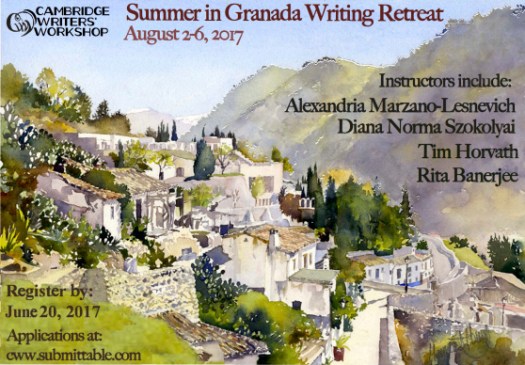
Cambridge Writers’ Workshop Summer in Granada, Spain Writing Retreat featured in The Washington Post

Original illustration by Lisk Feng for The Washington Post

The Cambridge Writers’ Workshop is delighted to be chosen as one of the six best writing retreats for the summer in The Washington Post‘s recent feature, “When You’re Ready to Move from Summer Writing to Summer Reading.”  In the article, journalist Jennifer Howard writes:

Your boss doesn’t care if you finish your novel. Your partner would rather not hear about the memoir you’ve been threatening to write. Feeling discouraged? It may be time to escape the creativity-quashing grind and reconnect with your muse in a lovely locale.

Whether you like Midwestern lakes or Icelandic hot springs, there’s a writers retreat for you. Here are half a dozen programs where you can spend quality time with your journal or get started on the next bestseller:

For culture connoisseurs

If tapas and flamenco are more your thing, the Summer in Granada retreat, sponsored by the Cambridge Writers’ Workshop, promises a warm cultural bath: “Let the old city stimulate your writing with its winding streets, Moorish history, and evocative landscapes,” the website says.

Summer in Granada is part of a series of retreats created by writers Rita Banerjee and Diana Norma Szokolyai. They describe their retreat model as a kind of roving salon, with previous sessions in Paris and at a chateau in Picardy, among its envy-inducing locations. “All of these places have a very alive and electric culture, a culture that exists on the streets, in the imagination,” Banerjee says.

This summer, participating writers will enjoy an “experiential tour” alongside workshops and writing sessions. Fiction writer Tim Horvath will teach a “writing from the senses” class that includes a visit to a “museum of smells,” a visit to a chocolatier and a tapas tour. “No matter how intellectual writing gets, you always want to draw in the senses and immerse the reader,” he says. (Did we mention chocolate?)

Cost/duration: $2,950; four nights. Some scholarships available.

To read the complete article, please visit the The Washington Post website here.  Print versions of the article will be available on June 11, 2017.

Applications and scholarships for our Summer in Granada Writing Retreat (Aug 2-6, 2017) are open until June 20, 2017.  Please apply at cww.submittable.com.

Mad Heart Be Brave now available from the University of Michigan Press!

Born and raised in Kashmir, Agha Shahid Ali (1949–2001) came to the United States in the mid-1970s to pursue graduate study in literature; by the mid-1980s, he had begun to establish himself as one of the most important American poets of the late 20th century.  Mad Heart Be Brave: On the Poetry of Agha Shahid Ali is the first comprehensive examination of all stages of his career, from his earliest work published in India but never reissued in the U.S., through his seven poetry volumes from American publishers, ultimately collected as The Veiled Suite.  Contributors to this volume include Sejal Shah, Rita Banerjee, Amanda Golden, Ravi Shankar, Abin Chakraborty, Amy Newman, Christopher Merrill, Jason Schneiderman, Stephen Burt, Raza Ali Hassan, Syed Humayoun, Feroz Rather, Dur e Aziz Amna, Mihaela Moscaliuc, Reginald Dwayne Betts, Mahwash Shoaib, Shadab Zeest Hashmi, Grace Schulman, and Ada Limón. Mad Heart Be Brave closes with a long biographical sketch and elegy by Agha Shahid Ali’s friend Amitav Ghosh and a comprehensive bibliography assembled by scholar Patricia O’Neill with Reid Larson.

In her essay, “Between Postindependence and the Cold War: Agha Shahid Ali’s Publications with the Calcutta Writers Workshop,” Rita Banerjee writes:  “In 1958, editor, critic, translator, and poet P. Lal established the English-language creative writing group the Writers Workshop in Kolkata. The Writers Workshop helped launch the careers of many well-known English-language South Asian authors, such as Anita Desai, Bharati Mukherjee, Vikram Seth, A. K. Ramanujan, Arvind Krishna Mehrotra, and Agha Shahid Ali. As an editor, P. Lal was a key figure in establishing the relevance and necessity of Anglophone South Asian writing in the postindependence period. His seminal work, Modern Indian Poetry in English: The Writers Workshop Selection, an Anthology & a Credo (1969) served as a manifesto for the function and viability of Indian English literature in the postindependence period and featured one of Agha Shahid Ali’s most dystopian and memorable poems, “Lunarscape.” In the poem Ali not only critiqued the rivalry between the United States and the USSR during the Cold War but also presented the recent American moon landing as a neocolonial and self-destructive move. After the publication of “Lunarscape,” Agha Shahid Ali went on to publish his first and second collections of poems, Bone-Sculpture (1972) and In Memory of Begum Akhtar (1979) with P. Lal’s Writers Workshop. Ali’s first collection, Bone-Sculpture, featured several poems that reflected his response to the postindependence and postpartition realities of South Asia, his own conflicted feelings over his divided home state of Kashmir, and poems that responded to the Cold War, cultural revolutions, and other global political events of the time and captured Ali’s own experiences of immigration…”  To read the full essay, please order Mad Heart Be Brave: On the Poetry of Agha Shahid Ali from the University of Michigan Press here.

Summer in Granada, Andalucía, Spain Writing Retreat – June 20, 2017 Deadline


The Cambridge Writers’ Workshop’s Summer in Granada Writing Retreat will take place from August 2-6, 2017. Located at the foot of the Sierra Nevada mountains in Andalucía, Granada is one of the gems of Spain and has inspired writers from Washington Irving to Salman Rushdie to Ali Smith. Let the old city stimulate your writing with its winding streets, Moorish history, and evocative landscapes. Located at the foot of the Sierra Nevada mountains in Andalucía, Granada is one of the gems of Spain and has inspired writers from Washington Irving to Salman Rushdie to Ali Smith. Let the old city stimulate your writing with its winding streets, Moorish history, and evocative landscapes. The retreat offers multi-genre workshops, as well as craft seminars and time to write. The faculty includes award-winning writers Tim Horvath, Alexandria Marzano-Lesnevich, Rita Banerjee, and Diana Norma Szokolyai. Genres include fiction, nonfiction, and poetry.  To apply, please submit an application at http://cww.submittable.com by June 20, 2017.

Schedule of Classes:

Character Development & the Law of Desire (with Rita Banerjee)

Femme fatales, gumshoe detectives, star-crossed lovers, wicked stepmothers, wise fools, empathetic anti-heroes: dynamic and archetypal characters can be key to making a good story or lyrical piece tick and pulling in the reader deeper into your creative work. In this workshop, we will discuss how dynamic and archetypal characters can help structure stories, propel narratives forwards, and how each character’s desire provides interesting ethical dilemmas and emotional spectrums to narratives and verse. We will learn about the building blocks of creating strong, unforgettable characters, discuss the connection between desire and plot, and learn how playing with persona can help liberate nonfictional stories and lyrical poems. 

Writing from the Senses (with Tim Horvath)

Memorable writing often engages the senses first and foremost, immersing us in a character’s perceptions and sensations, and thus allowing us to dwell inside that character’s perspective. In this class, we’ll strive to make our writing more wholly and richly embodied by engaging the senses directly, building our abilities to depict each individually like a muscle group, and eventually intertwining them in synesthesia for the fullest effect. We explore each of the senses in turn by looking at exemplary instances where a writer is able to conjure the sense effectively.  We’ll take focused walks, taste local foods, do ekphrastic writing in museums, and attempt to capture sounds from that of traffic to flamenco guitar to the idiosyncratic grain of the individual human voice in multiple languages. This class also cuts across genres, shifting seamlessly between poetry, fiction, and creative nonfiction, grounding each in an embodied experience of the world. When we travel abroad, our senses are generally enlivened to begin with, and so you can think of this class as a way to translate that enhanced awareness into equally vivid words on the page.

The Storyteller’s Voice (with Alexandria Marzano-Lesnevich)

Of all types of prose, personal narrative is perhaps the most inherently voice-driven. After all, the reader is essentially choosing to spend a lot of time with you, the author. Too often, the writer’s desire to be relatable on the page results in a watered-down, bland voice, when a distinctive voice is what’s needed to keep the reader engaged. (As V.S.Pritchett put it, in memoir, you get no credit for the living—it’s all in how the living’s told.) So how can you find—and sharpen—your narrative voice? Will it be crisp like Didion’s? Humorously exaggerated like Sedaris’s? Lyrically gritty like Ballantine’s? We’ll look at exceptional examples of voice in memoir and personal essays, and diagnose what makes them so successful. We’ll discuss ways to identify and amplify whatever yours is, working to make it even more distinctive. Come prepared with an essay or chapter draft to work on.

Leyendo Intensamente: Writers Reading Spanish/Latin American Literature in Translation (with Tim Horvath)

It is a given that writers must learn to read closely, with attention to nuance and craft, to unravel the methods by which other writers have managed to tell stories effectively and adapt them for their own purposes. In this class, we’ll focus on writers in Spanish and Portuguese, from canonical authors like Borges, Marquez, Valenzuela, Cortázar, and Lispector to contemporary luminaries and up-and-comers such as Eduardo Halfon, Valeria Luiselli, Javier Marías, and Laia Jufresa. We’ll swerve through techniques of developing metafiction and surrealism, magical realism, and philosophical fiction, and blending these with realism where suitable. We’ll also explore the fraught, infinitely rich topic of translation, discussing its complexities really and the ways that understanding the innumerable decisions involved in bringing a work into another language can shed light on the act of “translating” any experience or concept from mind or world onto the page, i.e. writing itself.

Life Isn’t A Book Structure: Strategies for Shaping Memoir (with Alexandria Marzano-Lesnevich)

Even the wildest life, recounted straightforwardly from memory, will suffer from what Sven Birkerts calls “the coma-inducing effect of ‘and then.’” Good memoirists know this. So they reach into literature’s bag of tricks and find other ways to keep the pages turning: they speed time up in some places and slow it down in others; they layer two or more threads; or perhaps they find a structure that helps evoke the book’s meaning. All these considerations are part of shifting from thinking about your life as a life to thinking about the book as a book. But how can aspiring memoirists ready themselves to make that leap? In this session we’ll discuss strategies and approaches, as well as break down the choices made by a few published memoirists as they turned memory into literature. Then we’ll do a few exercises to help free you to do the same with your own material, turning life into art.

Featured Faculty:

tim_horvath_authorphotoTim Horvath is the author of Understories (Bellevue Literary Press), which won the New Hampshire Literary Award, and Circulation (sunnyoutside). His stories have appeared in Conjunctions, Fiction, The Normal School, Harvard Review, and elsewhere. His story “The Understory” won the Raymond Carver Short Story Award, and “The Conversations” earned a Special Mention in the 2014 Pushcart Prize Anthology; he is also a recipient of a Yaddo Fellowship. He teaches in the BFA and low-residency MFA programs at the New Hampshire Institute of Art, where he coordinates the Visiting Writers Series. He is currently at work on The Spinal Descent, a novel about contemporary classical composers, as well as a second short story collection.


Alexandria-Marzano-Lesnevich_MACD-15-201_414

Alexandria Marzano-Lesnevich’s first book, THE FACT OF A BODY: A Murder and a Memoir, is forthcoming from Flatiron Books (Macmillan) in May 2017, as well as from publishers internationally. The book layers a memoir with an investigation into, and recreation of, a 1992 Louisiana murder and death penalty case. For her work on the book, Marzano-Lesnevich received a National Endowment for the Arts fellowship and a Rona Jaffe Award, and has twice been a fellow at both MacDowell and Yaddo. Other scholarships and fellowships received include those from the Bread Loaf Writers’ Conference, the Millay Colony for the Arts, Blue Mountain Center, Kimmel Harding Nelson Center, Djerassi Resident Artists Program, the Studios at Key West, Vermont Studio Center, and the Alice Hayes Fellowship for Social Justice Writing from the Ragdale Foundation. Her essays appear in The New York Times, Oxford American, Iowa Review, Hotel Amerika, The Rumpus, and the anthologies True Crime and Waveform: Twenty-First Century Essays by Women, among many other publications, and were recognized “notable” in Best American Essays 2013, 2015, and 2016. She was educated at Harvard (JD), Emerson College (MFA), and Columbia University (BA) and now teaches at Grub Street, a nonprofit writing center in Boston, and in the graduate public policy program at Harvard’s Kennedy School of Government.

ritabanerjeeRita Banerjee is the Executive Creative Director of the Cambridge Writers’ Workshop and teaches at Rutgers University.  She received her doctorate in Comparative Literature from Harvard and her MFA in Creative Writing from the University of Washington, and her writing appears in Poets & Writers, The Rumpus, Painted Bride Quarterly, Mass Poetry, Hyphen Magazine, Los Angeles Review of BooksElectric Literature, VIDA: Women in Literary Arts, AWP WC&C Quarterly, Queen Mob’s Tea House, Riot Grrrl Magazine, The Fiction Project, Objet d’Art, KBOO Radio’s APA Compass, and elsewhere. Her first collection of poems, Cracklers at Night (Finishing Line Press), received First Honorable Mention for Best Poetry Book of 2011-2012 at the Los Angeles Book Festival, and her novella, A Night with Kali, in Approaching Footsteps (Spider Road Press), released in November 2016. Finalist for the 2015 Red Hen Press Benjamin Saltman Award and the 2016 Aquarius Press Willow Books Literature Award, she is currently working on a novel, a book on South Asian literary modernisms, and a collection of lyric essays.

DianaNormaDiana Norma Szokolyai is a writer and Executive Artistic Director of Cambridge Writers’ Workshop. She is author of the poetry collections Parallel Sparrows (honorable mention for Best Poetry Book in the 2014 Paris Book Festival) and Roses in the Snow (first runner-­up Best Poetry Book at the 2009 DIY Book Festival). She also records her poetry with musicians and has collaborated with several composers. Her poetry-music collaboration with Flux Without Pause led to their collaboration “Space Mothlight” hitting #16 on the Creative Commons Hot 100 list in 2015, and can be found in the curated WFMU Free Music Archive. Szokolyai’s work has been recently reviewed by The London Grip and published in Quail Bell Magazine, Lyre Lyre, The Fiction Project, The Boston Globe, Dr. Hurley’s Snake Oil Cure, The Dudley Review and Up the Staircase Quarterly, as well as anthologized in The Highwaymen NYC #2, Other Countries: Contemporary Poets Rewiring History, Always Wondering and Teachers as Writers. Szokolyai earned her Ed.M. in Arts in Education from Harvard University and her M.A. in French Literature from the University of Connecticut, while she completed coursework at the Sorbonne and research on Romani writers in Paris. She is currently at work on three books and recording an album of poetry & music.

applyDeadline: June 20, 2017
CWW Presents: Fertile Ground for Celebration – Democracy Center, Cambridge, MA – May 5

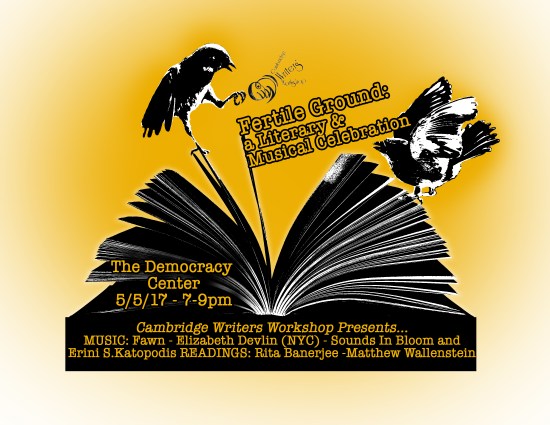
CWW Presents: Fertile Ground – A Literary & Musical Celebration – May 5, 2017

7 p.m. – 7:45p.m. Literary Readings/Performances
– intermission & book/album signing-
8 p.m. – 9 p.m. Musical Performances

Join us for a night of creative writing & music by and for diverse voices from NYC to Boston! Our evening will feature lyrical readings and musical performances by Matthew Wallenstein, Rita BanerjeeErini S. Katopodis, Sounds in Bloom (Diana Norma SzokolyaiDennis Shafer), Fawn (Anne Malin Ringwalt and Will Johnson) and Elizabeth Devlin, and will take place at the Democracy Center in Harvard Square, Cambridge, MA.

Tickets are available for pre-purchase in advance on Eventbrite, and will be available for purchase at the door starting at 6:30 PM. Sliding scale: $5-10. Your ticket helps us support the artists and the Democracy Center. Please note that the Democracy Center is not wheelchair accessible.

Here’s more about our performers:

photo(6)


Matthew Wallenstein
‘s writing has been published by the University of Chicago, the University of Maine Farmington, Bowling Green Sate University and others. He lives in a small Rust Belt town. “Tiny Alms,” his new release, covers a range of topics from growing up in poor rural New Hampshire to mental illness to the deportation of his wife. It is his first book and was Published by Permanent Sleep Press.


ritabanerjee

Rita Banerjee is the Executive Creative Director of the Cambridge Writers’ Workshop and teaches at Rutgers University.  She received her doctorate in Comparative Literature from Harvard and her MFA in Creative Writing from the University of Washington, and her writing appears in Poets & Writers, The Rumpus, Painted Bride Quarterly, Mass Poetry, Hyphen Magazine, Los Angeles Review of BooksElectric Literature, VIDA: Women in Literary Arts, AWP WC&C Quarterly, Queen Mob’s Tea House, Riot Grrrl Magazine, The Fiction Project, Objet d’Art, KBOO Radio’s APA Compass, and elsewhere. Her first collection of poems, Cracklers at Night (Finishing Line Press), received First Honorable Mention for Best Poetry Book of 2011-2012 at the Los Angeles Book Festival, and her novella, A Night with Kali, in Approaching Footsteps (Spider Road Press), released in November 2016.  Her edited volume, CREDO: An Anthology of Manifestos and Sourcebook for Creative Writing, will release in March 2018.  She is currently working on a novel, a book on South Asian literary modernisms, and a collection of lyric essays.

Erini S. Katopodis is a Greek-American poetry, fiction, and music writer from Los Angeles, CA. She’s graduating from Emerson College with a BFA in Fiction this May. Erini loves her music to be dreamy, folky, and intimate, with a touch of the strange, and loves making new sounds with new people. Performing with her are Shelby Marnett and Rob Luzier.


Sounds in Bloom (Diana Norma Szokolyai & Dennis Shafer)

Parisian literary life and contemporary art & music laid the groundwork and inspiration for Sounds in Bloom, a poetry-music-movement-art ensemble co-founded by poet Diana Norma Szokolyai & saxophonist Dennis Shafer in 2006. The Boston Globe has called their work “avant-garde.” Originally participating in David Barne’s Spoken Word nights in Paris and featured by Paris Soirees Salons, Sounds in Bloom now performs in NY, Boston and & Paris. Some places they have performed include The Firehouse Space, Pete’s Candy Store, Barbès, The Boston Conservatory, The Outpost, Theatre Salle Edmond Michelet, and the Cité International des Arts.

42040011


Fawn is Will Johnson and Anne Malin Ringwalt. Combining elements of banjo, guitar, ukulele, synth and poetry, the duo explores the often-ignored spaces between pre-established genres. Fawn’s debut EP, “Neither Dog Nor Car,” was released on November 5, 2016, and their first music video, for “Good Earth,” premiered on NPR’s All Songs Considered TV in January 2017.


Elizabeth Devlin, with her haunting combination of lilting voice and enchanting Autoharp, is a self-produced NYC singer- songwriter. Devlin defies traditional musical structure with many of her songs, building miniature narratives and magical worlds where characters, fantasies and time collide. Devlin has toured nationally, internationally, & performs in venues throughout NYC’s 5 boroughs. “Orchid Mantis,” her newest full-length album, was released in February 2017 at Sidewalk Café’s Winter Anti-folk Festival in NYC.

CREDO: An Anthology of Manifestos & Sourcebook for Creative Writing (ed. Rita Banerjee & Diana Norma Szokolyai) forthcoming from C&R Press in March 2018!

The Cambridge Writers’ Workshop is proud to announce that CREDO: An Anthology of Manifestos and Sourcebook for Creative Writingedited by Rita Banerjee and Diana Norma Szokolyai, and produced by the Cambridge Writers’ Workshop (with assistant editors Alexander Carrigan and Megan Tilley), will be published on March 7, 2018 by C&R Press.  C&R Press began in 2006 as a literary press committed to publishing books from new and emerging writers.  C&R Press is interested in supporting authors whose thoughtful and imaginative contribution to contemporary literature deserves recognition and support. C&R Press’s catalogue includes exciting new poetry, fiction, nonfiction, as well as reportage/journalism.

CREDO. I believe. No other statement is so full of intent, subversion and power. A Credo is a call to arms. It is a declaration. A Credo is the act of an individual pushing back against society, against established stigmas, taboos, values, and norms. A Credo provokes. It desires change. A Credo is an artist or community challenging dogma, and putting themselves on the frontline. A Credo is art at risk. A Credo can be a marker of revolution. A Credo, is thus, the most calculating and simple form of a manifesto.

The Cambridge Writers’ Workshop’s CREDO: An Anthology of Manifestos and Sourcebook for Creative Writing is a raw look at what motivates 21st century authors. CREDO is a triad of creative writing manifestos, essays on the craft of writing, and creative writing exercises. These manifestos interrogate and harken back to the modernist manifestos of the early 20th century. The second section of CREDO focuses on craft of writing essays that examine the writing process with candid vulnerability. The third section includes writing exercises, which are meant to challenge and incite creativity.

CREDO is our declaration against violence and limitations of free speech. Our CREDO focuses on transgender poetics, world literature and aesthetics, collage and appropriation, and the politics of place. The anthology bridges the theoretical and the practical with accessible writing advice, and its ultimate mission is to inspire innovative writing and to provoke it. CREDO features writing from contemporary authors such as Kazim Ali, Forrest Anderson, Rita Banerjee, Lisa-Marie Basile, Jaswinder Bolina, Stephen Burt, Alexander Carrigan, Sam Cha, Melinda Combs, Thade Correa, Jeff Fearnside, John Guzlowski, Rachael Hanel, Janine Harrison, Lindsay Illich, Douglas C. Jackson, Caitlin Johnson, Christine Johnson-Duell, Jason Kapcala, Richard Kenney, Eva Langston, John Laue, Stuart Lishan, Ellaraine Lockie, Amy MacLennan, Kevin McLellan, E. Ce. Miller, Brenda Moguez, Peter Mountford, Robert Pinsky, Kara Provost, Jessica Reidy, Amy Rutten, Elisabeth Sharp McKetta, David Shields, Lillian Ann Slugocki, Maya Sonenberg, Kathleen Spivack, Laura Steadham Smith, Molly Sutton Kiefer, Jade Sylvan, Anca Szilágyi, Diana Norma Szokolyai, Marilyn Taylor, Megan Tilley, Suzanne Van Dam, Nicole Walker, Allyson Whipple, Shawn Wong, Caroll Yang, and Matthew Zapruder.

Stay tuned for our upcoming launch & book tours for CREDO!  For inquiries and reading engagements regarding CREDO and publications by the Cambridge Writers’ Workshop, Inc., please contact our agent, Natalie Kimber at The Rights Factory.

Rooms are Never Finished: The Legacy of Agha Shahid Ali – A Poets House Podcast

On April 21, 2017, writers Kazim Ali, Rita Banerjee, Amanda Golden, Shadab Zeest Hashmi, Patricia O’Neill, and Sejal Shah examined the life and work of Kashmiri poet Agha Shahid Ali (1949-2001) at the Poets House in New York City during their panel “Rooms Are Never Finished: The Legacy of Agha Shahid Ali.”  Celebrated for bringing the ghazal into English, Ali’s work explores cultural ties and divisions, the enduring qualities of love and friendship, and the difficulty of maintaining both.  These writers highlighted Ali’s groundbreaking work in their new collection of essays, Mad Heart Be Brave: Essays on the Poetry of Agha Shahid Ali (Ed. Kazim Ali, University of Michigan Press, May 2017).  A recording of their essays and discussions on Ali’s work can be found on the Poets House website here.

Poets House: Rooms Are Never Finished: The Legacy of Agha Shahid Ali – April 21

aghashahidali
April 21, 2017 – 7:00PM
Poets House, 10 River Terrace, New York, NY 10282

Kazim Ali, Rita Banerjee, Amanda Golden, Shadab Zeest Hashmi, Patricia O’Neill, and Sejal Shah examine the life and work of Kashmiri poet Agha Shahid Ali (1949-2001). Celebrated for bringing the ghazal into English, Ali’s work explores cultural ties and divisions, the enduring qualities of love and friendship, and the difficulty of maintaining both. Admission: $10, $7 for students and seniors, free to Poets House members.

The Reader as Critic: Everything You Ever Wanted to Know about South Asian Literary Theory But Were Afraid to Ask – Rutgers University – April 20

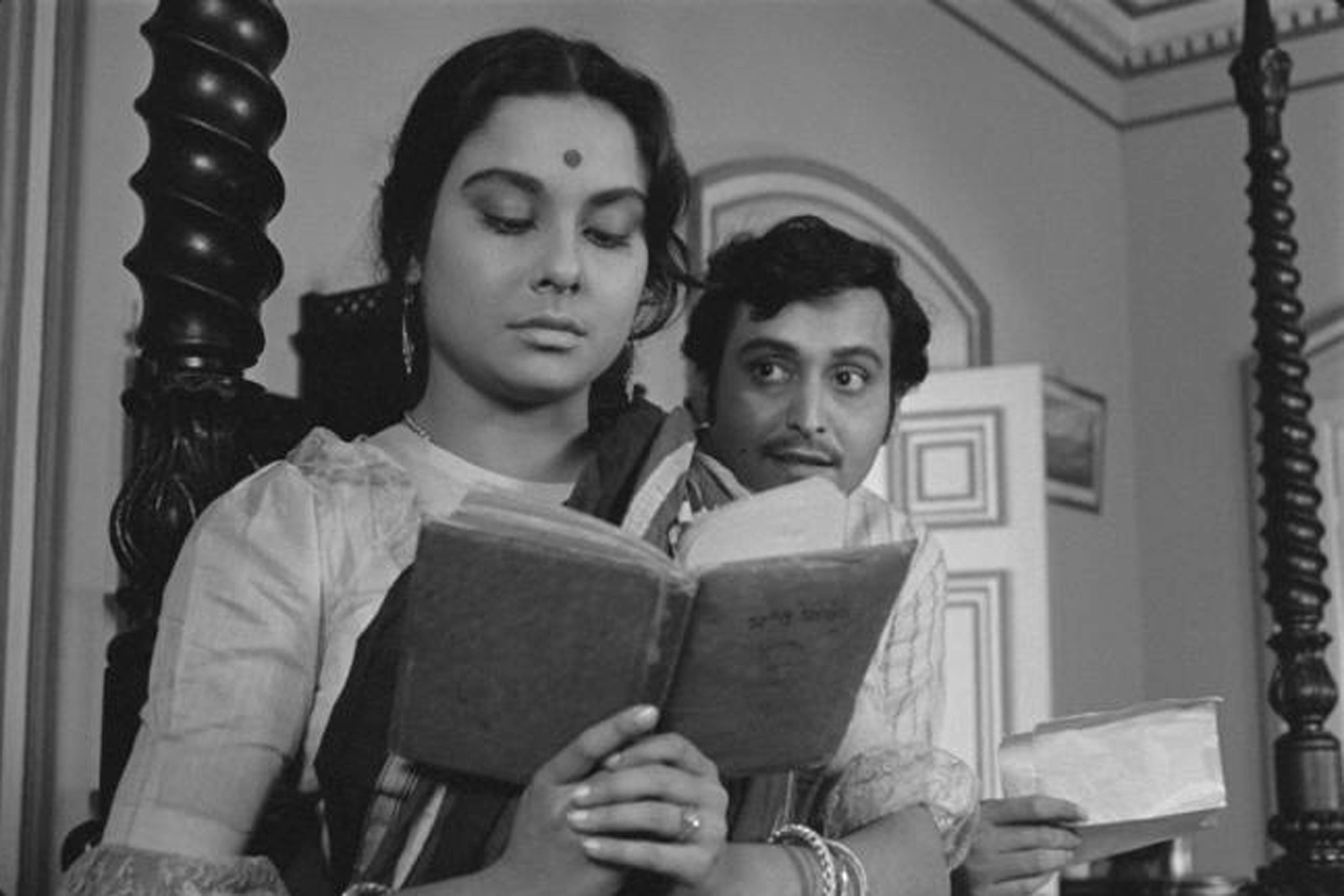
Charulata (dir. Satyajit Ray, 1964)

A Lecture by Dr. Rita Banerjee
Department of African, Middle Eastern, South and South Asian Literatures and Languages

Thursday, April 20 * 11:30 am – 1:00 pm
Rutgers University, Academic Building 6010
15 Seminary Place, New Brunswick, NJ 08901

The creation hymn from the Rig Veda begins with a series of provocative statements and spiky questions: “There was neither non-existence or existence then…The gods came afterwards, with the creation of this universe…Whence this creation has arisen…the one who looked down on it, in the highest heaven, only he knows – or perhaps, he does not know.” In explaining the origins of the Indus Valley civilization and the universe at large, the Rig Veda’s playful, interrogative style places the burden of understanding and interpretation on the reader. The creative power of the poet, non-dualism, uncertainty, and even atheism are hinted at in these opening lines of the Rig Veda. But what makes this seminal and foundational text of Indic philosophy and oral literature especially interesting is the emphasis it places on the critical distance and interpretive lens of the reader. From the Rig Veda onwards, this gesture towards hermeneutics repeats in canons of South Asian literary theory and literature from texts such as Bharata’s yaśāstra and Kālidāsa’s The Recognition of Śakuntalā in the classical period, to the manifestos and discussions of literary modernisms emerging in Bengali, Hindi, and Indian English little magazines and literatures in the 20th century. In this talk, we will examine why Indic literature continues to place the reader in the role of a critic, translator, debater, or connoisseur. What does placing the reader in the role of the critic convey about South Asian literary theory and intellectual culture? Does the emphasis on the reader as critic reveal the deconstructive, pluralistic, or matrix-like nature of South Asian literary theory? Come join us for a rousing debate and discussion on the structural gestures and intellectual goals of South Asian literary theory.

Rita Banerjee’s poem “Ilha Formosa” feat. in Hyphen Magazine

For the month of March, Hyphen Magazine has featured a new poem by Rita Banerjee entitled, “Ilha Formosa.”  On Banerjee’s poetry, editor Eugenia Leigh writes:

This March—a season of spring, of sloughing off the dead weight of winter and examining our year’s progress—we offer Rita Banerjee’s meditative and magical profile of the “Ilha Formosa” that “knows / more than sulfur and air and water shift / between earth and its beautiful blue fringe—”. This poem quiets the clamor of our blue-lit lives so we can catch the “rhythm of the blood-beat” in the South Pacific. Banerjee teaches us to see what the eye “almost misses”: not only the mountain, but also “your own face grown thick” reflected in that mountain and in the entire natural world around us.  —Eugenia Leigh, Poetry Editor, Hyphen Magazine

You can read Rita Banerjee’s poem, “Ilha Formosafeatured on Hyphen Magazine here.

Spring in Portland, OR Writing Retreat – March 25, 2017 Registration Deadline

The Cambridge Writers’ Workshop Spring in Portland Writing Retreat will take place from April 22-24, 2017.  While you’re in the home of writers Cheryl Strayed and Ursula K. Le Guin, feel free to go bicycling and explore the terrain, hike, or relax at local cafes for people watching—no matter how you choose to spend your time, this city is full inspiration. We will be staying in the Alberta Arts District during the retreat, an area that is sure to inspire our participants and help them create.  The retreat offers multi-genre workshops, as well as craft seminars and time to write. The faculty includes award-winning writers Adam Reid Sexton, Kerry Cohen, Rita Banerjee, and Diana Norma Szokolyai. Genres include fiction, nonfiction, and poetry. The deadline to apply is March 25th, 2017.

Schedule of Classes:

cww-portland2017schedule

Writing in the Lyric Register (with Diana Norma Szokolyai)
In this writing workshop, we will practice writing in the lyric register, expanding our writing into descriptive, poetic prose.  We will look intensively at writing “the moment,” slowing down and unpacking a single moment.  After examining some examples in literature, we will take to writing and revising our own pieces to unlock the lyrical qualities of a single moment.  Our aim will be to pull our readers into the emotionally charged and poetic world of our narratives.

Structuring Your Short Story or Novel (with Adam Reid Sexton)
From the time of Homer to the present day, writers have provided stories with the same basic shape – narrative structure, it’s called.  Regardless of content, the result of that structure is a kind of reading machine that people feel compelled to experience from start to finish.  In this course we learn the elements of classic story structure, as well as how much those elements can be varied without damage to your short-story, novel, or memoir.  Learn how to structure stories so potential readers of your work become actual readers.

Writing Memoir Honestly (with Kerry Cohen)
Annie Lamott famously wrote, “You own everything that happened to you. Tell your stories. If people wanted you to write warmly about them, they should have behaved better.” If only it were that easy! In this course we will examine the many challenges of writing about other people in memoir. We will discuss some anecdotes from memoir authors, address students’ concerns about their own memoirs, and we will complete writing exercises that will allow for practice in writing about ourselves and others honestly and ethically.

Science: Fiction – Building Literary Worlds  (with Rita Banerjee)
In this class, we will explore how the fabric and rules of literary worlds in realist and speculative fiction are created.  By examining the parameters of social and behavioral codes, human interactions and psychology, and the materiality of worlds, we’ll explore that volatile space where truth and lie meet, where conflicts crystallize, and where storytelling disturbs and delights.

Writing the Personal Essay (with Kerry Cohen)
Personal essays allow us to understand one another as fellow humans, to see ourselves in each other. They give us ways to know something in a new way, thereby expanding our understandings of ourselves. They are, in my mind, a key to living a self-examined life; and who wants to live another way? In this course, we will examine select essays by authors for their craft, their purpose, and their effect. Students will brainstorm ideas, write, workshop, and share their own personal essays, resulting in a polished piece by the end.

Playing with Point of View (with Adam Reid Sexton)
What’s the best point-of-view strategy to use when writing a particular work of fiction or creative nonfiction – first-person central, or third omniscient?  Second-person (“you”) – or even first person plural (“we”)?  This course breaks down the complicated, challenging topic of POV in storytelling, employing mini-lectures, in-class exercises, and short readings by contemporary masters like Jeffrey Eugenides and Lorrie Moore, to turn point of view from an obligation into an opportunity.  POV can be fun!

Featured Faculty:

kerrycohen
Kerry Cohen
is the author of 10 books, including the bestselling  Loose Girl:  A Memoir of Promiscuity and Girl Trouble: An Illustrated Memoir, her most recent book, which came out October 2016. Kerry is faculty at the Red Earth Low Residency MFA program and is a practicing counselor. She lives with her family in Portland, Oregon.


adamsextonAdam Reid Sexton teaches writing at Yale University, where he is a Lecturer in the English Department, a Critic on the faculty of Yale’s School of Art, and a Silliman Residential College Fellow.  He has taught writing at Columbia University and the New School, and he has lectured at the Folger Shakespeare Library, the University of Pennsylvania’s Kelly Writers House, and the University of Alabama, where he delivered the Hudson Strode Lecture in the Age of Shakespeare.  Sexton is the author of Master Class in Fiction Writing: Techniques from Austen, Hemingway and Other Greats, and with a team of graphic artists, he has adapted four of Shakespeare’s tragedies as manga (Japanese-style graphic novels).  His anthology Rap on Rap was acquired by Harvard’s W.E.B. Dubois Institute for African and African American Research, while Desperately Seeking Madonna is in the Rock & Roll Hall of Fame Library and Archive.  Sexton’s fiction, essays, and reviews have been published in the Bellevue Literary Review, the Mississippi Review, and Off Assignment, as well as the Boston Phoenix, the New York Times, and the Village Voice.  For four years Sexton curated a reading series at KGB Bar in New York City.  He has been interviewed on writing and literature by the New York Times, the Washington Post, Time, and npr.com, and one of his classes was broadcast on BBC Radio.

ritabanerjeeRita Banerjee is the Executive Creative Director of the Cambridge Writers’ Workshop and teaches at Rutgers University.  She received her doctorate in Comparative Literature from Harvard and her MFA in Creative Writing from the University of Washington, and her writing appears in Poets & Writers, The Rumpus, Painted Bride Quarterly, Mass Poetry, Hyphen Magazine, Los Angeles Review of BooksElectric Literature, VIDA: Women in Literary Arts, AWP WC&C Quarterly, Queen Mob’s Tea House, Riot Grrrl Magazine, The Fiction Project, Objet d’Art, KBOO Radio’s APA Compass, and elsewhere. Her first collection of poems, Cracklers at Night (Finishing Line Press), received First Honorable Mention for Best Poetry Book of 2011-2012 at the Los Angeles Book Festival, and her novella, A Night with Kali, in Approaching Footsteps (Spider Road Press), released in November 2016. Finalist for the 2015 Red Hen Press Benjamin Saltman Award and the 2016 Aquarius Press Willow Books Literature Award, she is currently working on a novel, a book on South Asian literary modernisms, and a collection of lyric essays.

DianaNormaDiana Norma Szokolyai is a writer and Executive Artistic Director of Cambridge Writers’ Workshop. She is author of the poetry collections Parallel Sparrows (honorable mention for Best Poetry Book in the 2014 Paris Book Festival) and Roses in the Snow (first runner-­up Best Poetry Book at the 2009 DIY Book Festival). She also records her poetry with musicians and has collaborated with several composers. Her poetry-music collaboration with Flux Without Pause led to their collaboration “Space Mothlight” hitting #16 on the Creative Commons Hot 100 list in 2015, and can be found in the curated WFMU Free Music Archive. Szokolyai’s work has been recently reviewed by The London Grip and published in Quail Bell Magazine, Lyre Lyre, The Fiction Project, The Boston Globe, Dr. Hurley’s Snake Oil Cure, The Dudley Review and Up the Staircase Quarterly, as well as anthologized in The Highwaymen NYC #2, Other Countries: Contemporary Poets Rewiring History, Always Wondering and Teachers as Writers. Szokolyai earned her Ed.M. in Arts in Education from Harvard University and her M.A. in French Literature from the University of Connecticut, while she completed coursework at the Sorbonne and research on Romani writers in Paris. She is currently at work on three books and recording an album of poetry & music.

applyDeadline: March 25, 2017